

3.1.6/7/8
ATP
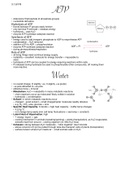
• Adenosine Triphosphate (3 phosphate groups)
• nucleotide derivative
Hydrolysis of ATP
• bonds between P-groups easily broken
• only terminal P removed = releases energy
• hydrolysis :. uses H₂O
• enzyme ATP hydrolase catalyses reaction
Synthesis of ATP
• energy used to add inorganic phosphate to ADP to resynthesise ATP
• condensation :. H₂O removed condensation
• addition of Pi to ADP = phosphorylation
• enzyme ATP synthase catalyses reaction ADP + Pi ATP
• during photosynthesis/respiration
hydrolysis
Role of ATP
• all living things need continual energy supply.
• instability = excellent molecule for energy transfer + impossible to
store
• hydrolysis of ATP can be coupled to energy-requiring reactions within cells.
• Pi released during hydrolysis be used to phosphorylate other compounds, oft making them
more reactive.
Water
• no overall charge. O slightly -ve, H slightly +ve (polar)
• -ve pole attracted to +ve pole
• attractive force = H bond
• Metabolism: H₂O = metabolite in many metabolic reactions
• chem reactions occur as molecules↑likely collide in solution
• hydrolysis + condensation
• Solvent: in which metabolic reactions occur
• charged :. good solvent + small charged/polar molecules readily dissolve
• e.g. O₂, CO₂, urea, glucose + ions
• Speci c Heat Capacity: H-bonds = high heat capacity :. bu er temp changes
• 4.2J/g °C
• not change temp easily (min cell temp uctuations + sea temp = constant)
• Latent Heat of Vaporisation: high
• ↑ energy: liquid -> gas
• cooling mechanism in animals (sweating/panting) + plants (transpiration). as H₂O evaporates
extracts heat from around :. cooling organism (w. little H₂O loss)
• Cohesion: strong between H₂O molecules - “stick together” due H-bonds
• allows columns of H₂O be pulled through tube-like transport cells of plants (transpiration)
• surface tension where H₂O meets air :. small animals walk on H₂O
fi fl ff
ATP
• Adenosine Triphosphate (3 phosphate groups)
• nucleotide derivative
Hydrolysis of ATP
• bonds between P-groups easily broken
• only terminal P removed = releases energy
• hydrolysis :. uses H₂O
• enzyme ATP hydrolase catalyses reaction
Synthesis of ATP
• energy used to add inorganic phosphate to ADP to resynthesise ATP
• condensation :. H₂O removed condensation
• addition of Pi to ADP = phosphorylation
• enzyme ATP synthase catalyses reaction ADP + Pi ATP
• during photosynthesis/respiration
hydrolysis
Role of ATP
• all living things need continual energy supply.
• instability = excellent molecule for energy transfer + impossible to
store
• hydrolysis of ATP can be coupled to energy-requiring reactions within cells.
• Pi released during hydrolysis be used to phosphorylate other compounds, oft making them
more reactive.
Water
• no overall charge. O slightly -ve, H slightly +ve (polar)
• -ve pole attracted to +ve pole
• attractive force = H bond
• Metabolism: H₂O = metabolite in many metabolic reactions
• chem reactions occur as molecules↑likely collide in solution
• hydrolysis + condensation
• Solvent: in which metabolic reactions occur
• charged :. good solvent + small charged/polar molecules readily dissolve
• e.g. O₂, CO₂, urea, glucose + ions
• Speci c Heat Capacity: H-bonds = high heat capacity :. bu er temp changes
• 4.2J/g °C
• not change temp easily (min cell temp uctuations + sea temp = constant)
• Latent Heat of Vaporisation: high
• ↑ energy: liquid -> gas
• cooling mechanism in animals (sweating/panting) + plants (transpiration). as H₂O evaporates
extracts heat from around :. cooling organism (w. little H₂O loss)
• Cohesion: strong between H₂O molecules - “stick together” due H-bonds
• allows columns of H₂O be pulled through tube-like transport cells of plants (transpiration)
• surface tension where H₂O meets air :. small animals walk on H₂O
fi fl ff


