RESPIRATION
Aerobic respiration is the splitting of a respiratory substrate, to release carbon dioxide as a waste product and
reunite hydrogen with atmospheric oxygen, with the release of a large amount of energy.
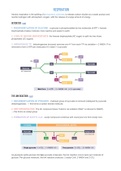
GLYCOLYSIS (vid)
1. PHOSPHORYLATION OF GLUCOSE - a glucose is phosphorylated by two molecules of ATP = hexose
bisphosphate.(makes molecule more reactive and easier to split)
2. LYSIS OF HEXOSE BISPHOSPHATE- the hexose bisphosphate (6C sugar) is split into two triose
phosphates (3C sugars)
3. OXIDATION OF TP - dehydrogenase (enzyme) removes one H+ from each TP via oxidation = 2 NADH. Pi is
removed to form 2 ATP per molecules (4 in total) = 2 pyruvate
THE LINK REACTION (vid)
1. DECARBOXYLATION OF PYRUVATE - Carboxyl group of pyruvate is removed (catalysed by pyruvate
dehydrogenase). → this forms a carbon dioxide molecule.
2. DEHYDROGENATION- The 2C compound loses H atoms via oxidation (NAD+ is reduced to NADH).
→ this forms an acetyl group.
3. FORMATION OF ACETYL CoA - acetyl compound combines with coenzyme A to form Acetyl CoA.
As glycolysis splits glucose into two pyruvate molecules, the link reaction occurs twice per molecule of
glucose. Per glucose molecule, the link reaction produces: 2 acetyl CoA, 2 NADH and 2 CO2
,KREBS CYCLE
1. Acetyl group is released from Acetyl CoA (Coenzyme A released returns to the link reaction to form
another molecule of acetyl CoA) and combines with oxaloacetate (4C) to form citrate (6C).
2. Decarboxylation + dehydrogenation of citrate =
5C
3. Decarboxylation + dehydrogenation of 5C = 4C
4. Combination of 4C with CoA temporarily
5. Dehydrogenation of 4C using FAD
6. Dehydrogenation of new 4C = oxaloacetate
As link reaction produces two acetyl CoA (one
per each pyruvate), Krebs cycle occurs twice.
OXIDATIVE PHOSPHORYLATION
1. ELECTRON TRANSPORT CHAIN - reduced coenzymes accumulate near inner mitochondrial membrane
and release their H atoms which separate into p+ and e-. e- pass down chain through series of oxidation-
reduction reactions. energy released is used to pump protons (by active transport) into intermembrane space,
which creates a proton gradient.
2. CHEMIOSMOSIS - protons diffuse by
facilitated diffusion through ATP synthase
channel, causing a conformational change
in ATP shape causing it to rotate like a
turbine. rotation allows ADP + Pi to be
combined and thus synthesise ATP
3. OXYGEN AS FINAL ELECTRON ACCEPTOR - oxygen combines with protons that have diffused down
ATP synthase channels, forming water. oxygen maintains proton gradient and allows continuing of respiration.
, ANAEROBIC RESPIRATION
1. glucose is converted into pyruvate by glycolysis. No oxygen so can’t go to the next step.
2. the pyruvate is then further converted into lactate with the help of NADH during lactate fermentation.
3. lactate is acidic so it’s then converted back to pyruvate in the liver.
Respiratory quotient (rq)
→ the volume of carbon dioxide released over the volume of oxygen absorbed during respiration. For instance, the
RQ when carbohydrates are the respiratory substrate is around 1.0, whereas for lipids it’s 0.7.
RQ = carbon dioxide produced ÷ oxygen used
When RQ is less than one it means respiration is aerobic but the respiratory substrate is either fat or protein.
RQ is about 0.7 for most of the common fats (and it occurs during germination of fatty seeds).
Aerobic respiration is the splitting of a respiratory substrate, to release carbon dioxide as a waste product and
reunite hydrogen with atmospheric oxygen, with the release of a large amount of energy.
GLYCOLYSIS (vid)
1. PHOSPHORYLATION OF GLUCOSE - a glucose is phosphorylated by two molecules of ATP = hexose
bisphosphate.(makes molecule more reactive and easier to split)
2. LYSIS OF HEXOSE BISPHOSPHATE- the hexose bisphosphate (6C sugar) is split into two triose
phosphates (3C sugars)
3. OXIDATION OF TP - dehydrogenase (enzyme) removes one H+ from each TP via oxidation = 2 NADH. Pi is
removed to form 2 ATP per molecules (4 in total) = 2 pyruvate
THE LINK REACTION (vid)
1. DECARBOXYLATION OF PYRUVATE - Carboxyl group of pyruvate is removed (catalysed by pyruvate
dehydrogenase). → this forms a carbon dioxide molecule.
2. DEHYDROGENATION- The 2C compound loses H atoms via oxidation (NAD+ is reduced to NADH).
→ this forms an acetyl group.
3. FORMATION OF ACETYL CoA - acetyl compound combines with coenzyme A to form Acetyl CoA.
As glycolysis splits glucose into two pyruvate molecules, the link reaction occurs twice per molecule of
glucose. Per glucose molecule, the link reaction produces: 2 acetyl CoA, 2 NADH and 2 CO2
,KREBS CYCLE
1. Acetyl group is released from Acetyl CoA (Coenzyme A released returns to the link reaction to form
another molecule of acetyl CoA) and combines with oxaloacetate (4C) to form citrate (6C).
2. Decarboxylation + dehydrogenation of citrate =
5C
3. Decarboxylation + dehydrogenation of 5C = 4C
4. Combination of 4C with CoA temporarily
5. Dehydrogenation of 4C using FAD
6. Dehydrogenation of new 4C = oxaloacetate
As link reaction produces two acetyl CoA (one
per each pyruvate), Krebs cycle occurs twice.
OXIDATIVE PHOSPHORYLATION
1. ELECTRON TRANSPORT CHAIN - reduced coenzymes accumulate near inner mitochondrial membrane
and release their H atoms which separate into p+ and e-. e- pass down chain through series of oxidation-
reduction reactions. energy released is used to pump protons (by active transport) into intermembrane space,
which creates a proton gradient.
2. CHEMIOSMOSIS - protons diffuse by
facilitated diffusion through ATP synthase
channel, causing a conformational change
in ATP shape causing it to rotate like a
turbine. rotation allows ADP + Pi to be
combined and thus synthesise ATP
3. OXYGEN AS FINAL ELECTRON ACCEPTOR - oxygen combines with protons that have diffused down
ATP synthase channels, forming water. oxygen maintains proton gradient and allows continuing of respiration.
, ANAEROBIC RESPIRATION
1. glucose is converted into pyruvate by glycolysis. No oxygen so can’t go to the next step.
2. the pyruvate is then further converted into lactate with the help of NADH during lactate fermentation.
3. lactate is acidic so it’s then converted back to pyruvate in the liver.
Respiratory quotient (rq)
→ the volume of carbon dioxide released over the volume of oxygen absorbed during respiration. For instance, the
RQ when carbohydrates are the respiratory substrate is around 1.0, whereas for lipids it’s 0.7.
RQ = carbon dioxide produced ÷ oxygen used
When RQ is less than one it means respiration is aerobic but the respiratory substrate is either fat or protein.
RQ is about 0.7 for most of the common fats (and it occurs during germination of fatty seeds).