ENERGY FLOW
Photosynthesis is a reaction in which light energy is used to split apart bonds in water molecules through
photolysis, to combine hydrogen with carbon dioxide, to produce glucose. Oxygen is a waste product and is
released into the atmosphere. Rate is determined by CO2 concentration, light intensity and temperature.
Atp → breaking of third phosphate bond by hydrolysis reaction (catalysed by ATPase) when energy is needed.
Two ways ATP is formed from ADP:
- using energy released from catabolic
reactions (respiration).
- removal of hydrogen atoms (from a
compound) and collected by a
hydrogen carrier or acceptor to an
electron transport chain. Several
redox reactions release energy, used
to drive synthesis of an ATP.
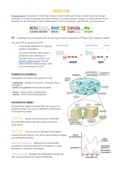
Chloroplasts & chlorophyll
Chloroplasts are found in the cytosol of a cell.
• thylakoids - membrane (contains chlorophyll) discs
arranged in
• grana (sing granum) interconnected stack.
• lumen - space inside a thylakoid disc
• stroma - fluid surrounding thylakoids
PHOTOSYNTHETIC PIGMENTS
Photosynthetic pigments absorb light and convert it to
chemical energy. The colour of pigments is determined
by the light they reflect.
chlorophyll - absorb red as well as blue-violet light,
they only reflect green light, thus giving chlorophyll
green colour.
carotenoids - serve to prevent damage of chlorophyll.
Carotenoids are present in two forms, beta carotene (orange)
and xanthophyll (yellow).
absorption spectrum - determines the wavelengths
absorbed by particular pigments by illustrating % of light
absorbed at a particular wavelength.
action spectrum - illustrates the relationship between the
rate of photosynthesis for a given wavelength.
, CHROMATOGRAPHY → used to separate photosynthetic pigments in chloroplasts.
1. build up a concentrated spot of pigments on a chromatography plate
2. immerse the plate in a solvent, which will travel up it, separating the different pigments as they have
different solubilities in the solvent
3. the plate produced will have several spots up the plate, each being a different pigment that can be
identified by calculating its Rf value
Rf value = distance travelled by spot ÷ distance by solvent
Different pigments travel (by capillary action) different distances due to their polarities and solubility. Carotene
is non-polar so it travels the furthest. Chlorophyll is the most polar so it travelled the least. You know an
element is polar if it's down on earth, if it's high up in
space the element won’t be polar.
Light harvesting – proteins in pigments help funnel
photons entering the chloroplast until they reach
chlorophyll A, the primary pigment at the reaction
centre. ‘Electrons’ leave the chlorophyll molecule
and are picked up by an electron acceptor (in the
thylakoid membrane) and become part of the
electron transport chain.
Photosynthesis is a reaction in which light energy is used to split apart bonds in water molecules through
photolysis, to combine hydrogen with carbon dioxide, to produce glucose. Oxygen is a waste product and is
released into the atmosphere. Rate is determined by CO2 concentration, light intensity and temperature.
Atp → breaking of third phosphate bond by hydrolysis reaction (catalysed by ATPase) when energy is needed.
Two ways ATP is formed from ADP:
- using energy released from catabolic
reactions (respiration).
- removal of hydrogen atoms (from a
compound) and collected by a
hydrogen carrier or acceptor to an
electron transport chain. Several
redox reactions release energy, used
to drive synthesis of an ATP.
Chloroplasts & chlorophyll
Chloroplasts are found in the cytosol of a cell.
• thylakoids - membrane (contains chlorophyll) discs
arranged in
• grana (sing granum) interconnected stack.
• lumen - space inside a thylakoid disc
• stroma - fluid surrounding thylakoids
PHOTOSYNTHETIC PIGMENTS
Photosynthetic pigments absorb light and convert it to
chemical energy. The colour of pigments is determined
by the light they reflect.
chlorophyll - absorb red as well as blue-violet light,
they only reflect green light, thus giving chlorophyll
green colour.
carotenoids - serve to prevent damage of chlorophyll.
Carotenoids are present in two forms, beta carotene (orange)
and xanthophyll (yellow).
absorption spectrum - determines the wavelengths
absorbed by particular pigments by illustrating % of light
absorbed at a particular wavelength.
action spectrum - illustrates the relationship between the
rate of photosynthesis for a given wavelength.
, CHROMATOGRAPHY → used to separate photosynthetic pigments in chloroplasts.
1. build up a concentrated spot of pigments on a chromatography plate
2. immerse the plate in a solvent, which will travel up it, separating the different pigments as they have
different solubilities in the solvent
3. the plate produced will have several spots up the plate, each being a different pigment that can be
identified by calculating its Rf value
Rf value = distance travelled by spot ÷ distance by solvent
Different pigments travel (by capillary action) different distances due to their polarities and solubility. Carotene
is non-polar so it travels the furthest. Chlorophyll is the most polar so it travelled the least. You know an
element is polar if it's down on earth, if it's high up in
space the element won’t be polar.
Light harvesting – proteins in pigments help funnel
photons entering the chloroplast until they reach
chlorophyll A, the primary pigment at the reaction
centre. ‘Electrons’ leave the chlorophyll molecule
and are picked up by an electron acceptor (in the
thylakoid membrane) and become part of the
electron transport chain.