MEMBRANES
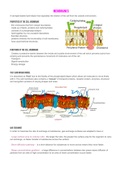
A semipermeable lipid bilayer that separates the interior of the cell from the outside environment.
PROPERTIES OF THE CELL MEMBRANE
• thin enclosures that form closed boundaries.
• made up of lipids, proteins and carbohydrates.
• consists of a phospholipid bilayer.
• held together by non-covalent interactions
• fluid-like structure.
• proteins diversity the functionality of cell membranes.
• have asymmetrical structures.
FUNCTIONS OF THE CELL MEMBRANE
• Creates a protective barrier between the inside and outside environment of the cell which prevents toxins from
entering and prevents the spontaneous movement of molecules out of the cell
• Transport
• Signal transduction
• Energy storage
THE FLUID MOSAIC MODEL
It is described as ‘fluid’ due to the fluidity of the phospholipid bilayer which allows all molecules to move freely
with it. The cell membrane also contains a ‘mosaic’ of transport proteins, receptor protein, enzymes, structural
and recognition proteins of varying shapes and sizes.
GAS EXCHANGE
In order to maximise the rate of exchange of substances, gas exchange surfaces are adapted to have a:
• Large surface area to volume ratio - the larger the ratio, the greater the surface area for the organism to carry
out exchange, so faster transfer of substances across the surface.
• Short diffusion pathway - is a short distance for substances to move across means they move faster.
• Steep concentration gradient - a large difference in concentrations between two areas means diffusion of
particles from an area of high concentration to an area of lower concentration occurs faster.
, Fick’s Law
Rate of diffusion is directly proportional to:
1. Surface area
2. Concentration difference
3. Thickness of membrane
Surface area of a sphere : 4πr2
Volume of a sphere : 4/3πr3
Fick's Law describes the relationship between the rate of diffusion and the three factors that affect diffusion. It
states that 'the rate of diffusion is proportional to both the surface area and concentration difference and is
inversely proportional to the thickness of the membrane.
The mammalian lung
Alveoli are adapted to make gas exchange easy and efficient.
• they give the lungs a really big surface area
• they have moist, thin walls (one cell thick)
• they have a lot of tiny blood vessels called capillaries
The gases move by diffusion from where they have a high
concentration to where they have a low concentration.
• oxygen diffuses from the air in the alveoli into the blood
• carbon dioxide diffuses from the blood into the air in the alveoli
PASSIVE TRANSPORT
Passive transport is the movement of ions and other atomic or molecular substances across cell membranes
without need of energy input.
➔ Diffusion - the movement of particles from a high to low
concentration down a concentration gradient passively.
➔ Facilitated diffusion - the movement of molecules
through the channels formed by integral membrane
protein.
➔ Osmosis - the passive movement of free water
molecules from high to low concentration through a
partially permeable membrane, down a water potential
gradient.
ACTIVE TRANSPORT
Active transport is the movement of substances from a region of low concentration to a region of high
concentration against a concentration gradient. This occurs via specific carrier proteins for specific ions/molecules
that use energy from ATP.
ENDOCYTOSIS AND EXOCYTOSIS
➔ Endocytosis – the movement of substances into the cell. It involves the engulfing of the material by
fusing with the plasma membrane to form an endocytic vacuole in the form of phagocytosis (bulk uptake
of solids) or pinocytosis (bulk uptake of liquids) using ATP.
A semipermeable lipid bilayer that separates the interior of the cell from the outside environment.
PROPERTIES OF THE CELL MEMBRANE
• thin enclosures that form closed boundaries.
• made up of lipids, proteins and carbohydrates.
• consists of a phospholipid bilayer.
• held together by non-covalent interactions
• fluid-like structure.
• proteins diversity the functionality of cell membranes.
• have asymmetrical structures.
FUNCTIONS OF THE CELL MEMBRANE
• Creates a protective barrier between the inside and outside environment of the cell which prevents toxins from
entering and prevents the spontaneous movement of molecules out of the cell
• Transport
• Signal transduction
• Energy storage
THE FLUID MOSAIC MODEL
It is described as ‘fluid’ due to the fluidity of the phospholipid bilayer which allows all molecules to move freely
with it. The cell membrane also contains a ‘mosaic’ of transport proteins, receptor protein, enzymes, structural
and recognition proteins of varying shapes and sizes.
GAS EXCHANGE
In order to maximise the rate of exchange of substances, gas exchange surfaces are adapted to have a:
• Large surface area to volume ratio - the larger the ratio, the greater the surface area for the organism to carry
out exchange, so faster transfer of substances across the surface.
• Short diffusion pathway - is a short distance for substances to move across means they move faster.
• Steep concentration gradient - a large difference in concentrations between two areas means diffusion of
particles from an area of high concentration to an area of lower concentration occurs faster.
, Fick’s Law
Rate of diffusion is directly proportional to:
1. Surface area
2. Concentration difference
3. Thickness of membrane
Surface area of a sphere : 4πr2
Volume of a sphere : 4/3πr3
Fick's Law describes the relationship between the rate of diffusion and the three factors that affect diffusion. It
states that 'the rate of diffusion is proportional to both the surface area and concentration difference and is
inversely proportional to the thickness of the membrane.
The mammalian lung
Alveoli are adapted to make gas exchange easy and efficient.
• they give the lungs a really big surface area
• they have moist, thin walls (one cell thick)
• they have a lot of tiny blood vessels called capillaries
The gases move by diffusion from where they have a high
concentration to where they have a low concentration.
• oxygen diffuses from the air in the alveoli into the blood
• carbon dioxide diffuses from the blood into the air in the alveoli
PASSIVE TRANSPORT
Passive transport is the movement of ions and other atomic or molecular substances across cell membranes
without need of energy input.
➔ Diffusion - the movement of particles from a high to low
concentration down a concentration gradient passively.
➔ Facilitated diffusion - the movement of molecules
through the channels formed by integral membrane
protein.
➔ Osmosis - the passive movement of free water
molecules from high to low concentration through a
partially permeable membrane, down a water potential
gradient.
ACTIVE TRANSPORT
Active transport is the movement of substances from a region of low concentration to a region of high
concentration against a concentration gradient. This occurs via specific carrier proteins for specific ions/molecules
that use energy from ATP.
ENDOCYTOSIS AND EXOCYTOSIS
➔ Endocytosis – the movement of substances into the cell. It involves the engulfing of the material by
fusing with the plasma membrane to form an endocytic vacuole in the form of phagocytosis (bulk uptake
of solids) or pinocytosis (bulk uptake of liquids) using ATP.