
3.3.10: Aromatics
Aromatics (arenes) are a series of cyclic hydrocarbons with a pleasant smell, based on the structure of the
benzene ring.
Bonding in Benzene
Benzene (C6H6) is the parent of the aromatic group. It is a cyclic structure
containing delocalised electrons.
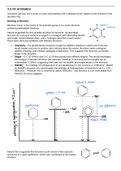
Kekulé suggested the first sensible structure for benzene. He described
benzene as a group of carbons arranged in a hexagon, with alternating double-
and single- bonds between them, and a hydrogen attached to each carbon.
There were some key problems with Kekulé’s structure:
• Chemistry – the double bonds would be a target for addition reactions in which one of the two
bonds breaks and joins to another atom (ethene does this easily). Benzene rarely undergoes
addition reactions and instead undergoes substitutions. This suggests that there are not double-
bonds in the structure.
• Shape – C-C (0.154nm) and C=C (0.134nm) bonds have different lengths. This would misshapen
the hexagon if Kekulé’s structure was accurate. However, in benzene all bond lengths are an
intermediate 0.139nm, suggesting that there are not double- and single- bonds in the structure.
• Stability – the enthalpy of hydrogenation of one double-bond in the structure is -120KJmol-1. Based
on Kekulé’s structure, you would expect the enthalpy of hydrogenation of benzene to be 3 x -120 = -
360KJmol-1. However, this is incorrect by about 150KJmol-1; real benzene is a lot more stable than
Kekulé’s structure suggests.
Kekulé then suggested that benzene could consist of two opposite
structures in a rapid equilibrium, which later contributed to the modern
structure.
Aromatics (arenes) are a series of cyclic hydrocarbons with a pleasant smell, based on the structure of the
benzene ring.
Bonding in Benzene
Benzene (C6H6) is the parent of the aromatic group. It is a cyclic structure
containing delocalised electrons.
Kekulé suggested the first sensible structure for benzene. He described
benzene as a group of carbons arranged in a hexagon, with alternating double-
and single- bonds between them, and a hydrogen attached to each carbon.
There were some key problems with Kekulé’s structure:
• Chemistry – the double bonds would be a target for addition reactions in which one of the two
bonds breaks and joins to another atom (ethene does this easily). Benzene rarely undergoes
addition reactions and instead undergoes substitutions. This suggests that there are not double-
bonds in the structure.
• Shape – C-C (0.154nm) and C=C (0.134nm) bonds have different lengths. This would misshapen
the hexagon if Kekulé’s structure was accurate. However, in benzene all bond lengths are an
intermediate 0.139nm, suggesting that there are not double- and single- bonds in the structure.
• Stability – the enthalpy of hydrogenation of one double-bond in the structure is -120KJmol-1. Based
on Kekulé’s structure, you would expect the enthalpy of hydrogenation of benzene to be 3 x -120 = -
360KJmol-1. However, this is incorrect by about 150KJmol-1; real benzene is a lot more stable than
Kekulé’s structure suggests.
Kekulé then suggested that benzene could consist of two opposite
structures in a rapid equilibrium, which later contributed to the modern
structure.

