
HART 2003A: Portrait (Figure) Landscape
TAKE HOME EXAM 2022
Kerri Liebovitz
2454163
17-27 June 2022
SECTION A: PORTRAITS
SECTION A: PART 1
SECOND PAIR:
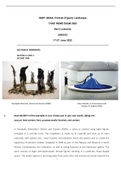
Nandipha Mntambo, Silence and Dreams (2008) Mary Sibande, In Conversation with
Madam CJ Walker (2009)
1. Describe BOTH of the examples in your chosen pair in your own words, taking into
account their content, form, purpose and/or function, and context.
In Nandipha Mntambo’s Silence and Dreams (2008), a scene is created using eight figures
arranged in a cult-like circle. The installation is made up of cowhide and resin as its main
materials, with waxed cord , cows' hooves, and polyester mesh and waxed cord to create the
apparency of women’s bodies. Displayed in 2009 as part of the "Beauty and Pleasure in South
African Contemporary Art" exhibition, as well as being featured at the Stevenson gallery. The
work consists of eight anthropomorphic female figures standing in a cattle-like ‘kraal-shaped
space’. The bodies appear to be facing away from each other and instead are turned towards the
1
,viewer, each facing a different person depending on the direction they walk through the exhibit,
and which figure they see depending on where they are standing. Since they are displayed
together, the pieces could be approached either from the back or the front, depending on where
the viewer entered the room. Mntambo creates the figures by moulding her own body, which is
an interesting aspect that, to me, adds to the cultish apparency. They are all the same. Her body
of art is grouped together as if to enhance the feeling that their individuality as women has been
removed as they stand in unity. She also creates unison in the artwork in the form, direction, and
colour shades of the figures as they stand together (Ntombela, 2015). I can imagine the figures
dancing around in a circle in a sort of cultural ritual. Along with the material used, this could be a
form of a religious practice or sacrifice as well as a symbol of female stereotypes.
The materials Mntambo has chosen to use have significant value to the overall interpretation of
the work, as Nandipha Mntambo’s utilizes the complex relationship between metaphor and
material. Her use of cowhide is a strong one, with the combination of smells, texture, and
meaning. Through the process of stripping the hide and mixing chemicals such as polyester resin,
Mntambo manipulates and moulds the hide to create the shape of the body. While the stench of
the cowhide and resin is overpowering and repulsive, the texture of the cowhide hair, when
moulded into the curled feminine form, is seductive. The work's potent aroma and the visual
features of the hide engage the senses of sight and smell, activating an embodied experience for
spectators. The way Mntambo manipulates and shapes cowhide to produce the contours of her
body and that of her mother is what distinguishes her work. The figures are constructed from
the "memory" of the physical body and are, therefore, the metaphor of memory materialized.
The material used is seen as an object with memory, able to hold the shape of the body with the
skin as well as the process of wreckage and death that allowed the piece to come about, leaving
an impression. The smooth female body held in place by the sculpture contrasts with the hairy
surface of cowhide, yet the hairiness of the cowhide contradicts the attraction of the smooth
body is removed by the shape of the sculpture. As a sculptural artist who uses her body to create
the figures in her art paired with traditional cloth that is made from cowhide, we can note the
importance of home and heritage, where she came from, in her practice (Ntombela,2015).
Mntambo admits that "cowhide resonates deeply within" (Mntambo, 2008) her as she states
that there is a strong bond between cloth and cultural heritage. In an interview, she told them
2
, that the idea for the cowhide came from a large herd of cattle she saw in a dream, and her work
flourished from there on (Stevenson 2008:58). It can also be seen as a metaphor for stories
about the social dilemmas faced by Nguni women in the modern world, as her work attempts to
validate the argument that although she is an independent modern woman, her attitude
towards individuality is different from that of Western women. Mntambo challenges the
patriarchal settings in her artwork and considers the stereotypical standards of the female form,
as well as notions of femininity (Ntombela,2015). She states, "The pains that many women,
including myself, have subjected themselves to in order to conform to society-dictated norms
have greatly informed my work to date" (Nntambo,2009:20).
The significance of the title paired with the layout of the installation produces the importance of
silence, culturally and as an art activist. According to Mntambo, the kraal shape in Silence and
Dreams is an important aspect as it mimics the masked cultural setup to appreciate her ancestral
background. The cattle kraal is a sacred area, and cattle represent sacrifices; meat and milk are
all connected to living with the spirits (Du Preez 2005:16). In her artwork, Mntambo complies
with the requirement to respect the ancestors by promoting silence, which is in line with the
interpretation of the initiation practice. The art installation's design alludes to the fact that only
family members are permitted to converse with ancestors; everyone else should remain outside
and silent (Ntombela, 2015).
In In Conversation with Madam CJ Walker (2009), Mary Sibanda uses her iconic figure of an
‘alter-ego’, Sophie, in this installation that deals with issues of patriarchal and apartheid
representations of black femininity. The work consists of two major parts, the obvious being the
large presence of Sophie, the figure in the centre of the room, and the other is the image of
Madam CJ Walker on the wall, who is attached to the main figure by the braided synthetic hair
she is weaving or unravelling. Madame CJ Walker was one of the first wealthy black woman in
America, and (regardless of race) is regarded as the first female self-made millionaire in
America., Walker made her fortunes in cosmetics and hair-care products, especially for black skin
& hair. Because of the broader social experience in South Africa where it is predominantly black
women who are employed as domestic workers and the "narrative" of hair care is essentially
3
TAKE HOME EXAM 2022
Kerri Liebovitz
2454163
17-27 June 2022
SECTION A: PORTRAITS
SECTION A: PART 1
SECOND PAIR:
Nandipha Mntambo, Silence and Dreams (2008) Mary Sibande, In Conversation with
Madam CJ Walker (2009)
1. Describe BOTH of the examples in your chosen pair in your own words, taking into
account their content, form, purpose and/or function, and context.
In Nandipha Mntambo’s Silence and Dreams (2008), a scene is created using eight figures
arranged in a cult-like circle. The installation is made up of cowhide and resin as its main
materials, with waxed cord , cows' hooves, and polyester mesh and waxed cord to create the
apparency of women’s bodies. Displayed in 2009 as part of the "Beauty and Pleasure in South
African Contemporary Art" exhibition, as well as being featured at the Stevenson gallery. The
work consists of eight anthropomorphic female figures standing in a cattle-like ‘kraal-shaped
space’. The bodies appear to be facing away from each other and instead are turned towards the
1
,viewer, each facing a different person depending on the direction they walk through the exhibit,
and which figure they see depending on where they are standing. Since they are displayed
together, the pieces could be approached either from the back or the front, depending on where
the viewer entered the room. Mntambo creates the figures by moulding her own body, which is
an interesting aspect that, to me, adds to the cultish apparency. They are all the same. Her body
of art is grouped together as if to enhance the feeling that their individuality as women has been
removed as they stand in unity. She also creates unison in the artwork in the form, direction, and
colour shades of the figures as they stand together (Ntombela, 2015). I can imagine the figures
dancing around in a circle in a sort of cultural ritual. Along with the material used, this could be a
form of a religious practice or sacrifice as well as a symbol of female stereotypes.
The materials Mntambo has chosen to use have significant value to the overall interpretation of
the work, as Nandipha Mntambo’s utilizes the complex relationship between metaphor and
material. Her use of cowhide is a strong one, with the combination of smells, texture, and
meaning. Through the process of stripping the hide and mixing chemicals such as polyester resin,
Mntambo manipulates and moulds the hide to create the shape of the body. While the stench of
the cowhide and resin is overpowering and repulsive, the texture of the cowhide hair, when
moulded into the curled feminine form, is seductive. The work's potent aroma and the visual
features of the hide engage the senses of sight and smell, activating an embodied experience for
spectators. The way Mntambo manipulates and shapes cowhide to produce the contours of her
body and that of her mother is what distinguishes her work. The figures are constructed from
the "memory" of the physical body and are, therefore, the metaphor of memory materialized.
The material used is seen as an object with memory, able to hold the shape of the body with the
skin as well as the process of wreckage and death that allowed the piece to come about, leaving
an impression. The smooth female body held in place by the sculpture contrasts with the hairy
surface of cowhide, yet the hairiness of the cowhide contradicts the attraction of the smooth
body is removed by the shape of the sculpture. As a sculptural artist who uses her body to create
the figures in her art paired with traditional cloth that is made from cowhide, we can note the
importance of home and heritage, where she came from, in her practice (Ntombela,2015).
Mntambo admits that "cowhide resonates deeply within" (Mntambo, 2008) her as she states
that there is a strong bond between cloth and cultural heritage. In an interview, she told them
2
, that the idea for the cowhide came from a large herd of cattle she saw in a dream, and her work
flourished from there on (Stevenson 2008:58). It can also be seen as a metaphor for stories
about the social dilemmas faced by Nguni women in the modern world, as her work attempts to
validate the argument that although she is an independent modern woman, her attitude
towards individuality is different from that of Western women. Mntambo challenges the
patriarchal settings in her artwork and considers the stereotypical standards of the female form,
as well as notions of femininity (Ntombela,2015). She states, "The pains that many women,
including myself, have subjected themselves to in order to conform to society-dictated norms
have greatly informed my work to date" (Nntambo,2009:20).
The significance of the title paired with the layout of the installation produces the importance of
silence, culturally and as an art activist. According to Mntambo, the kraal shape in Silence and
Dreams is an important aspect as it mimics the masked cultural setup to appreciate her ancestral
background. The cattle kraal is a sacred area, and cattle represent sacrifices; meat and milk are
all connected to living with the spirits (Du Preez 2005:16). In her artwork, Mntambo complies
with the requirement to respect the ancestors by promoting silence, which is in line with the
interpretation of the initiation practice. The art installation's design alludes to the fact that only
family members are permitted to converse with ancestors; everyone else should remain outside
and silent (Ntombela, 2015).
In In Conversation with Madam CJ Walker (2009), Mary Sibanda uses her iconic figure of an
‘alter-ego’, Sophie, in this installation that deals with issues of patriarchal and apartheid
representations of black femininity. The work consists of two major parts, the obvious being the
large presence of Sophie, the figure in the centre of the room, and the other is the image of
Madam CJ Walker on the wall, who is attached to the main figure by the braided synthetic hair
she is weaving or unravelling. Madame CJ Walker was one of the first wealthy black woman in
America, and (regardless of race) is regarded as the first female self-made millionaire in
America., Walker made her fortunes in cosmetics and hair-care products, especially for black skin
& hair. Because of the broader social experience in South Africa where it is predominantly black
women who are employed as domestic workers and the "narrative" of hair care is essentially
3


