

🟥
Systemic Endocrinology
Thursday, 28th April 2022
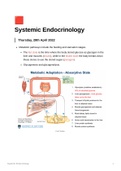
Metabolic pathways include the feeding and starvation stages.
The fed state is the time where the body stored glucose as glycogen in the
liver and muscles (insulin), while in the fasted state the body breaks down
these stores to use the stored sugar (glucagon).
Glycogenesis and glycogenolysis.
Fed State.
Systemic Endocrinology 1
, Fasted State.
Insulin and Glucagon:
The energy stores in the body are stored in many places and in many forms.
Systemic Endocrinology 2
, Above are the different hormones the body uses to maintain the body’s stores of
energy.
The Major Pancreatic Hormones:
Insulin is a polypeptide composed of two chains linked by a disulphide bond.
Systemic Endocrinology 3
, They are secreted by the beta cells of the pancreatic islets.
Its release is stimulated by hyperglycaemia, amino acids, GIT hormones
(secretin and gastrin) and parasympathetic (rest & digest) stimulation.
Mediates glucose metabolism and is secreted when plasma glucose levels
are elevated, to then facilitate glucose transport into the cells and promotes
glycogenesis (inhibits gluconeogenesis).
It promotes cellular uptake of amino acids and increases fat and protein
synthesis to use up excess glucose.
Glucagon is a polypeptide composed of 29 AA and is secreted by the alpha cells
of the pancreatic islets.
Stimuli for its release includes hypoglycaemia, norepinephrine, epinephrine
and amino acids.
Activated via sympathetic and parasympathetic stimulation and its target
hormone is the liver (no receptors in the muscle).
Counter regulates glucose metabolism and is secreted when glucose levels
in plasma drops which then increases glycogenolysis and gluconeogenesis
in the liver.
Stimulates the breakdown of protein and fat as alternative fuels for the body.
An increase in glucose levels → insulin
levels rise → glucose is taken in by the
cells → normal levels return → a
decrease in glucose levels → glucagon
levels rise → glycogen is broken down →
normal levels return → ...
The normal BGL is 90mg per 100ml
(0.9mg/mL).
The insulin-process is anabolic while the
glucagon-process is catabolic.
These processes are are negative-
feedback loops where when normal
levels are re-established, the hormone
that was secreted is inhibited and no
longer released into the blood.
Systemic Endocrinology 4
Systemic Endocrinology
Thursday, 28th April 2022
Metabolic pathways include the feeding and starvation stages.
The fed state is the time where the body stored glucose as glycogen in the
liver and muscles (insulin), while in the fasted state the body breaks down
these stores to use the stored sugar (glucagon).
Glycogenesis and glycogenolysis.
Fed State.
Systemic Endocrinology 1
, Fasted State.
Insulin and Glucagon:
The energy stores in the body are stored in many places and in many forms.
Systemic Endocrinology 2
, Above are the different hormones the body uses to maintain the body’s stores of
energy.
The Major Pancreatic Hormones:
Insulin is a polypeptide composed of two chains linked by a disulphide bond.
Systemic Endocrinology 3
, They are secreted by the beta cells of the pancreatic islets.
Its release is stimulated by hyperglycaemia, amino acids, GIT hormones
(secretin and gastrin) and parasympathetic (rest & digest) stimulation.
Mediates glucose metabolism and is secreted when plasma glucose levels
are elevated, to then facilitate glucose transport into the cells and promotes
glycogenesis (inhibits gluconeogenesis).
It promotes cellular uptake of amino acids and increases fat and protein
synthesis to use up excess glucose.
Glucagon is a polypeptide composed of 29 AA and is secreted by the alpha cells
of the pancreatic islets.
Stimuli for its release includes hypoglycaemia, norepinephrine, epinephrine
and amino acids.
Activated via sympathetic and parasympathetic stimulation and its target
hormone is the liver (no receptors in the muscle).
Counter regulates glucose metabolism and is secreted when glucose levels
in plasma drops which then increases glycogenolysis and gluconeogenesis
in the liver.
Stimulates the breakdown of protein and fat as alternative fuels for the body.
An increase in glucose levels → insulin
levels rise → glucose is taken in by the
cells → normal levels return → a
decrease in glucose levels → glucagon
levels rise → glycogen is broken down →
normal levels return → ...
The normal BGL is 90mg per 100ml
(0.9mg/mL).
The insulin-process is anabolic while the
glucagon-process is catabolic.
These processes are are negative-
feedback loops where when normal
levels are re-established, the hormone
that was secreted is inhibited and no
longer released into the blood.
Systemic Endocrinology 4


