Lecture Two – Ethics
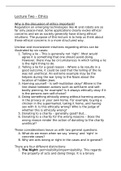
Why is the discussion of ethics important?
Regulation on emerging technologies like AI and robots are so
far only peace-meal. Some applications clearly evoke ethical
concerns and we as society generally have strong ethical
intuitions. The purpose of this lecture is to help us think about
these ethical concerns in a more structured way.
Unclear and inconsistent intuitions regarding ethics can be
illustrated by six cases:
1. Telling a lie – This is generally not ‘right’. Most would
agree it is something that one should avoid doing.
However, there may be circumstances in which telling a lie
is the right thing to do.
2. Telling a lie for a good reason – Where a lie results in a
good outcome, it could be said that the telling of the lie
was not unethical. An extreme example may be the
helpers during the war lying to the Nazis about the
location of hidden Jews.
3. Harming yourself – Is self-mutilation okay? Where is the
line drawn between actions such as self-harm and self-
bodily piercing, for example? Is it always ethically okay if it
is the persons own self-choice?
4. Doing something ethically wrong without harming anyone,
in the privacy or your own home. For example, buying a
chicken in the supermarket, taking it home, and having
sex with it. Is this ethically wrong? Who is the judge of
whether this is ethically wrong?
5. Donating to a charity – generally good? But…
6. Donating to a charity for the wrong reasons – Does the
wrong reason render the action of donating to the charity
unethical?
These considerations leave us with two general questions:
A. What do we mean when we say ‘wrong’ and ‘right’ in
concrete cases?
B. Why are acts wrong or right in the cases and in general?
There are four different distinctions:
1. The Right: permissibility/impermissibility. This regards
the property of acts and doing things. It is a binary
, concept (not a matter of degree) and tells us how we
ought to act. There are three possibilities for an act:
obligatory, optional, and impermissible.
2. The Good: morally better / worse than. This focuses on a
property of acts or state of affairs as a matter of degree.
The good can depend in different ways on different
properties of acts / states of affairs. There tends to be a
scale of how ‘good’ something can be.
3. Praiseworthy / blameworthy: These are reactive
attitudes that don’t always coincide with permissibility. It
often links to a persons’ intuitions or character and is
therefore subjective. If one does something wrong
accidentally (e.g., taking something because you mistook
it for your own) you may not be blamed.
4. Legal / illegal: The law follows morality to some extent,
but some things are morally wrong (adultery), but not
illegal. However, morality doesn’t follow the law. Acts are
not usually morally wrong because they are illegal (except
coordination norms, such as driving on the right side of
the road). They are morally wrong because it is generally
agreed across society that it is morally wrong.
Ethical Theories
Teleology – This theory says that the good is prior to the right.
First one must assess how good something is, then one knows
what is right. The most well-known theory that falls under
teleology is utilitarianism.
Deontology – This argues that the right is prior to the good.
First assess right and wrong. The most well-known theory is
Kantianism.
Utilitarianism: calculates what brings the greatest happiness for
the largest number of people. It justifies the sacrifice of an
individual for the common good. Killing one person to save
many would be considered the ethical thing to do.
Kantianism: consists of categorical imperatives and variants.
Some things are just wrong to do, regardless of the purpose or
motive. There is a particular emphasis on autonomy. It is based
on the notion that it is impossible to think of anything at all in
Why is the discussion of ethics important?
Regulation on emerging technologies like AI and robots are so
far only peace-meal. Some applications clearly evoke ethical
concerns and we as society generally have strong ethical
intuitions. The purpose of this lecture is to help us think about
these ethical concerns in a more structured way.
Unclear and inconsistent intuitions regarding ethics can be
illustrated by six cases:
1. Telling a lie – This is generally not ‘right’. Most would
agree it is something that one should avoid doing.
However, there may be circumstances in which telling a lie
is the right thing to do.
2. Telling a lie for a good reason – Where a lie results in a
good outcome, it could be said that the telling of the lie
was not unethical. An extreme example may be the
helpers during the war lying to the Nazis about the
location of hidden Jews.
3. Harming yourself – Is self-mutilation okay? Where is the
line drawn between actions such as self-harm and self-
bodily piercing, for example? Is it always ethically okay if it
is the persons own self-choice?
4. Doing something ethically wrong without harming anyone,
in the privacy or your own home. For example, buying a
chicken in the supermarket, taking it home, and having
sex with it. Is this ethically wrong? Who is the judge of
whether this is ethically wrong?
5. Donating to a charity – generally good? But…
6. Donating to a charity for the wrong reasons – Does the
wrong reason render the action of donating to the charity
unethical?
These considerations leave us with two general questions:
A. What do we mean when we say ‘wrong’ and ‘right’ in
concrete cases?
B. Why are acts wrong or right in the cases and in general?
There are four different distinctions:
1. The Right: permissibility/impermissibility. This regards
the property of acts and doing things. It is a binary
, concept (not a matter of degree) and tells us how we
ought to act. There are three possibilities for an act:
obligatory, optional, and impermissible.
2. The Good: morally better / worse than. This focuses on a
property of acts or state of affairs as a matter of degree.
The good can depend in different ways on different
properties of acts / states of affairs. There tends to be a
scale of how ‘good’ something can be.
3. Praiseworthy / blameworthy: These are reactive
attitudes that don’t always coincide with permissibility. It
often links to a persons’ intuitions or character and is
therefore subjective. If one does something wrong
accidentally (e.g., taking something because you mistook
it for your own) you may not be blamed.
4. Legal / illegal: The law follows morality to some extent,
but some things are morally wrong (adultery), but not
illegal. However, morality doesn’t follow the law. Acts are
not usually morally wrong because they are illegal (except
coordination norms, such as driving on the right side of
the road). They are morally wrong because it is generally
agreed across society that it is morally wrong.
Ethical Theories
Teleology – This theory says that the good is prior to the right.
First one must assess how good something is, then one knows
what is right. The most well-known theory that falls under
teleology is utilitarianism.
Deontology – This argues that the right is prior to the good.
First assess right and wrong. The most well-known theory is
Kantianism.
Utilitarianism: calculates what brings the greatest happiness for
the largest number of people. It justifies the sacrifice of an
individual for the common good. Killing one person to save
many would be considered the ethical thing to do.
Kantianism: consists of categorical imperatives and variants.
Some things are just wrong to do, regardless of the purpose or
motive. There is a particular emphasis on autonomy. It is based
on the notion that it is impossible to think of anything at all in