Physical Assessment Week 1 Notes
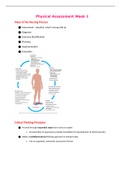
Critical Thinking Principles ⬤ Proceed through sequential steps from novice to expert Incorporation of experience provides foundation for development of clinical practice ⬤ Utilize a multidimensional thinking approach to interpret data Use an organized, systematic assessment format ⬤ Validate and confirm findings based on nonjudgmental interpretation of data Check and corroborate accuracy and reliability of data ⬤ Cluster data information to support evidence as well as rule out inconsistent clinical findings in terms of differential diagnosis Distinguish relevant signs and symptoms Priority Problems Level ⬤ First-level priority Emergent, life threatening, and immediate ⬤ Second-level priority Next in urgency, requiring attention so as to avoid further deterioration ⬤ Third-level priority Important to patient’s health but can be addressed after more urgent problems are addressed ⬤ Collaborative problems Approach to treatment involves multiple disciplines Assessment: Point of Entry in an Ongoing Process ⬤ Subjective data What patient says about himself or herself during history taking – THEM ⬤ Objective data Observed when inspecting, percussing, palpating, and auscultating patient during physical examination-US ⬤ Database Formed from these elements, plus patient’s record and laboratory studies Can we talk about this first? Before asking to undress etc The Interview (gather info 1st) ⬤ Subjective data collection ⬤ Patient perception of health ⬤ First step in the therapeutic relationship Successful Interview Characteristics ⬤ Gather complete and accurate data about person’s health state, including description and chronology of any symptoms of illness ⬤ Establish rapport and trust so person feels accepted and free to share all relevant data ⬤ Teach person about health state so that he or she may participate in identifying problems ⬤ Build rapport to continue therapeutic relationship and to facilitate future diagnoses, planning, and treatment ⬤ Begin teaching for health promotion and disease prevention Open-Ended Questions ⬤ Ask for narrative responses ⬤ State topic only in general terms ⬤ Use them in the following situations: To begin interview To introduce a new section of questions Whenever the patient introduces a new topic Closed or Direct Questions ⬤ Ask for specific information ⬤ Elicit short one- or two-word answers, a yes or no answer, or a forced choice ⬤ Use them in the following situations: After opening narrative to fill in details person may have left out When you need many specific facts about past health problems or during review of systems To move the interview along, In a panic The Health History Sequence ⬤ Biographical data ⬤ Source of history ⬤ Reason for seeking care ⬤ Present health or history of present illness ⬤ Past health ⬤ Family history ⬤ Review of systems ⬤ Functional assessment including activities of daily living (ADLs) And so it begins! (Gown on) Chp 7 Providing a Safe and Comfortable Environment • Setting – Clinic, hospital room, nurse's office, patient's home, etc. – Should be warm, private, & distraction free – Lighting must ensure visibility. • Preparation – Determine best method for communication – Patient may be asked to sign a consent form. – Patient should empty bladder in most cases. Providing a Safe and Comfortable Environment • Privacy – Show patient how to put on gown – Leave patient to undress in privacy – Drapes preserve privacy & provide warmth. • Examination considerations – Exam table with clean sheet or paper cover – Explain each step in advance – Inform patient when another examiner may be called in Providing a Safe and Comfortable Environment • Special considerations – Many patients experience anxiety. – Individualize according to person's values and beliefs – May be exhausting for patient who is older, frail, or suffering Standard Precautions • Guidelines to protect patients & healthcare workers • Principles of asepsis • Nurses responsible for knowing policies of agency for which they work • Hand hygiene - Nonsterile examination gloves – Scrub & rinse hands with soap for 40–60 secs ▪ When hands visibly soiled ▪ After using restroom ▪ After removing gloves ▪ Before & after contact with medical equipment Standard Precautions • Hand hygiene – Healthcare-associated infections (HAIs)-common cause for complications & longer hospital stays ▪ Reduced by hand washing, antiseptics • Use & care of medical equipment – Proper cleaning, use, & disposal of equipment • Patient hazards – Such as becoming dizzy or falling – Greatest risk if frail, weak, debilitated, or suffering from a chronic illness – Some assessment techniques may injure patient if used indiscriminately. Professional Responsibilities • Apply critical thinking – Be organized
Document information
- Uploaded on
- June 6, 2022
- Number of pages
- 32
- Written in
- 2020/2021
- Type
- Exam (elaborations)
- Contains
- Questions & answers