Family OB Escape Room Study Guide Exam 3
OB Escape Room Study Guide Exam 3
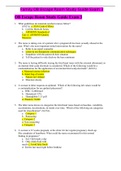
1. What guidelines do maternal-newborn nurses follow?
(SATA). a. ANA Code of Ethics
b. Call the Midwife Series
c. AWHONN Standards of
Care d. AWHONN Quality
Measures
2. The nurse is taking care of a patient who’s pregnant & has been sexually abused in the
past. What’s the most important initial intervention for the nurse?
a. Refer to an expert counselor
b. Listen & use therapeutic communication techniques
c. Empathize with the patient & their situation
d. Tell the patient to only disclose the bare minimum
3. The nurse is having difficulty tracing the fetal heart tones with the external ultrasound, so
an internal fetal scalp electrode is considered. Which of the following would be a
contraindication for the application of an internal fetal scalp electrode? (SATA).
a. Maternal uterine infection
b. Intact bag of waters
c. Patient isn’t dilated
d. Maternal obesity
4. A woman in labor requests an epidural. Which of the following lab values would be
a contraindication for an epidural placement?
a. WBC 12,000/mm3
b. Hematocrit 33%
c. Hemoglobin 11.5 g/dl
d. Platelets 70,000
5. The labor nurse knows to categorize the fetal heart tones based on baseline, variability,
accelerations, decelerations, & trends over time. Which of the following are categories
used for classification? (SATA).
a. Category 1
b. Reassuring
c. Category 2
d. Non-reassuring
e. Category 3
6. A woman is 32 weeks pregnant, at the clinic for her regular pregnancy check-up.
She complains of heartburn. What could the nurse recommend for this normal
finding in pregnancy?
a. Eat 3 full meals a day
b. Only drink fluid with
meals c. Avoid fatty foods
d. Eat the last meal right before bedtime
, Family OB Escape Room Study Guide Exam 3
7. Which of the following are PROBABLE signs of pregnancy? (SATA).
a. Chadwick’s sign: bluish-purple coloration of the vaginal mucosa, cervix, &
vulva seen at 6-8 weeks
b. Uterine growth & abdominal
growth c. Positive pregnancy test results
d. Fetal heart tones noted with doppler
8. The nurse gets report on a laboring patient & is told that her last cervical exam is 2 cm,
50%, & -2. What’s the interpretation of this?
a. Cervix is 2 cm dilated, 50% effaced, presenting part is 2 above ischial spines
b. Cervix is 2 cm effaced, 50% dilated, presenting part is 2 above ischial spines
c. Cervix is 2 cm dilated, 50% effaced, presenting part is 2 below the ischial spines
d. Cervix is 2 cm effaced, 50% dilated, presenting part is 2 below ischial spines
9. Hormone levels during pregnancy cause changes in the mother’s integumentary
system. Which of the following are normal changes in this system? (SATA).
a. Overall darkening of skin tone
b. Linea nigra
c. Chloasma
d. Increased pigmentation of the nipples, areola, vulva, scars, & moles
10. Some IV pain meds, when given to the laboring mom, can cause the FHR to lose
variability for a certain length of time. The fetus is neurologically depressed & would have
a more difficult time adjusting to the extrauterine environment if birth were to take place
within 2 hrs. of administration of these meds. However, labor is far from predictable &
sometimes these babies are born during this time. What medication could be given to these
babies to combat the pain medication’s adverse effects?
a. Diphenhydramine
b. Tetracycline
c. Morphine
d. Naloxone
11. The OB clinic nurse is discussing with the pregnant woman reasons to contact her
provider. Which of the following should be included in this? (SATA).
a. Decreased fetal movement
b. Rupture of membranes
c. Frequent urination
d. Vaginal bleeding
12. All women should receive an abuse screening when seen in the clinic. Which of
the following are appropriate to include with this screening? (SATA).
a. Ask if the patient is afraid of her partner
b. Ask if the patient has ever been slapped or kicked by her
partner c. Ask if she has been forced to perform any sexual acts
d. Photograph any bruises or marks as evidence
OB Escape Room Study Guide Exam 3
1. What guidelines do maternal-newborn nurses follow?
(SATA). a. ANA Code of Ethics
b. Call the Midwife Series
c. AWHONN Standards of
Care d. AWHONN Quality
Measures
2. The nurse is taking care of a patient who’s pregnant & has been sexually abused in the
past. What’s the most important initial intervention for the nurse?
a. Refer to an expert counselor
b. Listen & use therapeutic communication techniques
c. Empathize with the patient & their situation
d. Tell the patient to only disclose the bare minimum
3. The nurse is having difficulty tracing the fetal heart tones with the external ultrasound, so
an internal fetal scalp electrode is considered. Which of the following would be a
contraindication for the application of an internal fetal scalp electrode? (SATA).
a. Maternal uterine infection
b. Intact bag of waters
c. Patient isn’t dilated
d. Maternal obesity
4. A woman in labor requests an epidural. Which of the following lab values would be
a contraindication for an epidural placement?
a. WBC 12,000/mm3
b. Hematocrit 33%
c. Hemoglobin 11.5 g/dl
d. Platelets 70,000
5. The labor nurse knows to categorize the fetal heart tones based on baseline, variability,
accelerations, decelerations, & trends over time. Which of the following are categories
used for classification? (SATA).
a. Category 1
b. Reassuring
c. Category 2
d. Non-reassuring
e. Category 3
6. A woman is 32 weeks pregnant, at the clinic for her regular pregnancy check-up.
She complains of heartburn. What could the nurse recommend for this normal
finding in pregnancy?
a. Eat 3 full meals a day
b. Only drink fluid with
meals c. Avoid fatty foods
d. Eat the last meal right before bedtime
, Family OB Escape Room Study Guide Exam 3
7. Which of the following are PROBABLE signs of pregnancy? (SATA).
a. Chadwick’s sign: bluish-purple coloration of the vaginal mucosa, cervix, &
vulva seen at 6-8 weeks
b. Uterine growth & abdominal
growth c. Positive pregnancy test results
d. Fetal heart tones noted with doppler
8. The nurse gets report on a laboring patient & is told that her last cervical exam is 2 cm,
50%, & -2. What’s the interpretation of this?
a. Cervix is 2 cm dilated, 50% effaced, presenting part is 2 above ischial spines
b. Cervix is 2 cm effaced, 50% dilated, presenting part is 2 above ischial spines
c. Cervix is 2 cm dilated, 50% effaced, presenting part is 2 below the ischial spines
d. Cervix is 2 cm effaced, 50% dilated, presenting part is 2 below ischial spines
9. Hormone levels during pregnancy cause changes in the mother’s integumentary
system. Which of the following are normal changes in this system? (SATA).
a. Overall darkening of skin tone
b. Linea nigra
c. Chloasma
d. Increased pigmentation of the nipples, areola, vulva, scars, & moles
10. Some IV pain meds, when given to the laboring mom, can cause the FHR to lose
variability for a certain length of time. The fetus is neurologically depressed & would have
a more difficult time adjusting to the extrauterine environment if birth were to take place
within 2 hrs. of administration of these meds. However, labor is far from predictable &
sometimes these babies are born during this time. What medication could be given to these
babies to combat the pain medication’s adverse effects?
a. Diphenhydramine
b. Tetracycline
c. Morphine
d. Naloxone
11. The OB clinic nurse is discussing with the pregnant woman reasons to contact her
provider. Which of the following should be included in this? (SATA).
a. Decreased fetal movement
b. Rupture of membranes
c. Frequent urination
d. Vaginal bleeding
12. All women should receive an abuse screening when seen in the clinic. Which of
the following are appropriate to include with this screening? (SATA).
a. Ask if the patient is afraid of her partner
b. Ask if the patient has ever been slapped or kicked by her
partner c. Ask if she has been forced to perform any sexual acts
d. Photograph any bruises or marks as evidence