
BOT2601 Exam prep.
1. Explain the terms “fascicular cambium”, “inter-fascicular cambium” and “vascular
cambium”. (5)
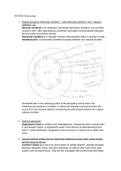
Vascular cambium is an extensive, permanent secondary meristem, one cell thick,
conical in form, often described as cylindrical, that begins its development between
primary xylem and primary phloem.
Fascicular cambium is a vascular cambium that develops within a vascular bundle.
Interfascicular is a secondary meristem occupied between two vascular bundles.
Somewhat later in the maturing portion of the elongating woody shoot, the
interfascicular cambium is initiated. In stems with separate vascular bundles, this
occurs from the renewed division of parenchyma cells located between the original
vascular bundles
2. Define Angiosperm
Angiosperm wood is complex and heterogeneous. Vessels are seen in plenty than
in gymnosperm wood. In angiosperm wood, more amount of axial parenchyma is
seen in varied distribution. Angiosperm wood is porous in nature and is called hard
wood.
3. Discuss fusiform initials and ray initials with reference to their origin, plane division
and the tissue produced
Fusiform initials give rise to an axial system of radially aligned, vertically elongate
tracheary elements, fibers, and sieve elements, as well as other cells of the axial
system such as parenchyma. They are flat, elongated with pointed ends and highly
, vacuolated. It is their spindle-like shape that caused their name.The fusiform initials
also are arranged as adjacent, overlapping cells that vary considerably in length.
Ray initials Ray initials divide periclinally to form aggregations of radially extended
parenchymatous cells called rays. They are more or less isodiametric cells that occur
in groups corresponding in height and width to the radial (horizontal) system of the
parenchymatous xylem and phloem rays to which they give rise. Within the actively
dividing cambium, new ray initials are constantly being added, and fusiform initials,
eliminated.
4. Describe growth in plants.(5)
plant “growth is a genetically programmed developmental process involving cell
division, selective cell enlargement, and maturation”. Roots also increase in length,
just as shoots do, this type of growth can be accounted for by a small region of cells
known as the meristem. The meristem is found at the tip of the stem and the root,
(derivatives of the meristem are also found at different parts of the plant, such as,
between the leaves and the main stem, known as, an axillary meristem), and its main
function is to form new and differentiated cells by the action of repeated subdivision
and cell expansion. The meristem forms an extremely important part of the plant
body as it initiates and controls growth and organ formation of a plant, therefore,
plants growth is largely contributed to by the presence of the meristem.
5. Why are nectaries important to plants? (2)
Nectaries are very important to plants in the sense that they secret nectar, a sugar
fluid that attracts pollinators. In addition, nectaries influence population growth as the
more frequently plants (because of attractive nectaries) would be visited, the more
seed they could produce.
6. List the cell types concerned with transport of water in angiosperms and briefly
explain the differences between these cell types. (10)
Xylem, the principal water-conducting tissue, is also involved in the conduction of
minerals, in support, and in food storage. Xylem is derived from the vascular
cambium. In addition to parenchyma and fibers, The principal conducting cells of the
xylem are the tracheary elements, of which there are two types, the tracheids and the
vessel elements, or vessel members. Both are elongated cells that have secondary
walls and lack protoplasts at maturity, and both types may have pits in their walls.
Vessel elements are generally thought to be more efficient conductors of water than
tracheids, because water can flow relatively unimpeded from vessel element through
the perforations. Loss of the vessel element end wall by hydrolysis of noncellulosic
matrix components results in the formation of pores, or of an opening, the perforation
plate, through which xylem sap moves freely. Vessel elements, however, with their
open system, are less safe for the plant than tracheids and generally with less
overlapping ends than in tracheids. Tracheids are phylogenetically more primitive
than vessel elements and are the principal water-conducting cell in gymnosperms
and primitive vascular plants. They also occur to a lesser extent in angiosperms.
Tracheids are distinguished from vessel elements in that they are very elongated in
form and imperforate; that is, water must pass from cell to cell through a series of pit
membranes of bordered pit pairs present along the extensively overlapping and
tapered end walls of two adjacent cells.
, 7. How do monocots and dicots differ structurally? (8)
Characteristics Dicots Monocots
Flower parts In fours or fives (usually) In three ( usually)
Pollen Triaperturate ( having three Monoaperturate (having one
pores or furrow) pore or furrow)
Cotyledons Two One
Leaf ventation Usually netlike (broad) Usually parallel
Primary vascular bundles in In a ring Complex arrangement (
stem scattered)
True secondary growth, with Commonly present Rare
vascular cambium
Woody or herbaceous Either Herbaceous
Root system Tap Fibrous
8. Compare collenchyma tissue to sclerenchyma tissue with regard to:
a. the structure and composition of the cell wall (10)
b. functions
c. position in plants
Sclerenchyma cells Collenchyma cells
Structure and ● Generally very ● Elongated cells
composition of the cell long Primary and ● Thicker primary
wall thick secondary walls
● Living or dead at ● Walls are
maturity unevenly
thickened
● Living at maturity
Function ● Support and ● Provide flexible
storage support without
● Mechanical restraining growth
protection ● Help support
young plant shoot
Position in plants ● Throughout the ● Young stems and
plant petioles.
1. Explain the terms “fascicular cambium”, “inter-fascicular cambium” and “vascular
cambium”. (5)
Vascular cambium is an extensive, permanent secondary meristem, one cell thick,
conical in form, often described as cylindrical, that begins its development between
primary xylem and primary phloem.
Fascicular cambium is a vascular cambium that develops within a vascular bundle.
Interfascicular is a secondary meristem occupied between two vascular bundles.
Somewhat later in the maturing portion of the elongating woody shoot, the
interfascicular cambium is initiated. In stems with separate vascular bundles, this
occurs from the renewed division of parenchyma cells located between the original
vascular bundles
2. Define Angiosperm
Angiosperm wood is complex and heterogeneous. Vessels are seen in plenty than
in gymnosperm wood. In angiosperm wood, more amount of axial parenchyma is
seen in varied distribution. Angiosperm wood is porous in nature and is called hard
wood.
3. Discuss fusiform initials and ray initials with reference to their origin, plane division
and the tissue produced
Fusiform initials give rise to an axial system of radially aligned, vertically elongate
tracheary elements, fibers, and sieve elements, as well as other cells of the axial
system such as parenchyma. They are flat, elongated with pointed ends and highly
, vacuolated. It is their spindle-like shape that caused their name.The fusiform initials
also are arranged as adjacent, overlapping cells that vary considerably in length.
Ray initials Ray initials divide periclinally to form aggregations of radially extended
parenchymatous cells called rays. They are more or less isodiametric cells that occur
in groups corresponding in height and width to the radial (horizontal) system of the
parenchymatous xylem and phloem rays to which they give rise. Within the actively
dividing cambium, new ray initials are constantly being added, and fusiform initials,
eliminated.
4. Describe growth in plants.(5)
plant “growth is a genetically programmed developmental process involving cell
division, selective cell enlargement, and maturation”. Roots also increase in length,
just as shoots do, this type of growth can be accounted for by a small region of cells
known as the meristem. The meristem is found at the tip of the stem and the root,
(derivatives of the meristem are also found at different parts of the plant, such as,
between the leaves and the main stem, known as, an axillary meristem), and its main
function is to form new and differentiated cells by the action of repeated subdivision
and cell expansion. The meristem forms an extremely important part of the plant
body as it initiates and controls growth and organ formation of a plant, therefore,
plants growth is largely contributed to by the presence of the meristem.
5. Why are nectaries important to plants? (2)
Nectaries are very important to plants in the sense that they secret nectar, a sugar
fluid that attracts pollinators. In addition, nectaries influence population growth as the
more frequently plants (because of attractive nectaries) would be visited, the more
seed they could produce.
6. List the cell types concerned with transport of water in angiosperms and briefly
explain the differences between these cell types. (10)
Xylem, the principal water-conducting tissue, is also involved in the conduction of
minerals, in support, and in food storage. Xylem is derived from the vascular
cambium. In addition to parenchyma and fibers, The principal conducting cells of the
xylem are the tracheary elements, of which there are two types, the tracheids and the
vessel elements, or vessel members. Both are elongated cells that have secondary
walls and lack protoplasts at maturity, and both types may have pits in their walls.
Vessel elements are generally thought to be more efficient conductors of water than
tracheids, because water can flow relatively unimpeded from vessel element through
the perforations. Loss of the vessel element end wall by hydrolysis of noncellulosic
matrix components results in the formation of pores, or of an opening, the perforation
plate, through which xylem sap moves freely. Vessel elements, however, with their
open system, are less safe for the plant than tracheids and generally with less
overlapping ends than in tracheids. Tracheids are phylogenetically more primitive
than vessel elements and are the principal water-conducting cell in gymnosperms
and primitive vascular plants. They also occur to a lesser extent in angiosperms.
Tracheids are distinguished from vessel elements in that they are very elongated in
form and imperforate; that is, water must pass from cell to cell through a series of pit
membranes of bordered pit pairs present along the extensively overlapping and
tapered end walls of two adjacent cells.
, 7. How do monocots and dicots differ structurally? (8)
Characteristics Dicots Monocots
Flower parts In fours or fives (usually) In three ( usually)
Pollen Triaperturate ( having three Monoaperturate (having one
pores or furrow) pore or furrow)
Cotyledons Two One
Leaf ventation Usually netlike (broad) Usually parallel
Primary vascular bundles in In a ring Complex arrangement (
stem scattered)
True secondary growth, with Commonly present Rare
vascular cambium
Woody or herbaceous Either Herbaceous
Root system Tap Fibrous
8. Compare collenchyma tissue to sclerenchyma tissue with regard to:
a. the structure and composition of the cell wall (10)
b. functions
c. position in plants
Sclerenchyma cells Collenchyma cells
Structure and ● Generally very ● Elongated cells
composition of the cell long Primary and ● Thicker primary
wall thick secondary walls
● Living or dead at ● Walls are
maturity unevenly
thickened
● Living at maturity
Function ● Support and ● Provide flexible
storage support without
● Mechanical restraining growth
protection ● Help support
young plant shoot
Position in plants ● Throughout the ● Young stems and
plant petioles.


