
Pass the Big ABA Exam Section 1 UPDATED 2021/2022
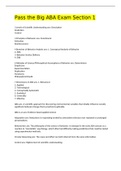
Pass the Big ABA Exam Section 1 3 Levels of Scientific Understanding ans: Description Prediction Control 3 Principles of Behavior ans: Punishment Extinction Reinforcement 4 Branches of Behavior Analysis ans: 1. Conceptual Analysis of Behavior 2. ABA 3. Behavior Service Delivery 4. EAB 6 Attitudes of Science/Philosophical Assumptions of Behavior ans: Determinism Empiricism Experimentation Replication Parsimony Philosophical Doubt 7 Dimensions of ABA ans: 1. Behavioral 2. Applied 3. Technological 4. Conceptually Systematic 5. Analytical 6. Generality 7. Effective ABA ans: A scientific approach for discovering environmental variables that reliably influence socially significant behavior change that is practical & aplicable. ABA is an ans: Evidence based applied science Adaptation ans: Reductions is responding evoked by antecedent stimulus over repeated or prolonged presentations. Behaviorism ans: The philosophy of the science of behavior. It emerged in the early 20th century as a reaction to "mentalistic" psychology, which often had difficulty making predictions that could be tested using experimental methods. Circular Reasoning ans: The cause and effect are both inferred from the same information. Control ans: Highest level of scientific understanding. Determinism ans: Lawfullness Empiricism ans: Requires objective quantification & detailed description of events Experimentation ans: Requires manipulating variables so as to see the effects on the dependent variable Explanatory Fictions ans: Fictitious variables that are another name for the observed behavior. They contribute nothing to to an understanding of the variables responsible for maintaining behavior. Habituation ans: When the eliciting stimulus is presented repeatedly over a short time, the strength of the respondent Behavior diminishes Mentalism ans: An approach to explaining behavior that assumes an inner dimension exists & causes behavior. Ontogenic ans: Learning that results from an organisms interaction with his/her environment Operant Behavior ans: Any behavior whose probability of occurrence is determined by its history of consequences. Must be defined in terms of their relationship to controlling variables. Voluntary Operant behavior is due to ans: Ontogenic history Operant Contingency ans: The occasion for a response, the response, and the outcome of the response. Parsimony ans: Helps scientists fit their findings within the field's existing knowledge base. Philosophical Doubt ans: Healthy skepticism Phylogeneic ans: Behavior that is inherited genetically Primary unit of ABA ans: Three term contingency A-B-C Replication ans: Reason that science is a self-correcting enterprise. Respondent behavior AKA ans: Reflex, unconditioned stimulus unconditioned response (US-UR) Respondent Behavior ans: Behavior someone does not have to learn. Elicited Involuntary Reflex Respondent Behavior is due to ans: Phylogeneic history Respondent Conditioning AKA ans: Classical conditioning, Pavlovian Conditioning, Stimulus-Stimulus Pairing (S-S), Conditioned Stimulus-conditioned Response (CS-CR) Temporal Contiguity ans: When 2 stimuli occur close together in time, resulting in an association of those 2 stimuli. The purpose of science is ans: To achieve a thorough understanding of the phenomena are socially important behaviors Two primary types of behavior ans: Respondent Behavior Operant Behavior
Document information
- Uploaded on
- May 24, 2022
- Number of pages
- 3
- Written in
- 2021/2022
- Type
- Exam (elaborations)
- Contains
- Questions & answers


