

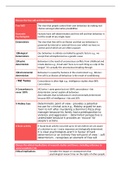
Discuss the free will and determinism
Free Will The view that people control their own behaviour by making real
choices amongst alternative possibilities
Humanist Humans have self-determination and free will and that behaviour is
Psychologists not the result of any single cause
Determinism The view that free will is an illusion and that our behaviour is
governed by internal or external forces over which we have no
control and of which we are often unaware
1)Biological Our behaviour is entirely controlled by genetic factors e.g., we
Determinism accept that schizophrenia has a genetic cause
2)Psychic Behaviour is the result of unconscious conflicts from childhood and
determinism innate desires e.g., Freud said “here is no such thing as a slip of the
tongue” it is actually the unconscious breaking through
3)Environmental Behaviour is caused by features in the environment e.g., Skinner -
determinism free will is an illusion all behaviour is the result of conditioning
✓MZ Twins Concordance is often high e.g.; intelligence studies show 80%
concordance
X Concordance is MZ twins = same genes but not 100% concordance = bio
never 100% determinism cannot explain all behaviour.
Also indicates that no behaviour is environmentally determined
because 80% of intelligence = bio and 20%
X Mobley Case Deterministic point of view - provides a potential
excuse for criminal acts e.g., Mobley argued he was
‘born to kill’ after murdering a Domino’s Pizza shop
manager because his family had a predisposition to
violence and aggression ∴ determinist perspective is
undesirable because it provides an ‘excuse’ for
people’s actions.
X Brain activity R found brain activity occurred up to 10 secs before we are aware
of a decision to act = many responses are biologically determined.
It is clear psychologists aren't in favour of hard
determinism or an entirely free will point of view ∴ soft
determinism - recognises an element of free will
Discuss the ethical implications of research studies and theory, including reference to
social sensitivity (16)
Ethical implications Consider the impact or consequences that
psychological research has on the rights of other people
Free Will The view that people control their own behaviour by making real
choices amongst alternative possibilities
Humanist Humans have self-determination and free will and that behaviour is
Psychologists not the result of any single cause
Determinism The view that free will is an illusion and that our behaviour is
governed by internal or external forces over which we have no
control and of which we are often unaware
1)Biological Our behaviour is entirely controlled by genetic factors e.g., we
Determinism accept that schizophrenia has a genetic cause
2)Psychic Behaviour is the result of unconscious conflicts from childhood and
determinism innate desires e.g., Freud said “here is no such thing as a slip of the
tongue” it is actually the unconscious breaking through
3)Environmental Behaviour is caused by features in the environment e.g., Skinner -
determinism free will is an illusion all behaviour is the result of conditioning
✓MZ Twins Concordance is often high e.g.; intelligence studies show 80%
concordance
X Concordance is MZ twins = same genes but not 100% concordance = bio
never 100% determinism cannot explain all behaviour.
Also indicates that no behaviour is environmentally determined
because 80% of intelligence = bio and 20%
X Mobley Case Deterministic point of view - provides a potential
excuse for criminal acts e.g., Mobley argued he was
‘born to kill’ after murdering a Domino’s Pizza shop
manager because his family had a predisposition to
violence and aggression ∴ determinist perspective is
undesirable because it provides an ‘excuse’ for
people’s actions.
X Brain activity R found brain activity occurred up to 10 secs before we are aware
of a decision to act = many responses are biologically determined.
It is clear psychologists aren't in favour of hard
determinism or an entirely free will point of view ∴ soft
determinism - recognises an element of free will
Discuss the ethical implications of research studies and theory, including reference to
social sensitivity (16)
Ethical implications Consider the impact or consequences that
psychological research has on the rights of other people


