
UWORLD 9
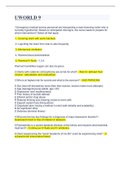
UWORLD 9 1.Emergency medical service personnel are transporting a near-drowning victim who is currently hypothermic. Based on anticipated vital signs, the nurse needs to prepare for which interventions? Select all that apply. 1. Covering client with warm blankets 2. Logrolling the client from side to side frequently 3. Mechanical ventilation 4. Warmed blood administration 5. Warmed IV fluids - 1,3,5 Warmed humidified oxygen can also be given. 2.Clients with catatonic schizophrenia are at risk for what? - Risk for deficient fluid volume - dehydration and malnutrition. 3.Who is at highest risk for suicide and what is the acronym? - SAD PERSONS S Sex (men kill themselves more often than women; women make more attempts) A Age (teenagers/young adults, age 45) D Depression (and hopelessness) P Prior history of suicide attempt E Ethanol and/or drug abuse R Rational thinking loss (hearing voices to harm self) S Support system loss (living alone) O Organized plan; having a method in mind (with lethality and availability) N No significant other S Sickness (terminal illness) 4.What are the two key findings for a diagnosis of major depressive disorder? - Depressed mood or loss of interest or pleasure. 5.Pylonephritis is a severe bacterial infection of the kidney and requires what essential treatment? - Continuous IV fluids and IV antibiotics 6.Client experiencing the "worst headache of my life" could be experiencing what? - A subarachnoid intercerebral bleed. 7.A 25-year-old marathon runner is admitted for suspected rhabdomyolysis. The client has oliguria, dark amber urine, and muscle pain. The nurse should implement which prescription first? 1. ECG 2. IV morphine 2 mg 3. Normal saline bolus 4. Urine sample The myoglobin needs to be flushed from the client or kidney damage can occur. 8.A nurse is caring for a client following a forceps-assisted vaginal birth. The client reports severe vaginal pain and fullness. On assessment the nurse notices a firm, midline uterine fundus. Lochia rubra is light. Which diagnosis should the nurse anticipate? 1. Cervical laceration 2. Inversion of the uterus 3. Uterine atony 4. Vaginal hematoma 9.How long should a patient wait for returning to vigorous activity post-tonsillectomy? - 2 weeks. Bleeding can occur at up to 14 days. 10.A child with autism spectrum disorder is being admitted to an acute care unit. Which is the most importantnursing action? 1. Placing the child in a private room away from the nurses' station 2. Placing the child in a private room near the playroom 3. Placing the child in a semi-private room near the nurses' station 4. Placing the child in a semi-private room with another child with autism spectrum disorder - 1. Placing the child in a private room away from the nurses' station 11.Autistic children are very sensitive to noise - alarms, monitors, etc.. 12.The nurse sticks himself with a needle from an HIV infected client. What is the protocol of action the nurse should take? - 1. Remove gloves 2. wash area with soap and water 3. Notify the nurse supervisor 4. Go to the employee health clinic 5. Baseline blood draw 6. Take post-exposure prophylaxis ......................
Document information
- Uploaded on
- May 17, 2022
- Number of pages
- 13
- Written in
- 2021/2022
- Type
- Exam (elaborations)
- Contains
- Questions & answers


