

How to use these essay plans
Each of these essay plans are headed with their question title. They are all
split into two main sections. The white section is AO1 content only and the
blue section is the AO3 evaluation section.
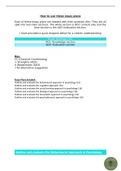
I have provided a quick diagram below for a clearer understanding
Essay Question (16)
AO1: Knowledge section
AO3: Evaluation section
Key
CC (Classical Conditioning)
+ Strengths (AO3)
X Weaknesses (AO3)
? An alternative suggestion
Essay Plans included
Outline and evaluate the behaviourist approach in psychology (16)
Outline and evaluate the cognitive approach (16)
Outline and evaluate the social learning approach in psychology (16)
Outline and evaluate the biological approach in psychology (16)
Outline and evaluate the humanistic approach in psychology (16)
Outline and evaluate the psychodynamic approach in psychology (16)
Outline and evaluate the Behaviourist Approach in Psychology
, (16)
Introduction Believe we are born as a blank slate (tabla rasa) & all
behaviour is learned
Only focuses on observable & measurable behaviour
Pavlov’s Dog First, he provided a dog with food (an unconditioned
(Classical stimulus) = salivation (unconditioned response).
Conditioning) Then rang a bell (neutral stimulus) = no response.
Paired neutral stimulus with the unconditioned stimulus
= created an association with the unconditioned
response.
After regular pairing the neutral stimulus it became a
conditioned stimulus which led to a conditioned
response.
This research led to his idea of classical conditioning - we
learn by association
Skinner He researched rats & found they could be trained to
(Operant repeat or avoid behaviours by adapting to the
Conditioning) consequences.
This research led to his idea of operant conditioning. This
is the idea that behaviour is learned & shaped by its
consequences and learning is an active process. He
found that reinforcement increased the likelihood of
behaviour being repeated and negative reinforcement
reduced this likelihood.
X Use of Animal testing has ethical implications
animals Also, animals and humans are different therefore any
findings cannot be generalised to humans = non-
applicable to humans
Pavlov’s CC is the basis for the development of
+ Successful treatments such as systematic desensitisation which is
practical used to treat phobias.
applications These applications are helpful for many and confirm the
accuracy of the behaviourist approach itself
+ CBT CBT is considered more effective at treating phobias than
systematic desensitisation = perhaps the Cog. Approach
is more accurate
+ Highly Reductionism is a key part in the philosophy of science -
reductionist = main aim = reduce complex behaviours into their simpler
scientific components
Each of these essay plans are headed with their question title. They are all
split into two main sections. The white section is AO1 content only and the
blue section is the AO3 evaluation section.
I have provided a quick diagram below for a clearer understanding
Essay Question (16)
AO1: Knowledge section
AO3: Evaluation section
Key
CC (Classical Conditioning)
+ Strengths (AO3)
X Weaknesses (AO3)
? An alternative suggestion
Essay Plans included
Outline and evaluate the behaviourist approach in psychology (16)
Outline and evaluate the cognitive approach (16)
Outline and evaluate the social learning approach in psychology (16)
Outline and evaluate the biological approach in psychology (16)
Outline and evaluate the humanistic approach in psychology (16)
Outline and evaluate the psychodynamic approach in psychology (16)
Outline and evaluate the Behaviourist Approach in Psychology
, (16)
Introduction Believe we are born as a blank slate (tabla rasa) & all
behaviour is learned
Only focuses on observable & measurable behaviour
Pavlov’s Dog First, he provided a dog with food (an unconditioned
(Classical stimulus) = salivation (unconditioned response).
Conditioning) Then rang a bell (neutral stimulus) = no response.
Paired neutral stimulus with the unconditioned stimulus
= created an association with the unconditioned
response.
After regular pairing the neutral stimulus it became a
conditioned stimulus which led to a conditioned
response.
This research led to his idea of classical conditioning - we
learn by association
Skinner He researched rats & found they could be trained to
(Operant repeat or avoid behaviours by adapting to the
Conditioning) consequences.
This research led to his idea of operant conditioning. This
is the idea that behaviour is learned & shaped by its
consequences and learning is an active process. He
found that reinforcement increased the likelihood of
behaviour being repeated and negative reinforcement
reduced this likelihood.
X Use of Animal testing has ethical implications
animals Also, animals and humans are different therefore any
findings cannot be generalised to humans = non-
applicable to humans
Pavlov’s CC is the basis for the development of
+ Successful treatments such as systematic desensitisation which is
practical used to treat phobias.
applications These applications are helpful for many and confirm the
accuracy of the behaviourist approach itself
+ CBT CBT is considered more effective at treating phobias than
systematic desensitisation = perhaps the Cog. Approach
is more accurate
+ Highly Reductionism is a key part in the philosophy of science -
reductionist = main aim = reduce complex behaviours into their simpler
scientific components


