
Agnp Board Exam With Answers Women’s Health Assessment
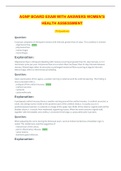
AGNP BOARD EXAM WITH ANSWERS WOMEN’S HEALTH ASSESSMENT (70 Questions) Question: A woman complains of infrequent menses with intervals greater than 35 days. This condition is termed: oligomenorrhea. Correct polymenorrhea. metrorrhagia. menorrhagia. Explanation: Oligomenorrhea is infrequent bleeding with menses occurring at greater than 35- day intervals, or 4-9 menstrual cycles per year. Polymenorrhea occurs when there are fewer than 21-day intervals between menses. Menorrhagia refers to excessive or prolonged menstrual flow occurring at regular intervals. Metrorrhagia refers to intermenstrual bleeding. Question: Upon examination of the vagina, a swollen red ring is noted around the urethral opening. This finding is most consistent with a: prolapse of the urethral mucosa. Correct urethral caruncle. cystocele. cystourethrocele. Explanation: A prolapsed urethral mucosa forms a swollen red ring around the urethral meatus. A urethral caruncle is a small, red, benign tumor visible at the posterior part of the urethral meatus. It usually occurs in postmenopausal women. A cystocele is a bulge of the upper two-thirds of the anterior vaginal wall and the bladder above it. It results from weakened supporting tissues. When the entire anterior vaginal wall, together with the bladder and urethra, is involved in the bulge, a cystourethrocele is present. Question: When palpating the cervix during the bimanual exam, cervical motion tenderness (chandelier sign) is noted. This tenderness could be suggestive of: retroversion of the uterus. pelvic inflammatory disease. Correct vulvar lesions. Bartholin gland infection. Explanation: Cervical motion tenderness, also known as Chandelier's sign, and/or adnexal tenderness, suggest pelvic inflammatory disease, ectopic pregnancy, or appendicitis.
Document information
- Uploaded on
- May 1, 2022
- Number of pages
- 22
- Written in
- 2021/2022
- Type
- Exam (elaborations)
- Contains
- Questions & answers


