

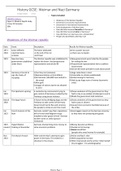
History GCSE: Weimar and Nazi Germany
25 April 2022 17:31
Topics included:
EDEXCEL History:
• Weakness of the Weimar Republic
Paper 3: Modern Depth study
• Stresemann's Economic Improvements
1 hour 20 minutes • Stresemann's International Improvements
30% • Early development of the Nazi party
• How did Hitler become Chancellor of Germany?
• How did Hitler become Fuhrer of Germany?
• How did Hitler turn Germany into a dictatorship?
• People who benefitted under Nazi rule
Weakness of the Weimar republic
Date: Event: Description: Results for Weimar republic
1871- Kaiser Wilhelm The kaiser abdicated Led to a power vacuum
1918 ruled Germany at the end of the 1st as there was no leader.
as kaiser world war
1919 New Germany The Weimar republic was established to 1) New government were hated by the people
government established replace the kaiser. Had proportional for ending the war
under Ebert representation and article 48 2) Proportional representation led to coalition
Government
3) Article 48 meant president could abuse power
1919 Germany is forced to 1) Territory lost (colonies) 1) Huge reductions in land
sign the treaty of 2) Representations set (6.6 billion) 2) Vulnerable to attack (undefended)
Versailles 3) Armaments (100,000 men limited to 3) Embarrassing for Germany
the army) 4) Had to pay huge sums of money (economic
4) War guilt crisis)
5) League of nations (were not allowed
to join)
Jan The Spartacist uprising A revolution by communists trying to 1) Shows weakness of the government as they
1919 gain control of Germany crushed by the had to rely on ex-soldiers (Freikorps) to end it.
Freikorps using brutal violence 2) Made the government look malicious
March The Kapp Putsch A Putsch led by Wolfgang Kapp and the 1) Shows weakness of the government as they
1920 Freikorps to take control of Germany. had to pay on citizens
Government had to flee and convince 2) Caused more economic hardship because of
the people to strike to end the revolt the strike.
Jan French Invasion of the Germans couldn’t pay their reparations 1) Even bigger impact on the German economy
1923 Ruhr bill so French and Belgium troops as they were not producing any goods
invaded to take 'goods in kind'. German
workers went on strike (passive
resistance)
1923 Hyperinflation Germans tried printing more money to 1) Money became worthless
onward Peaking in November solve economic problems 2) People lost all savings
s 3) Some benefitted
(people who owed money for example)
Nov The Munich Putsch Hitler and the Nazi's attempt to gain 1) Police and Nazi's shot
1923 power in Germany. This ended in a 2) Hitler popularity increase
shootout in the streets. 3) Hitler imprisoned and he writes ' Mein Kampf'
(my struggles' - his autobiography)
Stresemann's Economic Improvements
History Page 1
, Stresemann's Economic Improvements
Date: Event: Description: Results for Weimar republic
Sept Stresemann called Stresemann ordered the workers 1) The Government working again
1923 off passive of the Ruhr to go back work 2) Encouraged the French to leave the Ruhr
resistance
1923 New currency was New currency burnt the old This ended hyperinflation and got the German economy
introduced worthless marks and introduced a working again. (people who had savings in the bank lost their
(Rentenmark) new, stable currency savings- these were manly middle class people)
1924 The Dawes Pact 1) Stresemann organised a loan of Money could be used to rebuild factories to boost the
$800,000 from the USA economy.
2) Reparations payments would be (so they could produce more goods to trade)
what Germany could afford
Germany didn’t have to worry about huge reparations bills
each year
1929 The Young Plan Germany could have longer to pay 1) Germany didn’t have to pay as much in reparations and
off their reparations had longer to pay so was less of a strain on their economy
The reparations were introduced
to 2.2 billion
Stresemann's International Improvements
Date: Event: Description: Results for Weimar republic:
1925 The Locarno treaty Germany, France, Belgium, Britain, and Italy Germany was being accepted by other European
agreed to accept the borders set by the countries and proved they wouldn't challenge the
treaty of Versailles Treaty of Versailles.
1926 The league of Germany was accepted into the league of Germany was starting to be accepted by the other
nations nations. countries in the world.
1928 The Kellogg Briand Over 60 countries, including Germany, signed Would hopefully prevent future wars. Germany was
Pact an agreement never to go to war. accepted even more.
Early Development of the Nazi Party
Date: Event: Description: How this helped Hitler
History Page 2
25 April 2022 17:31
Topics included:
EDEXCEL History:
• Weakness of the Weimar Republic
Paper 3: Modern Depth study
• Stresemann's Economic Improvements
1 hour 20 minutes • Stresemann's International Improvements
30% • Early development of the Nazi party
• How did Hitler become Chancellor of Germany?
• How did Hitler become Fuhrer of Germany?
• How did Hitler turn Germany into a dictatorship?
• People who benefitted under Nazi rule
Weakness of the Weimar republic
Date: Event: Description: Results for Weimar republic
1871- Kaiser Wilhelm The kaiser abdicated Led to a power vacuum
1918 ruled Germany at the end of the 1st as there was no leader.
as kaiser world war
1919 New Germany The Weimar republic was established to 1) New government were hated by the people
government established replace the kaiser. Had proportional for ending the war
under Ebert representation and article 48 2) Proportional representation led to coalition
Government
3) Article 48 meant president could abuse power
1919 Germany is forced to 1) Territory lost (colonies) 1) Huge reductions in land
sign the treaty of 2) Representations set (6.6 billion) 2) Vulnerable to attack (undefended)
Versailles 3) Armaments (100,000 men limited to 3) Embarrassing for Germany
the army) 4) Had to pay huge sums of money (economic
4) War guilt crisis)
5) League of nations (were not allowed
to join)
Jan The Spartacist uprising A revolution by communists trying to 1) Shows weakness of the government as they
1919 gain control of Germany crushed by the had to rely on ex-soldiers (Freikorps) to end it.
Freikorps using brutal violence 2) Made the government look malicious
March The Kapp Putsch A Putsch led by Wolfgang Kapp and the 1) Shows weakness of the government as they
1920 Freikorps to take control of Germany. had to pay on citizens
Government had to flee and convince 2) Caused more economic hardship because of
the people to strike to end the revolt the strike.
Jan French Invasion of the Germans couldn’t pay their reparations 1) Even bigger impact on the German economy
1923 Ruhr bill so French and Belgium troops as they were not producing any goods
invaded to take 'goods in kind'. German
workers went on strike (passive
resistance)
1923 Hyperinflation Germans tried printing more money to 1) Money became worthless
onward Peaking in November solve economic problems 2) People lost all savings
s 3) Some benefitted
(people who owed money for example)
Nov The Munich Putsch Hitler and the Nazi's attempt to gain 1) Police and Nazi's shot
1923 power in Germany. This ended in a 2) Hitler popularity increase
shootout in the streets. 3) Hitler imprisoned and he writes ' Mein Kampf'
(my struggles' - his autobiography)
Stresemann's Economic Improvements
History Page 1
, Stresemann's Economic Improvements
Date: Event: Description: Results for Weimar republic
Sept Stresemann called Stresemann ordered the workers 1) The Government working again
1923 off passive of the Ruhr to go back work 2) Encouraged the French to leave the Ruhr
resistance
1923 New currency was New currency burnt the old This ended hyperinflation and got the German economy
introduced worthless marks and introduced a working again. (people who had savings in the bank lost their
(Rentenmark) new, stable currency savings- these were manly middle class people)
1924 The Dawes Pact 1) Stresemann organised a loan of Money could be used to rebuild factories to boost the
$800,000 from the USA economy.
2) Reparations payments would be (so they could produce more goods to trade)
what Germany could afford
Germany didn’t have to worry about huge reparations bills
each year
1929 The Young Plan Germany could have longer to pay 1) Germany didn’t have to pay as much in reparations and
off their reparations had longer to pay so was less of a strain on their economy
The reparations were introduced
to 2.2 billion
Stresemann's International Improvements
Date: Event: Description: Results for Weimar republic:
1925 The Locarno treaty Germany, France, Belgium, Britain, and Italy Germany was being accepted by other European
agreed to accept the borders set by the countries and proved they wouldn't challenge the
treaty of Versailles Treaty of Versailles.
1926 The league of Germany was accepted into the league of Germany was starting to be accepted by the other
nations nations. countries in the world.
1928 The Kellogg Briand Over 60 countries, including Germany, signed Would hopefully prevent future wars. Germany was
Pact an agreement never to go to war. accepted even more.
Early Development of the Nazi Party
Date: Event: Description: How this helped Hitler
History Page 2


