178569 – Jessica Johnson
Unit 13: Applications of Inorganic Chemistry
Learning aim A: Investigate acid-base equilibria in order and to understand buffer
action to optimise acid-base titration procedures.
Index.
Introduction,
Titration,
Results,
Graphs,
References.
Introduction.
This report will show how to evaluate the accuracy of acid-base titrations using an indicator, a pH
meter and an auto titrator, How to perform complex calculations involving pH, including rearranging
equations, assessing the action of a buffer solution. It will also justify the selection of indicators or the
titrators, perform straightforward calculations to determine the pH of solutions and demonstrate
accurately a reading of Ka in a weak acid and demonstrate buffer action. Finally demonstrate
accurate use of a pH meter in order to select suitable indicators.
Titration; Determining the constant Ka for a weak acid.
Risk Assessment.
Ethanoic Acid - Corrosive,
Sodium Hydroxide – Corrosive,
Phenol Phalen – Flammable,
In this practical you will use various hazardous substances including ethanoic acid, sodium hydroxide,
phenol Phalen, hydrochloric acid and ammonia. To prevent any harm from these chemicals you
should wear PPE such as eye protection to stop any of the corrosive and harmful chemicals from
entering your eyes as it would cause severe irritation. You should also wear gloves when necessary
as if any of these substances make contact with your skin they could also cause damage.
Equipment used.
50cm3 burette and stand,
Small funnel,
25cm3 pipette and pipette filler,
250cm3 beaker,
250cm3 conical flask,
Distilled water,
pH meter (accurately calibrated).
Method.
1
, 178569 – Jessica Johnson
1. Attach the 50cm3 burette to the stand with a clamp. Rinse and fill the burette with 0.1M
sodium hydroxide solution using a funnel.
2. Fill a pipette with ethanoic acid and transfer exactly 25cm3 of the solution into a 250cm3
conical flask using a pipette filler.,
3. Add 2-3 drops of phenolphthalein indicator solution to the conical flask and swirl to mix,
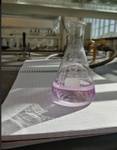
4. Swirl the sodium hydroxide solution out of the burette until it slightly turns pink and is
permanent.,
5. Repeat the titration until the titrates are all the same. Calculate the mean titre),
6. Repeat the titration until the titrates are all the same. Calculate the mean titre,
7. Fill the beaker with ethanoic acid with exactly V/2cm3 of sodium hydroxide solution from the
burette. This is the amount of water needed to neutralise half of the ethanoic acid,
8. To ensure that the solutions are thoroughly combined, gently swirl them together.,
9. In the beaker, place a carefully calibrated pH metre with the probe tip entirely immersed in the
solution you've created.,
10. Read and record the final pH of the solution in the beaker after the reading is stable..
11. Repeat the half-neutralisation stages to acquire a consistent average pH reading within 0.1 of
one another and calculate the average.
Risk Assessment.
Sodium Chloride – Irritant,
Sodium Carbonate – Irritant,
Sodium Bisulphate – Irritant,
In this practical you will use various hazardous substances including sodium chloride, sodium
carbonate and sodium bisulphate. To prevent any harm from these chemicals you should wear PPE
such as eye protection to stop any of the corrosive and harmful chemicals from entering your eyes as
it would cause severe irritation. These substances are also incredibly harmful to breath in so it’s
important that there is good ventilation in the room you are in and you should open windows to help
ventilate the room. Also PPE such as face masks will help in preventing yourself from breathing as
much of the harmful chemicals as possible.
Buffer solution Method.
1. Get 3 beakers and label them A, B and C. Pour a small amount of 0.1M of NaCl into
beaker A, 0.1M Na2CO3 into beaker B, and 0.1M NaHSO4 into beaker C.
2. Record the pH of these solutions.
3. 6 solutions are provided use 2 of them to pour 50ml into two separate beakers.
2
Unit 13: Applications of Inorganic Chemistry
Learning aim A: Investigate acid-base equilibria in order and to understand buffer
action to optimise acid-base titration procedures.
Index.
Introduction,
Titration,
Results,
Graphs,
References.
Introduction.
This report will show how to evaluate the accuracy of acid-base titrations using an indicator, a pH
meter and an auto titrator, How to perform complex calculations involving pH, including rearranging
equations, assessing the action of a buffer solution. It will also justify the selection of indicators or the
titrators, perform straightforward calculations to determine the pH of solutions and demonstrate
accurately a reading of Ka in a weak acid and demonstrate buffer action. Finally demonstrate
accurate use of a pH meter in order to select suitable indicators.
Titration; Determining the constant Ka for a weak acid.
Risk Assessment.
Ethanoic Acid - Corrosive,
Sodium Hydroxide – Corrosive,
Phenol Phalen – Flammable,
In this practical you will use various hazardous substances including ethanoic acid, sodium hydroxide,
phenol Phalen, hydrochloric acid and ammonia. To prevent any harm from these chemicals you
should wear PPE such as eye protection to stop any of the corrosive and harmful chemicals from
entering your eyes as it would cause severe irritation. You should also wear gloves when necessary
as if any of these substances make contact with your skin they could also cause damage.
Equipment used.
50cm3 burette and stand,
Small funnel,
25cm3 pipette and pipette filler,
250cm3 beaker,
250cm3 conical flask,
Distilled water,
pH meter (accurately calibrated).
Method.
1
, 178569 – Jessica Johnson
1. Attach the 50cm3 burette to the stand with a clamp. Rinse and fill the burette with 0.1M
sodium hydroxide solution using a funnel.
2. Fill a pipette with ethanoic acid and transfer exactly 25cm3 of the solution into a 250cm3
conical flask using a pipette filler.,
3. Add 2-3 drops of phenolphthalein indicator solution to the conical flask and swirl to mix,
4. Swirl the sodium hydroxide solution out of the burette until it slightly turns pink and is
permanent.,
5. Repeat the titration until the titrates are all the same. Calculate the mean titre),
6. Repeat the titration until the titrates are all the same. Calculate the mean titre,
7. Fill the beaker with ethanoic acid with exactly V/2cm3 of sodium hydroxide solution from the
burette. This is the amount of water needed to neutralise half of the ethanoic acid,
8. To ensure that the solutions are thoroughly combined, gently swirl them together.,
9. In the beaker, place a carefully calibrated pH metre with the probe tip entirely immersed in the
solution you've created.,
10. Read and record the final pH of the solution in the beaker after the reading is stable..
11. Repeat the half-neutralisation stages to acquire a consistent average pH reading within 0.1 of
one another and calculate the average.
Risk Assessment.
Sodium Chloride – Irritant,
Sodium Carbonate – Irritant,
Sodium Bisulphate – Irritant,
In this practical you will use various hazardous substances including sodium chloride, sodium
carbonate and sodium bisulphate. To prevent any harm from these chemicals you should wear PPE
such as eye protection to stop any of the corrosive and harmful chemicals from entering your eyes as
it would cause severe irritation. These substances are also incredibly harmful to breath in so it’s
important that there is good ventilation in the room you are in and you should open windows to help
ventilate the room. Also PPE such as face masks will help in preventing yourself from breathing as
much of the harmful chemicals as possible.
Buffer solution Method.
1. Get 3 beakers and label them A, B and C. Pour a small amount of 0.1M of NaCl into
beaker A, 0.1M Na2CO3 into beaker B, and 0.1M NaHSO4 into beaker C.
2. Record the pH of these solutions.
3. 6 solutions are provided use 2 of them to pour 50ml into two separate beakers.
2