

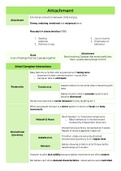
Attachment
Emotional connection between child and pcg
Attachment
Strong, enduring, emotional and reciprocal bond
Maccoby’s 4 characteristics (1980)
1. Seeking 3. Joy on reunion
attention 4. Orientation of
2. Distress on sep. behaviour
Attachment
Bond
Bond involving 2 people that emotionally links
A set of feelings that ties 2 people together
them, usually taking longer to form
Infant Caregiver Interactions
Baby falls into a rhythm with pcg almost as if taking turns
⤷ Important to later communication + social skills
⤷ Caregiver able to anticipate
Asked mothers to not smile when interacting with
Reciprocity Tronick et al.
baby
Babies tried to smile to provoke reaction and
became distressed
Reciprocal response to social releasers (crying, laughing etc.)
When two people interact in a mirror pattern in terms of facial and body
movements
Adult displays 1 or 3 expressions/gestures
Meltzoff & Moore ⤷ Baby’s behaviour is monitored and
reviewed by independent observers
Interactional synchrony recognised at 2 weeks
Interactional Repeat of study suggested 3 days old
Synchrony If mother + baby are securely attached
Isabella et al.
interactional synchrony is of a higher level
Babies showing imitation at birth have better
Heimann
relationships at 3 months
However studies lack validity because babies movements are often random
But babies can’t show demand characteristics + observations were controlled
, Schaffer & Emerson 1964 Experiment
Wanted to investigate the formation of early attachment and the age of its development
Procedure Findings
60 glaswegian, working class babies 25 - 30 weeks = 30% of babies show separation
anxiety
Visited once a month for the first 12 months then
again at 18 months Babies attached to figure most sensitive to
expressions and gestures
Asked parents to observe and record separation
anxiety and stranger anxiety 40 weeks = 30% of babies had formed multiple
attachments
Schaffer’s stages of attachment
Asocial stage
Stage 1
Treats humans and objects the same
0-2 months
Preference for familiar adults
Indiscriminate attachment
Stage 2 Will accept affection from anyone
2-7 months Preference for familiar adults
No stranger or separation anxiety
Specific attachment
Stage 3
Stranger and separation anxiety
7-12 months
65% show attachment to most responsive adult
Multiple Attachments
Stage 4
29% of babies form secondary attachment within a month of
1 year+
their primary attachment
Strengths Limitations
High external validity Longitudinal study
⤷ Naturalistic observation ⤷ Qualitative data
⤷ Mothers know babies best ⤷ Bias due to rapport
Researchers not present all the time Lacks Generalisability
⤷ Behaviour not affected ⤷ Sample from same area and class
Longitudinal study ⤷ Child rearing changes over time
⤷ High temporal + external validity Mothers reports unreliable
Support from bowlby ⤷ Selective + biassed
⤷ Primary att. Needs to happen before Difficult to gather meaningful info from infants
multiple atts. ⤷ Immobile and can’t share emotions
Conflicting research
⤷ Meltzoff & Moore say babies can socialise
at 3 days
Culturally specific
Emotional connection between child and pcg
Attachment
Strong, enduring, emotional and reciprocal bond
Maccoby’s 4 characteristics (1980)
1. Seeking 3. Joy on reunion
attention 4. Orientation of
2. Distress on sep. behaviour
Attachment
Bond
Bond involving 2 people that emotionally links
A set of feelings that ties 2 people together
them, usually taking longer to form
Infant Caregiver Interactions
Baby falls into a rhythm with pcg almost as if taking turns
⤷ Important to later communication + social skills
⤷ Caregiver able to anticipate
Asked mothers to not smile when interacting with
Reciprocity Tronick et al.
baby
Babies tried to smile to provoke reaction and
became distressed
Reciprocal response to social releasers (crying, laughing etc.)
When two people interact in a mirror pattern in terms of facial and body
movements
Adult displays 1 or 3 expressions/gestures
Meltzoff & Moore ⤷ Baby’s behaviour is monitored and
reviewed by independent observers
Interactional synchrony recognised at 2 weeks
Interactional Repeat of study suggested 3 days old
Synchrony If mother + baby are securely attached
Isabella et al.
interactional synchrony is of a higher level
Babies showing imitation at birth have better
Heimann
relationships at 3 months
However studies lack validity because babies movements are often random
But babies can’t show demand characteristics + observations were controlled
, Schaffer & Emerson 1964 Experiment
Wanted to investigate the formation of early attachment and the age of its development
Procedure Findings
60 glaswegian, working class babies 25 - 30 weeks = 30% of babies show separation
anxiety
Visited once a month for the first 12 months then
again at 18 months Babies attached to figure most sensitive to
expressions and gestures
Asked parents to observe and record separation
anxiety and stranger anxiety 40 weeks = 30% of babies had formed multiple
attachments
Schaffer’s stages of attachment
Asocial stage
Stage 1
Treats humans and objects the same
0-2 months
Preference for familiar adults
Indiscriminate attachment
Stage 2 Will accept affection from anyone
2-7 months Preference for familiar adults
No stranger or separation anxiety
Specific attachment
Stage 3
Stranger and separation anxiety
7-12 months
65% show attachment to most responsive adult
Multiple Attachments
Stage 4
29% of babies form secondary attachment within a month of
1 year+
their primary attachment
Strengths Limitations
High external validity Longitudinal study
⤷ Naturalistic observation ⤷ Qualitative data
⤷ Mothers know babies best ⤷ Bias due to rapport
Researchers not present all the time Lacks Generalisability
⤷ Behaviour not affected ⤷ Sample from same area and class
Longitudinal study ⤷ Child rearing changes over time
⤷ High temporal + external validity Mothers reports unreliable
Support from bowlby ⤷ Selective + biassed
⤷ Primary att. Needs to happen before Difficult to gather meaningful info from infants
multiple atts. ⤷ Immobile and can’t share emotions
Conflicting research
⤷ Meltzoff & Moore say babies can socialise
at 3 days
Culturally specific


