Counselling Micro Skills
Chapter 1 - Introduction
In this course you will briefly consider the core communication skills of counselling: those fundamental
skills that alone or together can help a client to access their deepest thoughts or clarify their future
dreams.
The skills we will examine here are attending skills, basic questioning skills, confrontation, focusing,
reflection of meaning and influencing skills.
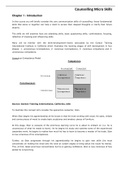
Many will be familiar with the skills-development-matrix advocated by the Gordon Training
International Institute in California which illustrates the learning stages of skill development in four
phases: 1. unconscious incompetence, 2: conscious incompetence, 3: conscious competence and 4:
unconscious competence.
Conscious-Competence Model
Source: Gordon Training International, California, USA
To illustrate this concept let’s consider the apprentice carpenter, Stan.
When Stan begins his apprenticeship all he knows is that he loves working with wood. He saws, chisels
and carves pieces of wood to create basic sculptures and amateur pieces of furniture.
At this stage, Stan is unaware of the enormous learning curve he is about to embark on (i.e. he is
unconscious of what he needs to learn). As he begins his study and watches some of the experienced
carpenters work, he begins to realise how much he has to learn to become a master of his trade. Stan
is now conscious of his incompetence.
Further, as Stan progresses through his apprenticeship he begins to gain new skills (he must
concentrate on holding the wood and the tools at certain angles to bring about the result he wants).
This, at first, takes enormous concentration but he is gaining confidence. Stan is now conscious of how
skilled he is becoming.
, Finally, Stan completes his apprenticeship and goes on to open his own business. In a few years, he is
making wonderful pieces of furniture, hardly thinking about what he has to do to bring about the
exquisite results he produces. Stan is now unconsciously competent. He simply does his work, barely
paying attention to the process (sometimes signing along to the radio in the background). He no longer
has to concentrate on every stage of his work.
In the same way, professionals build their skills in communication by progressing through these
stages. Professionals who are finding the use of micro skills awkward or difficult are likely to be in the
consciously incompetent stage. Professionals who are using the skills effectively but feel a little
unnatural or awkward, are likely to be consciously competent. And Professionals who have learnt the
skills thoroughly and are no longer immediately aware that they are using the skills are unconsciously
competent.
It can be reassuring to know that you will progress through the skill-development matrix. It is only a
matter of time and practice before you master the skills and they become second nature to you.
SUMMARY OF COUNSELLING SKILLS
Micro-skill Purpose When it’s used Examples
Attending behaviours
Throughout entire counselling Attentive body language
encourage clients to talk
Attending interview. Particularly (eye contact, leaning
and show that the
Behaviour important in the initial stages forward slightly,
counsellor is interested in
of establishing rapport. encouraging gestures)
what’s being said.
Effective questioning Questioning is useful in the
“What would you like to
helps guide the information gathering stage of
talk about today?”
counselling conversation the interview. It can however
Questioning
and may assist in be an important skill to use
“When does the problem
enriching the client’s throughout the entire
occur?”
story. process.
Accurate Responding Responding is useful “Let me see if I’ve got this
allows the counsellor to throughout all stages of a right. You want to go back
Responding
confirm with the client counselling interview. It helps to full time study but are
that they are being heard the counsellor to clarify and worried about your
correctly. encourage clients’ stories. financial commitments?”
Noting and reflecting can
assist in adding the emotional
“You feel disappointed
Noting and reflecting is dimension to the client’s
Noting and because your mother
used to bring out story, so is often used in the
Reflecting didn’t call you on your
underlying feelings. interview stages of gathering
birthday.”
information and exploring
alternatives.
Skilled client observation
allows the counsellor to
Observation is a skill that is Observing body language,
Client identify discrepancies or
utilised throughout the entire tone of voice and facial
Observation incongruities in the
counselling interview. expressions.
client’s or their own
communication.
Chapter 1 - Introduction
In this course you will briefly consider the core communication skills of counselling: those fundamental
skills that alone or together can help a client to access their deepest thoughts or clarify their future
dreams.
The skills we will examine here are attending skills, basic questioning skills, confrontation, focusing,
reflection of meaning and influencing skills.
Many will be familiar with the skills-development-matrix advocated by the Gordon Training
International Institute in California which illustrates the learning stages of skill development in four
phases: 1. unconscious incompetence, 2: conscious incompetence, 3: conscious competence and 4:
unconscious competence.
Conscious-Competence Model
Source: Gordon Training International, California, USA
To illustrate this concept let’s consider the apprentice carpenter, Stan.
When Stan begins his apprenticeship all he knows is that he loves working with wood. He saws, chisels
and carves pieces of wood to create basic sculptures and amateur pieces of furniture.
At this stage, Stan is unaware of the enormous learning curve he is about to embark on (i.e. he is
unconscious of what he needs to learn). As he begins his study and watches some of the experienced
carpenters work, he begins to realise how much he has to learn to become a master of his trade. Stan
is now conscious of his incompetence.
Further, as Stan progresses through his apprenticeship he begins to gain new skills (he must
concentrate on holding the wood and the tools at certain angles to bring about the result he wants).
This, at first, takes enormous concentration but he is gaining confidence. Stan is now conscious of how
skilled he is becoming.
, Finally, Stan completes his apprenticeship and goes on to open his own business. In a few years, he is
making wonderful pieces of furniture, hardly thinking about what he has to do to bring about the
exquisite results he produces. Stan is now unconsciously competent. He simply does his work, barely
paying attention to the process (sometimes signing along to the radio in the background). He no longer
has to concentrate on every stage of his work.
In the same way, professionals build their skills in communication by progressing through these
stages. Professionals who are finding the use of micro skills awkward or difficult are likely to be in the
consciously incompetent stage. Professionals who are using the skills effectively but feel a little
unnatural or awkward, are likely to be consciously competent. And Professionals who have learnt the
skills thoroughly and are no longer immediately aware that they are using the skills are unconsciously
competent.
It can be reassuring to know that you will progress through the skill-development matrix. It is only a
matter of time and practice before you master the skills and they become second nature to you.
SUMMARY OF COUNSELLING SKILLS
Micro-skill Purpose When it’s used Examples
Attending behaviours
Throughout entire counselling Attentive body language
encourage clients to talk
Attending interview. Particularly (eye contact, leaning
and show that the
Behaviour important in the initial stages forward slightly,
counsellor is interested in
of establishing rapport. encouraging gestures)
what’s being said.
Effective questioning Questioning is useful in the
“What would you like to
helps guide the information gathering stage of
talk about today?”
counselling conversation the interview. It can however
Questioning
and may assist in be an important skill to use
“When does the problem
enriching the client’s throughout the entire
occur?”
story. process.
Accurate Responding Responding is useful “Let me see if I’ve got this
allows the counsellor to throughout all stages of a right. You want to go back
Responding
confirm with the client counselling interview. It helps to full time study but are
that they are being heard the counsellor to clarify and worried about your
correctly. encourage clients’ stories. financial commitments?”
Noting and reflecting can
assist in adding the emotional
“You feel disappointed
Noting and reflecting is dimension to the client’s
Noting and because your mother
used to bring out story, so is often used in the
Reflecting didn’t call you on your
underlying feelings. interview stages of gathering
birthday.”
information and exploring
alternatives.
Skilled client observation
allows the counsellor to
Observation is a skill that is Observing body language,
Client identify discrepancies or
utilised throughout the entire tone of voice and facial
Observation incongruities in the
counselling interview. expressions.
client’s or their own
communication.