1. Open coding: Mark in the main texts (fragments/sentences) and add side notes
Making codes for these fragments, to understand what the segment is about.
Important to use correct names.
Making codes = determines themes, key concepts or sub concepts.
2. Axial coding = grouping around a certain theme (an ax)
Categorizing side notes. Sort certain information together and also to indicate the
importance.
Difference key concept and theme:
Theme
Key concept
Sub concepts
3. Selective coding = classifying themes and key concepts.
Making conceptual model build put h theory by grouping the themes and look for relations.
Lok at the main theme to answer the central question.
Sub questions:
Theory question can be used for any business so don’t mention the company because then
it becomes an internal question.
Internal question: about the company
External question: mostly the market and external environment. Example: What are the
trends and developments in the field of online communication.
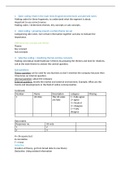
Codebook:
Number Name Description category Missing
1 US Vote The US votes 1 = fully agree
are fake 2= agree
3 = Neutral
4 = disagree
5 = Fully
disagree
Data matrix
Responses no. US vote
1 2
2 3
X= chi-square test
R-correlation
T = t-test
Inductive:
Creation of theory, go from broad data to one theory
Deductive: Using existent information
, Qualititative: data comes in words and brings in-depth knowledge. Data about not so many
people.
Quantitative: numerical data, data from a big group of people/more people.
Big difference: small and bigger population. Qualitative is small population and quantitative
bigger.
Multi-method: quantitative or qualitative, two different methods (survey and …) but part of
same method.
Mixed: quantitative AND qualitative
Another word for mixed method, triangulation
Cross sectional: Measure at one point in time (food secot in covid-19, it is one moment)
Lontitude research: measuring at multiple moments in time (the success of tio over the
years)
Ethics: Social norm when you do an activity. Don’t hit people on the side walk when driving.
(not written down rules)
Privacy and ask for consent when using data,voluntary participation and the right to
withdraw. Objectivity, confidentiality and anonymity.
Respect the other’s rights.
Sample: a part of your chosen population
Census: the whole population
Sampling frame: A list of all people in the population. E.g. all emailaddresses.
Example:
Company x has 500 customers. This is your target population.
You can either take a sample out of it. Send an email out to 200 people.
Census, emailing everyone. You use the whole entire population.
Random sampling: Every 3rd person
When does a sample represent the whole population
Confidence: never below 90%. 100 times a aurvey. 95 cases have similar than it is
repeatable and representable therefore confidence is 95%.
Only 10 out of 100 = 10% confidence
Error margin: the sample shows 45% of the respondents are positive.. If the error is 3 it
could be 42% and 48%.
Calculating sample size week 4/5
P and q always have to be 100% together. If this is not given on the test than it is always
50/50= maximum number is 2500
Ending sample number always round up not below because you don’t have half a survey or
half a person.
If total population is more than 10,000 it’s fine but if result is below 10,000 population size
than you need to use the adapted sample size calculation as well.
Calculate step by step to still get points.
Making codes for these fragments, to understand what the segment is about.
Important to use correct names.
Making codes = determines themes, key concepts or sub concepts.
2. Axial coding = grouping around a certain theme (an ax)
Categorizing side notes. Sort certain information together and also to indicate the
importance.
Difference key concept and theme:
Theme
Key concept
Sub concepts
3. Selective coding = classifying themes and key concepts.
Making conceptual model build put h theory by grouping the themes and look for relations.
Lok at the main theme to answer the central question.
Sub questions:
Theory question can be used for any business so don’t mention the company because then
it becomes an internal question.
Internal question: about the company
External question: mostly the market and external environment. Example: What are the
trends and developments in the field of online communication.
Codebook:
Number Name Description category Missing
1 US Vote The US votes 1 = fully agree
are fake 2= agree
3 = Neutral
4 = disagree
5 = Fully
disagree
Data matrix
Responses no. US vote
1 2
2 3
X= chi-square test
R-correlation
T = t-test
Inductive:
Creation of theory, go from broad data to one theory
Deductive: Using existent information
, Qualititative: data comes in words and brings in-depth knowledge. Data about not so many
people.
Quantitative: numerical data, data from a big group of people/more people.
Big difference: small and bigger population. Qualitative is small population and quantitative
bigger.
Multi-method: quantitative or qualitative, two different methods (survey and …) but part of
same method.
Mixed: quantitative AND qualitative
Another word for mixed method, triangulation
Cross sectional: Measure at one point in time (food secot in covid-19, it is one moment)
Lontitude research: measuring at multiple moments in time (the success of tio over the
years)
Ethics: Social norm when you do an activity. Don’t hit people on the side walk when driving.
(not written down rules)
Privacy and ask for consent when using data,voluntary participation and the right to
withdraw. Objectivity, confidentiality and anonymity.
Respect the other’s rights.
Sample: a part of your chosen population
Census: the whole population
Sampling frame: A list of all people in the population. E.g. all emailaddresses.
Example:
Company x has 500 customers. This is your target population.
You can either take a sample out of it. Send an email out to 200 people.
Census, emailing everyone. You use the whole entire population.
Random sampling: Every 3rd person
When does a sample represent the whole population
Confidence: never below 90%. 100 times a aurvey. 95 cases have similar than it is
repeatable and representable therefore confidence is 95%.
Only 10 out of 100 = 10% confidence
Error margin: the sample shows 45% of the respondents are positive.. If the error is 3 it
could be 42% and 48%.
Calculating sample size week 4/5
P and q always have to be 100% together. If this is not given on the test than it is always
50/50= maximum number is 2500
Ending sample number always round up not below because you don’t have half a survey or
half a person.
If total population is more than 10,000 it’s fine but if result is below 10,000 population size
than you need to use the adapted sample size calculation as well.
Calculate step by step to still get points.