Crime Prevention
Situational crime prevention Environment crime prevention
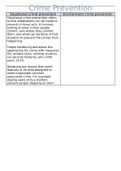
Situational crime prevention refers
to how adaptations can be made to
prevent criminal acts. It involves
looking at what crimes people
commit, and where they commit
them, and what can be done in that
situation to prevent the crimes from
happening.
Target hardening decreases the
opportunity for crime with measures
like window locks, window shutters,
car security features, anti-climb
paint, CCTV.
Designing out means that some
features of an area designed to
make impossible common
associated crime. For example,
sloping seats at bus shelters
prevent people sleeping on them.
Situational crime prevention Environment crime prevention
Situational crime prevention refers
to how adaptations can be made to
prevent criminal acts. It involves
looking at what crimes people
commit, and where they commit
them, and what can be done in that
situation to prevent the crimes from
happening.
Target hardening decreases the
opportunity for crime with measures
like window locks, window shutters,
car security features, anti-climb
paint, CCTV.
Designing out means that some
features of an area designed to
make impossible common
associated crime. For example,
sloping seats at bus shelters
prevent people sleeping on them.