
B1 – You and your genes
B1.1 What are genes and how do they affect the way that organisms develop?
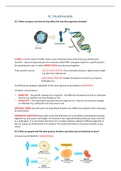
A GENE is a short section of DNA. Genes carry instructions that control how you develop and
function – they are long molecules of a molecule called DNA. Each gene codes for a specific protein
by specifying the order in which AMINO ACIDS must be joined together.
These proteins can be: STRUCTURAL PROTEIN: Gives the body structure, rigidity and strength
JJJJJJJJJ E.g. Skin, Hair, Muscles etc
FUNCTIONAL PROTEIN: Enables the body to function E.g. Enzymes,
ffffff Antibodies etc.
The differences between individuals of the same species are described as VARIATIONS.
Variations may be due to:
GENOTYPE – The genetic makeup of an organism. The different characteristics that an individual
inherits, E.g. whether you have dimples or not.
PHENOTYPE – The observable characteristics the organism has. How the environment changes
an individual, E.g. cutting the skin may cause a scar.
IDENTICAL TWINS have the same set of genotype however any differences between them is because
of environment.
CONTINOUS VARIATION shows when some characteristics are controlled by several genes working
together e.g. eye colours and height. For instance it was originally believed that eye colour was due
to a single gene. It is now known that there are a number of genes coding for different pigments in
the iris, mainly on chromosome 15 in humans. This means that there is enormous variation in eye
colour.
B1.2 Why can people look like their parents, brothers and sisters but not identical to them?
A human has 23 PAIRS OF CHROMOSOMES
,Parents pass on their genes to their offspring in their sex cells.
A pair of chromosomes carries the same genes in the same place, on each chromosome within the
pair. However, there are different versions of a gene called ALLELES. These alleles may be the same
(HOMOZYGOUS) on each pair of chromosome, or different (HETROZYGOUS) – For example to give
blue eyes or brown eyes.
Sex cells only contain one chromosome from each pair. When an egg cell and sperm cell join
together, the fertilised egg cell contains 23 pairs of chromosomes. One chromosome in each pair
comes from the mother, the other from the father.
WHICH CHROMOSOME WE GET FROM EACH PAIR IS COMPLETELY RANDOM. THIS MEANS
DIFFERENT CHILDREN IN THE SAME FAMILY WILL EACH GET A DIFFERENT COMBINATION. THIS IS
WHY CHILDREN IN THE SAME FAMILY LOOK A LITTLE LIKE EACH OTHER AND A LITTLE LIKE EACH
PARENT, BUT ARE NOT IDENTICAL TO THEM. THE CHILD WILL SHARE SIMILARITIES WITH ITS
PARENTS DEPENDING ON WHICH CHARACTERISTICS HAVE COME FROM THE FATHER AND WHICH
HAVE COME FROM THE MOTHER AND WHICH ONES ARE DOMINANT AND RECESSIVE.
An allele can be DOMINANT or RECESSIVE
a) An individual with one or both DOMINANT alleles (in a pair of alleles) will show the
associated DOMINANT characteristic.
b) An individual with one RECESSIVE allele (in a pair of alleles) will not show the associated
RECESSIVE characteristic.
c) An individual with both RECESSIVE alleles (in a pair of alleles) will show the associated
RECESSIVE characteristic.
GENETIC DIAGRAMS
It is easiest to follow what is happening with the inheritance of gene characteristics by drawing
genetic diagrams.
FAMILY TREES can be used to trace the inheritance of a characteristic and to work out who must
have been carrying a faulty allele. An example of this:
,When looking at the possibilities of inheriting and allele, we use a Punnett square diagram. This
shows all the possible pairings of alleles from sperm and egg at fertilisation.
For example if a male with a dominant A allele and recessive a allele was to mate with the same
alleles, the following diagram could be drawn:
A a
A AA Aa
a Aa aa
This means that three of the four possible offspring While only one of the four possible
would show the dominant characteristics offspring would be recessive for both
alleles
A Punnett square diagram can also be used to represent how sex is determined. This is because one
of the 23 pairs of chromosomes in a human cell is the sex chromosome. In females the sex
chromosomes are the same – they are both X chromosomes. In males they are different – there is an
X chromosome and a Y chromosome.
X Y
X XX XY
X XX XY
Therefore, 50% of the offspring will be female and 50% male. As the process of
fertilisation is completely random, some families will only have girls whilst
others will only have boys.
, Sex Determination:
The sex of an embryo is determined by a gene on the Y chromosome called the SRY (sex-
determining region Y) gene. If the gene is not present i.e. if there are two X chromosomes present,
the embryo will develop into a female and ovaries will grow. If the gene is present i.e. both an X and
a Y chromosome are present, then testes will begin to develop.
Six weeks after fertilisation, the undifferentiated gonads start producing a hormone called
ADROGEN. Specialised receptors in the developing embryo detect the androgen. This stimulates the
male reproductive organs to grow.
B1.3 How can and should genetic information be used? How can we use our knowledge to prevent
disease?
Different forms of the same gene are called ALLELES. You inherit one allele for each gene from your
father and one allele for each gene from your mother. For example, the gene for eye colour has
alleles for blue eye colour and alleles for brown eye colour. Your eye colour will depend on the
combination of alleles you have inherited from your parents.
Some diseases are inherited from our parents though our genes: they are called GENETIC
DISORDERS. They occur because of faulty or defective alleles.
E.g. CYSTIC FIBROSIS
Cystic fibrosis is caused by a recessive allele. You need to inherit two copies of the faulty allele to be
born with cystic fibrosis. If you have just one copy, you are a CARRIER
You must have 2
recessive alleles to
suffer from the
disorder.
25% will suffer
from CF
25% are healthy
50% are carriers
Cystic fibrosis affects the cell membranes causing a THICK MUCUS to be produced in the lungs, gut
and pancreas.
SYMPTOMS – Thick and sticky mucus
Breathing problems
Chest infections
Difficulty digesting food
B1.1 What are genes and how do they affect the way that organisms develop?
A GENE is a short section of DNA. Genes carry instructions that control how you develop and
function – they are long molecules of a molecule called DNA. Each gene codes for a specific protein
by specifying the order in which AMINO ACIDS must be joined together.
These proteins can be: STRUCTURAL PROTEIN: Gives the body structure, rigidity and strength
JJJJJJJJJ E.g. Skin, Hair, Muscles etc
FUNCTIONAL PROTEIN: Enables the body to function E.g. Enzymes,
ffffff Antibodies etc.
The differences between individuals of the same species are described as VARIATIONS.
Variations may be due to:
GENOTYPE – The genetic makeup of an organism. The different characteristics that an individual
inherits, E.g. whether you have dimples or not.
PHENOTYPE – The observable characteristics the organism has. How the environment changes
an individual, E.g. cutting the skin may cause a scar.
IDENTICAL TWINS have the same set of genotype however any differences between them is because
of environment.
CONTINOUS VARIATION shows when some characteristics are controlled by several genes working
together e.g. eye colours and height. For instance it was originally believed that eye colour was due
to a single gene. It is now known that there are a number of genes coding for different pigments in
the iris, mainly on chromosome 15 in humans. This means that there is enormous variation in eye
colour.
B1.2 Why can people look like their parents, brothers and sisters but not identical to them?
A human has 23 PAIRS OF CHROMOSOMES
,Parents pass on their genes to their offspring in their sex cells.
A pair of chromosomes carries the same genes in the same place, on each chromosome within the
pair. However, there are different versions of a gene called ALLELES. These alleles may be the same
(HOMOZYGOUS) on each pair of chromosome, or different (HETROZYGOUS) – For example to give
blue eyes or brown eyes.
Sex cells only contain one chromosome from each pair. When an egg cell and sperm cell join
together, the fertilised egg cell contains 23 pairs of chromosomes. One chromosome in each pair
comes from the mother, the other from the father.
WHICH CHROMOSOME WE GET FROM EACH PAIR IS COMPLETELY RANDOM. THIS MEANS
DIFFERENT CHILDREN IN THE SAME FAMILY WILL EACH GET A DIFFERENT COMBINATION. THIS IS
WHY CHILDREN IN THE SAME FAMILY LOOK A LITTLE LIKE EACH OTHER AND A LITTLE LIKE EACH
PARENT, BUT ARE NOT IDENTICAL TO THEM. THE CHILD WILL SHARE SIMILARITIES WITH ITS
PARENTS DEPENDING ON WHICH CHARACTERISTICS HAVE COME FROM THE FATHER AND WHICH
HAVE COME FROM THE MOTHER AND WHICH ONES ARE DOMINANT AND RECESSIVE.
An allele can be DOMINANT or RECESSIVE
a) An individual with one or both DOMINANT alleles (in a pair of alleles) will show the
associated DOMINANT characteristic.
b) An individual with one RECESSIVE allele (in a pair of alleles) will not show the associated
RECESSIVE characteristic.
c) An individual with both RECESSIVE alleles (in a pair of alleles) will show the associated
RECESSIVE characteristic.
GENETIC DIAGRAMS
It is easiest to follow what is happening with the inheritance of gene characteristics by drawing
genetic diagrams.
FAMILY TREES can be used to trace the inheritance of a characteristic and to work out who must
have been carrying a faulty allele. An example of this:
,When looking at the possibilities of inheriting and allele, we use a Punnett square diagram. This
shows all the possible pairings of alleles from sperm and egg at fertilisation.
For example if a male with a dominant A allele and recessive a allele was to mate with the same
alleles, the following diagram could be drawn:
A a
A AA Aa
a Aa aa
This means that three of the four possible offspring While only one of the four possible
would show the dominant characteristics offspring would be recessive for both
alleles
A Punnett square diagram can also be used to represent how sex is determined. This is because one
of the 23 pairs of chromosomes in a human cell is the sex chromosome. In females the sex
chromosomes are the same – they are both X chromosomes. In males they are different – there is an
X chromosome and a Y chromosome.
X Y
X XX XY
X XX XY
Therefore, 50% of the offspring will be female and 50% male. As the process of
fertilisation is completely random, some families will only have girls whilst
others will only have boys.
, Sex Determination:
The sex of an embryo is determined by a gene on the Y chromosome called the SRY (sex-
determining region Y) gene. If the gene is not present i.e. if there are two X chromosomes present,
the embryo will develop into a female and ovaries will grow. If the gene is present i.e. both an X and
a Y chromosome are present, then testes will begin to develop.
Six weeks after fertilisation, the undifferentiated gonads start producing a hormone called
ADROGEN. Specialised receptors in the developing embryo detect the androgen. This stimulates the
male reproductive organs to grow.
B1.3 How can and should genetic information be used? How can we use our knowledge to prevent
disease?
Different forms of the same gene are called ALLELES. You inherit one allele for each gene from your
father and one allele for each gene from your mother. For example, the gene for eye colour has
alleles for blue eye colour and alleles for brown eye colour. Your eye colour will depend on the
combination of alleles you have inherited from your parents.
Some diseases are inherited from our parents though our genes: they are called GENETIC
DISORDERS. They occur because of faulty or defective alleles.
E.g. CYSTIC FIBROSIS
Cystic fibrosis is caused by a recessive allele. You need to inherit two copies of the faulty allele to be
born with cystic fibrosis. If you have just one copy, you are a CARRIER
You must have 2
recessive alleles to
suffer from the
disorder.
25% will suffer
from CF
25% are healthy
50% are carriers
Cystic fibrosis affects the cell membranes causing a THICK MUCUS to be produced in the lungs, gut
and pancreas.
SYMPTOMS – Thick and sticky mucus
Breathing problems
Chest infections
Difficulty digesting food


