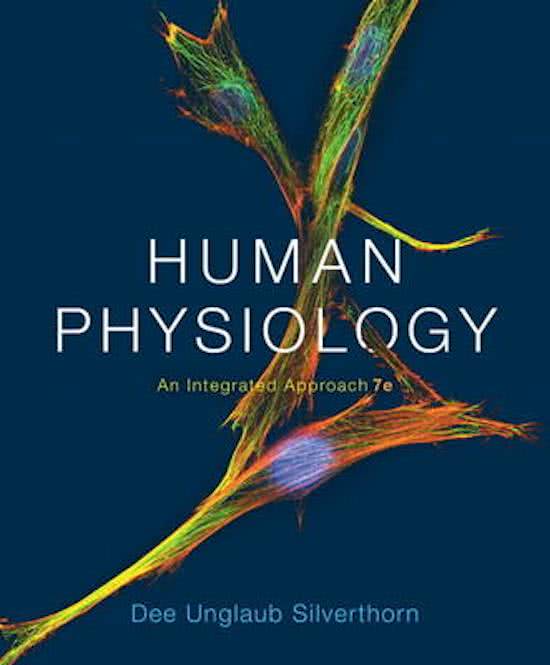
Human Physiology: An Integrated Approach, 7e, Global Edition (Silverthorn)
Chapter 1 Introduction to Physiology
1) Physiology is the study of
A) the structure of the body.
B) the tissues and organs of the body at the microscopic level.
C) growth and reproduction.
D) the normal function of living organisms.
E) the facial features as an indication of personality.
Answer: D
Section: Physiology Is an Integrative Science
Learning Outcome: 1.1
Bloom's Taxonomy: Knowledge
2) The literal meaning of the term physiology is knowledge of
A) organs.
B) nature.
C) science.
D) chemistry.
E) math.
Answer: B
Section: Physiology Is an Integrative Science
Learning Outcome: 1.1
Bloom's Taxonomy: Knowledge
,3) Because anatomy and physiology have different definitions, they are usually
considered separately in studies of the body.
A) True
B) False
Answer: B
Section: Physiology Is an Integrative Science
Learning Outcome: 1.1
Bloom's Taxonomy: Knowledge
,4) The following is a list of several levels of organization that make up the human body.
1. tissue
2. cell
3. organ
4. molecule
5. organism
6. organ system
The correct order from the smallest to the largest is
A) 2, 4, 1, 3, 6, 5.
B) 4, 2, 1, 6, 3, 5.
C) 4, 2, 1, 3, 6, 5.
D) 4, 2, 3, 1, 6, 5.
E) 6, 4, 5, 2, 3, 1.
Answer: C
Section: Physiology Is an Integrative Science
Learning Outcome: 1.2
Bloom's Taxonomy: Knowledge
5) "Glucose is transported from blood into cells because cells require glucose to meet
their energy needs." This type of explanation is
A) mechanistic.
B) theological.
C) teleological.
D) metalogical.
E) scatological.
, Answer: C
Section: Function and Mechanism
Learning Outcome: 1.4
Bloom's Taxonomy: Comprehension
6) "Glucose is transported from blood into cells by transporters in response to insulin."
This type of explanation is
A) mechanistic.
B) theological.
C) teleological.
D) metalogical.
E) scatological.
Answer: A
Section: Function and Mechanism
Learning Outcome: 1.4
Bloom's Taxonomy: Comprehension
Chapter 1 Introduction to Physiology
1) Physiology is the study of
A) the structure of the body.
B) the tissues and organs of the body at the microscopic level.
C) growth and reproduction.
D) the normal function of living organisms.
E) the facial features as an indication of personality.
Answer: D
Section: Physiology Is an Integrative Science
Learning Outcome: 1.1
Bloom's Taxonomy: Knowledge
2) The literal meaning of the term physiology is knowledge of
A) organs.
B) nature.
C) science.
D) chemistry.
E) math.
Answer: B
Section: Physiology Is an Integrative Science
Learning Outcome: 1.1
Bloom's Taxonomy: Knowledge
,3) Because anatomy and physiology have different definitions, they are usually
considered separately in studies of the body.
A) True
B) False
Answer: B
Section: Physiology Is an Integrative Science
Learning Outcome: 1.1
Bloom's Taxonomy: Knowledge
,4) The following is a list of several levels of organization that make up the human body.
1. tissue
2. cell
3. organ
4. molecule
5. organism
6. organ system
The correct order from the smallest to the largest is
A) 2, 4, 1, 3, 6, 5.
B) 4, 2, 1, 6, 3, 5.
C) 4, 2, 1, 3, 6, 5.
D) 4, 2, 3, 1, 6, 5.
E) 6, 4, 5, 2, 3, 1.
Answer: C
Section: Physiology Is an Integrative Science
Learning Outcome: 1.2
Bloom's Taxonomy: Knowledge
5) "Glucose is transported from blood into cells because cells require glucose to meet
their energy needs." This type of explanation is
A) mechanistic.
B) theological.
C) teleological.
D) metalogical.
E) scatological.
, Answer: C
Section: Function and Mechanism
Learning Outcome: 1.4
Bloom's Taxonomy: Comprehension
6) "Glucose is transported from blood into cells by transporters in response to insulin."
This type of explanation is
A) mechanistic.
B) theological.
C) teleological.
D) metalogical.
E) scatological.
Answer: A
Section: Function and Mechanism
Learning Outcome: 1.4
Bloom's Taxonomy: Comprehension