Chromatography
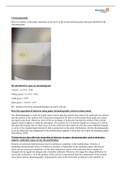
Here is evidence of the paper separation in the form of the actual chromatogram with spots labelled of the
chromatogram.
Rf calculated for spots on chromatogram.
Yellow = 6.5/9.8 = 0.66
Murky green = 8.1/9.8 = 0.82
Light green = 0.88
Dark green = 9.6/9.8 = 0.97
Rf = distance moved by chemical/distance moved by solvent
How the separation of mixtures using paper chromatography work in science based
For chromatography to work the liquid starts to move past the solid & then some of its molecules are sucked
into the surface of the solid & will remain here temporarily for then it will be pulled back again into where
the liquid came from. Moreover, this will be an exchange of molecules between the surface of the solid &
liquid is kind of adhesive called the absorption. The mixture for it is that the liquid as a mixture of it will be
like glue-like liquids, that of which stays in & the solid more than others & why this causes different liquids
to occur to the original liquid mixture & that is spread out on the solid. Furthermore, for the chromatography
to occur effectively the components of the mobile phase separate a lot as they move past the stationary phase
(Woodford, 2020).
Written factors that affect the separation of mixtures in paper chromatography such as molecular
polarity, molecular mass, etc use the specification
Polarity of molecules/intermolecular forces in relation to solubility in the mobile phase. Polarity of
molecules/intermolecular forces in relation to retention of molecules in the stationary phase, this has an
effect on how attracted a chemical is to the other substances. Some of the molecules have a positively
charged side & negatively charged side of another molecule. Moreover, the larger the charge difference &
more polar molecule is, so as the polarity of the solvent is increased & then the components of the mixture
move faster during chromatography, impacting the sizes of the molecules in relation to the solubility &
, mobility. Larger molecules take longer to move up the chromatography paper & the smaller molecules are
mobile, the interpretation of chromatograms in terms of the number of substances present & the Rf values of
components, there was four substances produced, this is an indication how soluble the particular pigment is
in the solvent. The yellow substance had a smaller Rf value (0.66), meaning the small Rf values tend to
indicate larger less soluble pigments & dark green had a higher Rf value (0.97). Usually, the two pigments
move on the paper & two pigments with the same Rf value are likely to be identical. The larger an Rf of a
compound the larger the distance it travels on the TLC (Thin Layer Chromatography) plate & when
comparing with two different compounds run under identical chromatography conditions, so what occurs is
that the larger the Rf is less polar, because it interacts less strongly with the polar absorbent on the TLC
plate. Partially in paper chromatography that is the stationary phase. Typically, the mobile phase may be an
aqueous liquid or non-aqueous organic solvent. What happens is that the organic solvent, as there will be a
dynamic equilibrium between the stationary phase & the mobile phase. As it depends upon how strongly
attracted the chemicals are to the mobile & stationary phases. Different components will travel at different
rates (Unit 2, 2020).
Evaluate the paper chromatography experiment you did
The aim of the experiment was to separate the plant pigments in spinach using paper chromatograph, the
methods, so I would have liked the spinach to be a bit pigmented so if I added a bit more spinach which
would have made it more pigmented and the chromatography colours to be separated better. I think how
much I grinded in the mortar was good, however I think some of the solids from the solution had went into
the green liquid, so I wanted the green liquid to be rich in deep green colour. I think the spinach is I had
maybe used tissues to put the solid in and squeezed out to remove the solid spinach grinded in would have
given a better deep green liquid. I think also if I shake it vigorously at time intervals would have been better
and the lighting wasn’t that great so it was quite hard to see the layers, maybe if I used my phones flashlight,
I would have seen them clearer. Also, by running the bright green hexane layer should have been done at the
right moment, as I could tell some of the layers did go in the beaker. I did use a ruler to accurately measure
the drawing the pencil line. I think I should have added a bit more drops so that the separation occurred the
colours could have been seen clearly. I made sure that it was dry the chromatography. Paper, so that it
wouldn’t have linked into the paper. By slipping the paper in the tank was good, that it was small, and the
paper did hang on to it better, the lid helped to show the colours. By suspending it into the tank, I should
have had a clip to have ensured that it was in the water better. Also, by removing the chromatography paper
and circling the chromatogram with pencil did ensure that the colours weren’t blended if it was done with a
regular pen, & by doing so helped to calculate the Rf value. My practical was pretty accurate because
spinach usually produce four colours which mine had. The paper is the stationary phase because it doesn’t
move allowing the solvent the mobile phase to move in the paper and causing the spots to rise up & so the
spinach is not a pure substance because it consists of more than one substances, as the paper chromatography
works because each of the chemical in the mixture will be attracted to the stationary phase to a different
extent, which means that the chemicals are not as attracted to the stationary and will not move very far,
however the spinach as it contained a lot of substances did move far. So, the chemicals that are only weakly
attracted will move further up the paper. If maybe I used a different solvent, it might have not gone up so far.
The Rf values will help to tell us the identity of the chemical & this shows an uncertainty of the following
substances.
Suggest possible improvements to the procedure
The ways to improve is that if the concentration of the sample was a bit more concentrated, so maybe tearing
more than three spinach leaves into more tinier pieces, when adding the crushed spinaches into the mortar is
to make sure that before grinding it to add the propanone and the small pinch of sand and making sure that a
lot wasn’t used to make it very gritty, when pouring the liquid into a small beaker. I would have used maybe
a tissue or towel to squish out the liquid and leave all the solid pieces behind. That was interpreting the
chromatogram as the colours were smudged in, and there were many green pigments it was kind of hard to
identify them, adding less green liquid into the chromatography paper, it was distributing paper during the
development of the paper. If I had maybe used a lid that would sit perfectly on top of the tank, without using
aluminium foil which caused the chromatography paper to move around a lot & making sure that the paper
did not touch the sides of the chromatography tank, the good thing was that mine was small, so the
chromatography paper fit perfectly into the tank. I used 6 drops of green plant extract, this helped to make
Here is evidence of the paper separation in the form of the actual chromatogram with spots labelled of the
chromatogram.
Rf calculated for spots on chromatogram.
Yellow = 6.5/9.8 = 0.66
Murky green = 8.1/9.8 = 0.82
Light green = 0.88
Dark green = 9.6/9.8 = 0.97
Rf = distance moved by chemical/distance moved by solvent
How the separation of mixtures using paper chromatography work in science based
For chromatography to work the liquid starts to move past the solid & then some of its molecules are sucked
into the surface of the solid & will remain here temporarily for then it will be pulled back again into where
the liquid came from. Moreover, this will be an exchange of molecules between the surface of the solid &
liquid is kind of adhesive called the absorption. The mixture for it is that the liquid as a mixture of it will be
like glue-like liquids, that of which stays in & the solid more than others & why this causes different liquids
to occur to the original liquid mixture & that is spread out on the solid. Furthermore, for the chromatography
to occur effectively the components of the mobile phase separate a lot as they move past the stationary phase
(Woodford, 2020).
Written factors that affect the separation of mixtures in paper chromatography such as molecular
polarity, molecular mass, etc use the specification
Polarity of molecules/intermolecular forces in relation to solubility in the mobile phase. Polarity of
molecules/intermolecular forces in relation to retention of molecules in the stationary phase, this has an
effect on how attracted a chemical is to the other substances. Some of the molecules have a positively
charged side & negatively charged side of another molecule. Moreover, the larger the charge difference &
more polar molecule is, so as the polarity of the solvent is increased & then the components of the mixture
move faster during chromatography, impacting the sizes of the molecules in relation to the solubility &
, mobility. Larger molecules take longer to move up the chromatography paper & the smaller molecules are
mobile, the interpretation of chromatograms in terms of the number of substances present & the Rf values of
components, there was four substances produced, this is an indication how soluble the particular pigment is
in the solvent. The yellow substance had a smaller Rf value (0.66), meaning the small Rf values tend to
indicate larger less soluble pigments & dark green had a higher Rf value (0.97). Usually, the two pigments
move on the paper & two pigments with the same Rf value are likely to be identical. The larger an Rf of a
compound the larger the distance it travels on the TLC (Thin Layer Chromatography) plate & when
comparing with two different compounds run under identical chromatography conditions, so what occurs is
that the larger the Rf is less polar, because it interacts less strongly with the polar absorbent on the TLC
plate. Partially in paper chromatography that is the stationary phase. Typically, the mobile phase may be an
aqueous liquid or non-aqueous organic solvent. What happens is that the organic solvent, as there will be a
dynamic equilibrium between the stationary phase & the mobile phase. As it depends upon how strongly
attracted the chemicals are to the mobile & stationary phases. Different components will travel at different
rates (Unit 2, 2020).
Evaluate the paper chromatography experiment you did
The aim of the experiment was to separate the plant pigments in spinach using paper chromatograph, the
methods, so I would have liked the spinach to be a bit pigmented so if I added a bit more spinach which
would have made it more pigmented and the chromatography colours to be separated better. I think how
much I grinded in the mortar was good, however I think some of the solids from the solution had went into
the green liquid, so I wanted the green liquid to be rich in deep green colour. I think the spinach is I had
maybe used tissues to put the solid in and squeezed out to remove the solid spinach grinded in would have
given a better deep green liquid. I think also if I shake it vigorously at time intervals would have been better
and the lighting wasn’t that great so it was quite hard to see the layers, maybe if I used my phones flashlight,
I would have seen them clearer. Also, by running the bright green hexane layer should have been done at the
right moment, as I could tell some of the layers did go in the beaker. I did use a ruler to accurately measure
the drawing the pencil line. I think I should have added a bit more drops so that the separation occurred the
colours could have been seen clearly. I made sure that it was dry the chromatography. Paper, so that it
wouldn’t have linked into the paper. By slipping the paper in the tank was good, that it was small, and the
paper did hang on to it better, the lid helped to show the colours. By suspending it into the tank, I should
have had a clip to have ensured that it was in the water better. Also, by removing the chromatography paper
and circling the chromatogram with pencil did ensure that the colours weren’t blended if it was done with a
regular pen, & by doing so helped to calculate the Rf value. My practical was pretty accurate because
spinach usually produce four colours which mine had. The paper is the stationary phase because it doesn’t
move allowing the solvent the mobile phase to move in the paper and causing the spots to rise up & so the
spinach is not a pure substance because it consists of more than one substances, as the paper chromatography
works because each of the chemical in the mixture will be attracted to the stationary phase to a different
extent, which means that the chemicals are not as attracted to the stationary and will not move very far,
however the spinach as it contained a lot of substances did move far. So, the chemicals that are only weakly
attracted will move further up the paper. If maybe I used a different solvent, it might have not gone up so far.
The Rf values will help to tell us the identity of the chemical & this shows an uncertainty of the following
substances.
Suggest possible improvements to the procedure
The ways to improve is that if the concentration of the sample was a bit more concentrated, so maybe tearing
more than three spinach leaves into more tinier pieces, when adding the crushed spinaches into the mortar is
to make sure that before grinding it to add the propanone and the small pinch of sand and making sure that a
lot wasn’t used to make it very gritty, when pouring the liquid into a small beaker. I would have used maybe
a tissue or towel to squish out the liquid and leave all the solid pieces behind. That was interpreting the
chromatogram as the colours were smudged in, and there were many green pigments it was kind of hard to
identify them, adding less green liquid into the chromatography paper, it was distributing paper during the
development of the paper. If I had maybe used a lid that would sit perfectly on top of the tank, without using
aluminium foil which caused the chromatography paper to move around a lot & making sure that the paper
did not touch the sides of the chromatography tank, the good thing was that mine was small, so the
chromatography paper fit perfectly into the tank. I used 6 drops of green plant extract, this helped to make