OMM from DK(Medical Terminology;
PHYSIOLOGY; MED SURG Nursing,final exam study latest 2022
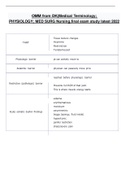
Tissue texture changes
TART Asymme
Restriction
Tendernessst
Physiologic barrier pt can actively move to
Anatomic barrier physican can passively move pt to
reached before physiologic barrier
Restrictive (pathologic) barrier
Prevents full ROM of that joint
This is where muscle energy starts
edema
erythematous
moisture
asymmetric
Acute somatic dysfxn findings
boggy (spongy, fluid inside)
hypertonic
painful restriction
sharp/severe pain
, no edema
cool
dry
Chronic somatic dysfxn fibrotic, roppy, rubbery
findings decreased mm tone, flaccid, fibrotic
compensated body
painless restriction
dull/achy/burning pain
L (type 1) N
if sidebend R without flex/ext,
which rotation?
occurs in groups
R (type 2) F/E
if sidebend R with flex/ext,
which rotation?
occurs individually
by the position of EASE
how is somatic dysfxn named?
if neck is restricted in Flexion (symmetry restored in
Extension), name: extende d
Cervical: BUM (backward, upward, medial)
Orientation of superior facets Thoracic: BUL
Lumbar: BM
medial 1/3 clavicle + sternum
where is SCM attached?
accessory n
innervation of SCM?
Action? sidebend toward
rotate away
, extend and rotate toward (sidebending not
ME for SCM
included in initial set up)
OA: flexion and extension
AA: rotation
Main motions of cervical
C2-C4: rotation
C5-C7: sidebending
OA: always opposite ("O" opposite)
SB and rotation patterns of AA: none, just rotation
cervical C2-C4: same (pseudo type 1)
C5-C7: same
What is the main motion of the Rotation
thoracic spine?
spine of scapula: T3
T level shortcut with scapula
angle of scapula: T7
T1 to 3 = 0 up
T4 to 6 =1/2 up
T7 to 9 = 1 up
T10 = 1 up
rules of three for thorax
T11= 1/2 up
T12 = 0 up
ex: T7 transverse process is located at T6 spinous
process (1 above) bc spinous process is long
PHYSIOLOGY; MED SURG Nursing,final exam study latest 2022
Tissue texture changes
TART Asymme
Restriction
Tendernessst
Physiologic barrier pt can actively move to
Anatomic barrier physican can passively move pt to
reached before physiologic barrier
Restrictive (pathologic) barrier
Prevents full ROM of that joint
This is where muscle energy starts
edema
erythematous
moisture
asymmetric
Acute somatic dysfxn findings
boggy (spongy, fluid inside)
hypertonic
painful restriction
sharp/severe pain
, no edema
cool
dry
Chronic somatic dysfxn fibrotic, roppy, rubbery
findings decreased mm tone, flaccid, fibrotic
compensated body
painless restriction
dull/achy/burning pain
L (type 1) N
if sidebend R without flex/ext,
which rotation?
occurs in groups
R (type 2) F/E
if sidebend R with flex/ext,
which rotation?
occurs individually
by the position of EASE
how is somatic dysfxn named?
if neck is restricted in Flexion (symmetry restored in
Extension), name: extende d
Cervical: BUM (backward, upward, medial)
Orientation of superior facets Thoracic: BUL
Lumbar: BM
medial 1/3 clavicle + sternum
where is SCM attached?
accessory n
innervation of SCM?
Action? sidebend toward
rotate away
, extend and rotate toward (sidebending not
ME for SCM
included in initial set up)
OA: flexion and extension
AA: rotation
Main motions of cervical
C2-C4: rotation
C5-C7: sidebending
OA: always opposite ("O" opposite)
SB and rotation patterns of AA: none, just rotation
cervical C2-C4: same (pseudo type 1)
C5-C7: same
What is the main motion of the Rotation
thoracic spine?
spine of scapula: T3
T level shortcut with scapula
angle of scapula: T7
T1 to 3 = 0 up
T4 to 6 =1/2 up
T7 to 9 = 1 up
T10 = 1 up
rules of three for thorax
T11= 1/2 up
T12 = 0 up
ex: T7 transverse process is located at T6 spinous
process (1 above) bc spinous process is long