
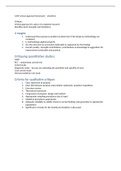
CASP critical appraisal framework – checklists
Critique:
Critical appraisal of a piece of completed research
Identifies both strengths and limitations
4 stages:
1. Understand the purpose & problem & determine if the design & methodology are
consistent
2. Is methodology applied properly
3. Are the outcomes & conclusions believable & supported by the findings
4. Overall, quality, strengths & limitations, contributions to knowledge & suggestions for
improvement achievable and practical.
Critiquing quantitative studies:
CASP :
RCT – randomised control trial
Cohort study
Diagnostic study – focuses on estimating the sensitivity and specifity of tests
Case control study
Clinical prediction rule study
Criteria for qualitative critique:
1. Clear statement of purpose
2. Clear link between purpose and problem statement/ question/ hypothesis
3. Literature review
4. Theoretical framework
5. Congruence of purpose, design and method
6. Appropriate sampling procedures (size & type)
7. Statistical procedures appropriate
8. Adequate reliability & validity checks to accept findings and generalise to appropriate
populations
9. Significance of study for the healthcare discipline is discussed
,
Critique:
Critical appraisal of a piece of completed research
Identifies both strengths and limitations
4 stages:
1. Understand the purpose & problem & determine if the design & methodology are
consistent
2. Is methodology applied properly
3. Are the outcomes & conclusions believable & supported by the findings
4. Overall, quality, strengths & limitations, contributions to knowledge & suggestions for
improvement achievable and practical.
Critiquing quantitative studies:
CASP :
RCT – randomised control trial
Cohort study
Diagnostic study – focuses on estimating the sensitivity and specifity of tests
Case control study
Clinical prediction rule study
Criteria for qualitative critique:
1. Clear statement of purpose
2. Clear link between purpose and problem statement/ question/ hypothesis
3. Literature review
4. Theoretical framework
5. Congruence of purpose, design and method
6. Appropriate sampling procedures (size & type)
7. Statistical procedures appropriate
8. Adequate reliability & validity checks to accept findings and generalise to appropriate
populations
9. Significance of study for the healthcare discipline is discussed
,


