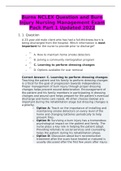
Burns NCLEX Question and Burn Injury Nursing Management Exam Pack Part 1 Updated 2022
1. 1. Question A 23-year-old male client who has had a full-thickness burn is being discharged from the hospital. Which information is most important for the nurse to provide prior to discharge? o A. How to maintain home smoke detectors o B. Joining a community reintegration program o C. Learning to perform dressing changes o D. Options available for scar removal Correct Answer: C. Learning to perform dressing changes Teaching the patient and his family to perform dressing changes is critical for the goal of progression towards independence. Proper management of burn injury through proper dressing changes helps prevent wound deterioration. Encouragement of the patient and his family members in participating in dressing changes and wound care helps prepare for the patient’s eventual discharge and home care needs. All other choices (below) are important during the rehabilitation stage but dressing changes is a priority. • Option A: Teach on the importance of installing and maintaining smoke detectors on every level of the home and changing batteries periodically to help prevent fires. • Option B: Surviving a burn injury has a tremendous psychological impact on the patient and family. The nurse plays a key role in helping the patient adapt. Providing referrals to social services and counseling helps the patient during his rehabilitation phase. • Option D: Discussion about burn reconstruction treatment after the scars have healed or matured is usually discussed after the first few years after injury. This option is often used to “improve both the function and the cosmetic appearance of burn scars”. 2. 2. Question A client who is admitted after a thermal burn injury has the following vital signs: blood pressure, 70/40; heart rate, 140 beats/min; respiratory rate, 25/min. He is pale in color and it is difficult to find pedal pulses. Which action will the nurse take first? • A. Start intravenous fluids. • B. Check the pulses using a Doppler device. • C. Obtain a complete blood count (CBC). • D. Obtain an electrocardiogram (ECG). Correct Answer: A. Start intravenous fluids. Hypovolemic shock is a common cause of death in the emergent phase of clients with serious injuries. Administration of fluids can treat this problem. For burns classified as severe ( 20% TBSA), fluid resuscitation should be initiated to maintain urine output 0.5 mL/kg/hour. • Option C: Following a severe burn injury, significant hematologic changes occur that are reflected in complete blood count (CBC) measurements. A CBC will be taken to ascertain if a cardiac or bleeding problem is causing these vital signs. However, these are not actions that the nurse would take immediately. • Option B: Checking pulses would indicate perfusion to the periphery but this is not an immediate nursing action. Carefully check pulses in any extremity with circumferential burns. These burns can act as tourniquets as burn-associated edema begins, leading to compartment syndrome. • Option D: In patients with extensive burns, it is sometimes a challenge to monitor the ECG, because the lack of natural skin and application of protective ointments prevent the adherence of the ECG discs.
Document information
- Uploaded on
- March 9, 2022
- Number of pages
- 19
- Written in
- 2021/2022
- Type
- Exam (elaborations)
- Contains
- Questions & answers