Gene Expression and Protein Synthesis
Nucleic Acids
DNA
Deoxyribonucleic acid is a nucleic acid known as DNA which
exists in all living cells. DNA is the source of all genetic
information for the organism that the cells make up. As DNA
is the source of genetic information, it stores the information
to produce (code for) proteins, which are then responsible for
building cells and structures within the body. DNA is specialised to carry out its function. Every cell must contain DNA
as without it, the cell could not function. DNA is a large molecule, meaning it is too big to be able to leave the cell.
DNA is a polymer made up of nucleotides. The nucleotides are bonded together to form a polymer via a
phosphodiester bond which is formed after a condensation reaction takes place.
Each nucleotide that forms the polymer is made up of a phosphate group,
a pentose sugar, and a base. In DNA, the phosphate group is ‘deoxyribose’
and the base can be any of the following bases: guanine, thymine,
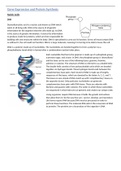
adenine or cytosine. The structure of DNA is referred to as a double helix.
The double helix consists of two polynucleotide units which are bonded
together via hydrogen bonds. These hydrogen bonds exist between the
complementary base pairs. Each strand of DNA is made up of lengthy
sequences of the bases, which are denoted by the letters A, C, G, and T.
The bases on one strand of DNA match up with 'complimentary' bases on
the opposite strand. Only particular nucleotides can generate
complementary base pairs with DNA bases. These are adenine with
thymine and guanine with cytosine. The order in which these nucleotides
are sequenced is what instructs our genome and creates our unique code.
Living organisms require DNA because it holds the genetic instructions
that allow them to 'be the way they are,' survive, develop, and reproduce.
Life forms require RNA because DNA must be processed in order to
perform these functions. The molecule RNA aids in the conversion of DNA
to proteins. The proteins are a by-product of the organism's DNA.
, RNA
RNA (ribonucleic acid) carries information. RNA is a molecule that transports genetic information from DNA to
ribosomes, where it can be translated into proteins. Both RNA and DNA are nucleotide-based polymers. Because of a
phosphodiester bond formed following a condensation reaction, the nucleotides are joined together to form a
polymer. A pentose sugar, phosphate group, and base make up a nucleotide. The phosphate group of an RNA
nucleotide is ribose, and the base is either adenine, cytosine, guanine, or uracil.
Like DNA, RNA is also specialised to carry out its function as it’s a smaller molecule, enabling it to leave the cell.
The structure of RNA is different to that of DNA as it consists of a single strand of nucleotides and has a base called
uracil which replaces thymine. DNA does not have this base.
mRNA
mRNA (messenger RNA) is a type of RNA that is single stranded. It is an RNA version of the gene, except is leaves the
nucleus of the cell and moves into the cytoplasm, which is where proteins are produced.
tRNA
tRNA (transfer RNA) has a clover-leaf shape. It is single-stranded but folds due to its base pairing to form this clover-
leaf shape. It translates the genetic information into protein sequences by delivering amino acids to the protein
synthesis during translation.
rRNA
rRNA (ribosomal RNA) has a specific structure known as nucleoli. These are dense, spherical shapes. It helps to
translate the information in mRNA into proteins.
SiRNA
SiRNA (small interfering RNA) is double stranded, short, and around 20-25 nucleotides long. It is also artificially
synthesised. They are cured in molecular biology and synthesised to reduce or stop the translation of particular
messenger RNAs. This is to prevent or reduce the synthesis of certain proteins.
Nucleic Acids
DNA
Deoxyribonucleic acid is a nucleic acid known as DNA which
exists in all living cells. DNA is the source of all genetic
information for the organism that the cells make up. As DNA
is the source of genetic information, it stores the information
to produce (code for) proteins, which are then responsible for
building cells and structures within the body. DNA is specialised to carry out its function. Every cell must contain DNA
as without it, the cell could not function. DNA is a large molecule, meaning it is too big to be able to leave the cell.
DNA is a polymer made up of nucleotides. The nucleotides are bonded together to form a polymer via a
phosphodiester bond which is formed after a condensation reaction takes place.
Each nucleotide that forms the polymer is made up of a phosphate group,
a pentose sugar, and a base. In DNA, the phosphate group is ‘deoxyribose’
and the base can be any of the following bases: guanine, thymine,
adenine or cytosine. The structure of DNA is referred to as a double helix.
The double helix consists of two polynucleotide units which are bonded
together via hydrogen bonds. These hydrogen bonds exist between the
complementary base pairs. Each strand of DNA is made up of lengthy
sequences of the bases, which are denoted by the letters A, C, G, and T.
The bases on one strand of DNA match up with 'complimentary' bases on
the opposite strand. Only particular nucleotides can generate
complementary base pairs with DNA bases. These are adenine with
thymine and guanine with cytosine. The order in which these nucleotides
are sequenced is what instructs our genome and creates our unique code.
Living organisms require DNA because it holds the genetic instructions
that allow them to 'be the way they are,' survive, develop, and reproduce.
Life forms require RNA because DNA must be processed in order to
perform these functions. The molecule RNA aids in the conversion of DNA
to proteins. The proteins are a by-product of the organism's DNA.
, RNA
RNA (ribonucleic acid) carries information. RNA is a molecule that transports genetic information from DNA to
ribosomes, where it can be translated into proteins. Both RNA and DNA are nucleotide-based polymers. Because of a
phosphodiester bond formed following a condensation reaction, the nucleotides are joined together to form a
polymer. A pentose sugar, phosphate group, and base make up a nucleotide. The phosphate group of an RNA
nucleotide is ribose, and the base is either adenine, cytosine, guanine, or uracil.
Like DNA, RNA is also specialised to carry out its function as it’s a smaller molecule, enabling it to leave the cell.
The structure of RNA is different to that of DNA as it consists of a single strand of nucleotides and has a base called
uracil which replaces thymine. DNA does not have this base.
mRNA
mRNA (messenger RNA) is a type of RNA that is single stranded. It is an RNA version of the gene, except is leaves the
nucleus of the cell and moves into the cytoplasm, which is where proteins are produced.
tRNA
tRNA (transfer RNA) has a clover-leaf shape. It is single-stranded but folds due to its base pairing to form this clover-
leaf shape. It translates the genetic information into protein sequences by delivering amino acids to the protein
synthesis during translation.
rRNA
rRNA (ribosomal RNA) has a specific structure known as nucleoli. These are dense, spherical shapes. It helps to
translate the information in mRNA into proteins.
SiRNA
SiRNA (small interfering RNA) is double stranded, short, and around 20-25 nucleotides long. It is also artificially
synthesised. They are cured in molecular biology and synthesised to reduce or stop the translation of particular
messenger RNAs. This is to prevent or reduce the synthesis of certain proteins.