
SÍNDROME
MENINGEO
Pertenece a: ___________________
, lOMoAR cPSD| 11823286
SÍNDROME MENINGEO
DEFINICIÓN
- Cuadro muy agudo que suele ocurrir en 24-48 horas.
- Conjunto de signos y síntomas que traducen la existencia de un proceso irritativo,
generalmente inflamatorio, a nivel de las leptomeninges durante el cual se pueden dañar
también vasos y nervios que discurren por el espacio subarcnoideo.
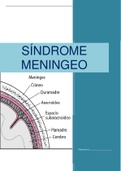
Leptomeninges: Cubiertas del encéfalo. Son tres: Duramadre, aracnoides y piamadre.
Aracnoides( Def.): Meninge intermedia que protege al SNC (encéfalo y médula espinal). Se
encuentra por debajo de la duramadre i por encima de la piamadre.
ETIOLOGIA ( causa de la enfermedad)
A. Infecciones=> Meningitis
o Bacterianas**( Meningococo(contagioso), Neumococo, H. Influenze, BGN, Listeria,
Mycroplasma, Estafilococos, Esterococos del grupo B..).
o Víricas**( Enterovirus, VIH, Virus Herpes…).
o Espiroquetas(Trepopnema pallidum…).
o Parásitos.
o Focos parameningeos** Es importante decir que la meningitis puede ser causada
por la complicación de otro proceso. Ej: Abscesos, Mastoiditis, Sinusitis, Trombosis
venosa intracraneal.
o Endocarditis bacteriana**: Infección de las valvas del corazón. Se suelen diagnosticar
en gente con alteraciones previas de las valvas. No suele dar un cuadro clínico claro.
o Sepsis ( origen orinario o pulmonar).
B. Hemorragias : Pueden ser intracerebrales(dentro del cerebro) o subaracnoidea( por
debajo del aracnoides).
o H. Subaracnoidea**: Se rompe un aneurisma o malformación arterial a nivel cerebral.
La persona sangra a nivel del espacio subaracnoideo y desenvolupa una hemorrágia
cerebral.
o H. Subdural: Normalmente por traumatismo.
o H epidural.
C. Neoplasias cerebrales primarias y metastasicas. (Complicaciones en algún cáncer).
D. Otras
o Meningitis química
o Meningitis por fármacos.
Espiroquetas(def.): Filo de bacterias gram-negativas que poseen unas características
morfológicas y unos órganos de locomoción que les diferencian del resto de las bacterias.
SÍNTOMAS Y SIGNOS DE SOSPECHA
- Cefalea y/o
- Fiebre
- Rigidez de nuca**: La persona no es capaz de tocar con la punta de la barbilla el
esternón.
MENINGEO
Pertenece a: ___________________
, lOMoAR cPSD| 11823286
SÍNDROME MENINGEO
DEFINICIÓN
- Cuadro muy agudo que suele ocurrir en 24-48 horas.
- Conjunto de signos y síntomas que traducen la existencia de un proceso irritativo,
generalmente inflamatorio, a nivel de las leptomeninges durante el cual se pueden dañar
también vasos y nervios que discurren por el espacio subarcnoideo.
Leptomeninges: Cubiertas del encéfalo. Son tres: Duramadre, aracnoides y piamadre.
Aracnoides( Def.): Meninge intermedia que protege al SNC (encéfalo y médula espinal). Se
encuentra por debajo de la duramadre i por encima de la piamadre.
ETIOLOGIA ( causa de la enfermedad)
A. Infecciones=> Meningitis
o Bacterianas**( Meningococo(contagioso), Neumococo, H. Influenze, BGN, Listeria,
Mycroplasma, Estafilococos, Esterococos del grupo B..).
o Víricas**( Enterovirus, VIH, Virus Herpes…).
o Espiroquetas(Trepopnema pallidum…).
o Parásitos.
o Focos parameningeos** Es importante decir que la meningitis puede ser causada
por la complicación de otro proceso. Ej: Abscesos, Mastoiditis, Sinusitis, Trombosis
venosa intracraneal.
o Endocarditis bacteriana**: Infección de las valvas del corazón. Se suelen diagnosticar
en gente con alteraciones previas de las valvas. No suele dar un cuadro clínico claro.
o Sepsis ( origen orinario o pulmonar).
B. Hemorragias : Pueden ser intracerebrales(dentro del cerebro) o subaracnoidea( por
debajo del aracnoides).
o H. Subaracnoidea**: Se rompe un aneurisma o malformación arterial a nivel cerebral.
La persona sangra a nivel del espacio subaracnoideo y desenvolupa una hemorrágia
cerebral.
o H. Subdural: Normalmente por traumatismo.
o H epidural.
C. Neoplasias cerebrales primarias y metastasicas. (Complicaciones en algún cáncer).
D. Otras
o Meningitis química
o Meningitis por fármacos.
Espiroquetas(def.): Filo de bacterias gram-negativas que poseen unas características
morfológicas y unos órganos de locomoción que les diferencian del resto de las bacterias.
SÍNTOMAS Y SIGNOS DE SOSPECHA
- Cefalea y/o
- Fiebre
- Rigidez de nuca**: La persona no es capaz de tocar con la punta de la barbilla el
esternón.


