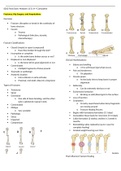
6202 Final Exam: Modules 13 & 14 + Cumulative
Fractures, Hip Surgery, and Amputations
Overview
Fracture: disruption or break in the continuity of
bone structure
Causes:
o Trauma
o Pathological (infection, steroids,
chemotherapy)
Fracture Classifications
Closed (simple) or open (compound)
o Have they broken through the skin?
Incomplete or complete
o Is the entire bone broken across or not?
Displaced or non-displaced Clinical Manifestations:
o Is the bone still in good alignment or not
Comminuted Edema and swelling
o Multiple fragments of bone present o r/t to soft tissue injury that occurs
Traumatic or pathologic Pain and tenderness
Anatomic location o On palpation
o Intra-articular or extra-articular Muscle spasm
o Proximal, mid-shaft, distal of a long bone o As the body tries to keep bone in proper
alignment
Types of Fractures Deformity
o Can be extremely obvious or not
Transverse
Ecchymosis/contusion
Spiral
o Bruising as subQ blood gets to the surface
Greenstick
o One side of bone bending, and the other Loss of function
Crepitation
side is splintered; typical in kids
o Crunchy sound heard when bony fragments
Comminuted
Oblique are moving around
o Very unstable o Fracture Healing Process
Pathologic Begins with hematoma formation (2-3 days)
Stress Granulation tissue-basis for new bone (3-14 days)
Impacted Callus formation (2 weeks); ossifies in 3 weeks-6
Compression months
Remodeling-callus reabsorbs (up to 1 year for
complete healing)
Gradual weight bearing over time
Factors
That Influence Fracture Healing
, 6202 Final Exam: Modules 13 & 14 + Cumulative
Age Circulation (color)
Infection o Distal pulses
Nutrition o Temperature
Electrical stimulation o Capillary refill time
o Can help with healing Motion (mobility)
o Use small electrical currents to enhance o ROM distal to fracture
activity of calcium in the area o Muscle spasms
Displacement Sensation (neurologic injury)
Site (poor blood supply) o Pain and/or acute tenderness
Immobilization o Loss of sensation to body parts
o Patient taking splint off before they should
Implants Alternate Neurovascular Assessment Methods
Fracture Healing CTMPS
o Color, temperature, mobility, pain,
Can take time – up to a year sensation
Do x-ray to determine how much bony healing has 5 P’s of fracture assessment
occurred → if bone can maintain mild stress, they o Pain
will remove the cast o Pulselessness
Fracture healing may o Pallor
o Not occur in the expected time – delayed o Paresthesia
union o Paralysis
o Not occur at all – nonunion
Healing time increases with age Laboratory/Diagnostic
Fracture Assessment Imaging: x-ray, CT, MRI
o Preferred method
Healthy history o May need repeat studies or other types of
o Past health
imaging
o Meds CBCs
o Surgery/treatments o Done with significant amount of
General hemorrhage or inflammatory response
o Pain? Electrolytes (↑ K+)
Integumentary o d/t muscle tissue necrosis and leakage of K+
o Warm, bruised, pale? out of cells
Cardiovascular Urinalysis
o Perfusion? o Crushing injury – myoglobinuria
Neurovascular Arteriogram
o Sensory changes or paresthesias? o If pulses are not present
Musculoskeletal
o Are they guarding or splinting/protecting Fracture Management
the region of the fracture? Initial care:
Examples of specific fracture findings: o ABCs
o Hip, proximal femur – shortening with
o Immobilize with cast or splint
external rotation of leg
Compound fracture – sterile
o Femur (mid-shaft, distal) – possible
dressing on open wound (or
shortening with internal or external rotation cleanest material available)
of leg o Neurovascular exam
CMS (Neurovascular) Checks Pharmacologic therapy:
Fractures, Hip Surgery, and Amputations
Overview
Fracture: disruption or break in the continuity of
bone structure
Causes:
o Trauma
o Pathological (infection, steroids,
chemotherapy)
Fracture Classifications
Closed (simple) or open (compound)
o Have they broken through the skin?
Incomplete or complete
o Is the entire bone broken across or not?
Displaced or non-displaced Clinical Manifestations:
o Is the bone still in good alignment or not
Comminuted Edema and swelling
o Multiple fragments of bone present o r/t to soft tissue injury that occurs
Traumatic or pathologic Pain and tenderness
Anatomic location o On palpation
o Intra-articular or extra-articular Muscle spasm
o Proximal, mid-shaft, distal of a long bone o As the body tries to keep bone in proper
alignment
Types of Fractures Deformity
o Can be extremely obvious or not
Transverse
Ecchymosis/contusion
Spiral
o Bruising as subQ blood gets to the surface
Greenstick
o One side of bone bending, and the other Loss of function
Crepitation
side is splintered; typical in kids
o Crunchy sound heard when bony fragments
Comminuted
Oblique are moving around
o Very unstable o Fracture Healing Process
Pathologic Begins with hematoma formation (2-3 days)
Stress Granulation tissue-basis for new bone (3-14 days)
Impacted Callus formation (2 weeks); ossifies in 3 weeks-6
Compression months
Remodeling-callus reabsorbs (up to 1 year for
complete healing)
Gradual weight bearing over time
Factors
That Influence Fracture Healing
, 6202 Final Exam: Modules 13 & 14 + Cumulative
Age Circulation (color)
Infection o Distal pulses
Nutrition o Temperature
Electrical stimulation o Capillary refill time
o Can help with healing Motion (mobility)
o Use small electrical currents to enhance o ROM distal to fracture
activity of calcium in the area o Muscle spasms
Displacement Sensation (neurologic injury)
Site (poor blood supply) o Pain and/or acute tenderness
Immobilization o Loss of sensation to body parts
o Patient taking splint off before they should
Implants Alternate Neurovascular Assessment Methods
Fracture Healing CTMPS
o Color, temperature, mobility, pain,
Can take time – up to a year sensation
Do x-ray to determine how much bony healing has 5 P’s of fracture assessment
occurred → if bone can maintain mild stress, they o Pain
will remove the cast o Pulselessness
Fracture healing may o Pallor
o Not occur in the expected time – delayed o Paresthesia
union o Paralysis
o Not occur at all – nonunion
Healing time increases with age Laboratory/Diagnostic
Fracture Assessment Imaging: x-ray, CT, MRI
o Preferred method
Healthy history o May need repeat studies or other types of
o Past health
imaging
o Meds CBCs
o Surgery/treatments o Done with significant amount of
General hemorrhage or inflammatory response
o Pain? Electrolytes (↑ K+)
Integumentary o d/t muscle tissue necrosis and leakage of K+
o Warm, bruised, pale? out of cells
Cardiovascular Urinalysis
o Perfusion? o Crushing injury – myoglobinuria
Neurovascular Arteriogram
o Sensory changes or paresthesias? o If pulses are not present
Musculoskeletal
o Are they guarding or splinting/protecting Fracture Management
the region of the fracture? Initial care:
Examples of specific fracture findings: o ABCs
o Hip, proximal femur – shortening with
o Immobilize with cast or splint
external rotation of leg
Compound fracture – sterile
o Femur (mid-shaft, distal) – possible
dressing on open wound (or
shortening with internal or external rotation cleanest material available)
of leg o Neurovascular exam
CMS (Neurovascular) Checks Pharmacologic therapy: