
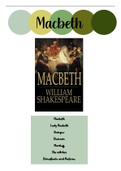
Macbeth
Macbeth
Lady Macbeth
Banquo
Duncan
Macduff
The witches
Donalbain and Malcom
, Character Sketches
In Act 1, Macbeth is a successful general, described as noble, valiant and 'brave', and respected by
his king and his fellow soldiers. He has a significant flaw in his nature, however - ambition. This leads
him to kill the rightful King of Scotland, and the evil of this murder has powerful effects on him and
the whole country. Macbeth knows that what he does is evil and initially is thrown into a moral
quandary, but eventually the temptation is too strong. The witches play upon Macbeth's weakness
and so does his equally ambitious wife, Lady Macbeth. Macbeth thinks that the supernatural powers
of the witches will help him, but instead they lead him to ruin. Macbeth's downfall is really his own
fault, because he makes a deliberate choice to take the road to evil. He is responsible for the
murder of King Duncan, his two sleeping guards, his colleague Banquo, Lady Macduff and her children
and Young Siward.
At the end of the play, Macbeth has changed from the 'Noble Macbeth' he was at the start, to a
'butcher' and a 'bloody tyrant' hated by everyone. Macbeth is, however, a strong character and is
fully aware of the good he has rejected. He is a fascinating character because he is much more
than just a horrible monster. It is possible to feel repelled by the evil in Macbeth and at the same
time to feel sorry for the waste of all the good things in his character.
The play has a tight, compact structure and all the action centres on Macbeth. We are granted
access to his thoughts through a series of illuminating soliloquies in which he shares his dilemma and
future plans with the audience. As a result, we feel very close to this protagonist.
You could think of Macbeth as someone who is too suspicious of those he should have trusted and too
trusting of the witches, whom he should have suspected more. Or perhaps he is a terrified man trying
to escape from his own conscience. Some people have interpreted Macbeth as a brave soldier who is
also a moral coward. When making up your own mind, it may help to think of how Macbeth may have
been seen by Banquo, Lady Macbeth or Macduff.
Macbeth
Lady Macbeth
Banquo
Duncan
Macduff
The witches
Donalbain and Malcom
, Character Sketches
In Act 1, Macbeth is a successful general, described as noble, valiant and 'brave', and respected by
his king and his fellow soldiers. He has a significant flaw in his nature, however - ambition. This leads
him to kill the rightful King of Scotland, and the evil of this murder has powerful effects on him and
the whole country. Macbeth knows that what he does is evil and initially is thrown into a moral
quandary, but eventually the temptation is too strong. The witches play upon Macbeth's weakness
and so does his equally ambitious wife, Lady Macbeth. Macbeth thinks that the supernatural powers
of the witches will help him, but instead they lead him to ruin. Macbeth's downfall is really his own
fault, because he makes a deliberate choice to take the road to evil. He is responsible for the
murder of King Duncan, his two sleeping guards, his colleague Banquo, Lady Macduff and her children
and Young Siward.
At the end of the play, Macbeth has changed from the 'Noble Macbeth' he was at the start, to a
'butcher' and a 'bloody tyrant' hated by everyone. Macbeth is, however, a strong character and is
fully aware of the good he has rejected. He is a fascinating character because he is much more
than just a horrible monster. It is possible to feel repelled by the evil in Macbeth and at the same
time to feel sorry for the waste of all the good things in his character.
The play has a tight, compact structure and all the action centres on Macbeth. We are granted
access to his thoughts through a series of illuminating soliloquies in which he shares his dilemma and
future plans with the audience. As a result, we feel very close to this protagonist.
You could think of Macbeth as someone who is too suspicious of those he should have trusted and too
trusting of the witches, whom he should have suspected more. Or perhaps he is a terrified man trying
to escape from his own conscience. Some people have interpreted Macbeth as a brave soldier who is
also a moral coward. When making up your own mind, it may help to think of how Macbeth may have
been seen by Banquo, Lady Macbeth or Macduff.


