Written by students who passed Immediately available after payment Read online or as PDF Wrong document? Swap it for free 4.6 TrustPilot
logo-home
Document preview thumbnail
Preview 3 out of 21 pages
Summary

Complete Summary Of Chapters 15, 19 and 21 From The Book of Financial Management 1

Document preview thumbnail
Preview 3 out of 21 pages

You prepare this summary for the Managerial accounting exam during the 2nd block of the first year at International Business at the Hva. Study this summary and you are guaranteed to pass with a grandiose grade!

Content preview

Financial Management – CH 15, 19, 21 Summary
Chapter 15
Video 1 – Introduction to managerial accounting and the management
process
Introduction to Management Accounting
Financial accounting gives information to external stakeholders (owners, shareholders,
creditors, etc.) about the financial performance and the economic health of a company.

Management accounting is a system that provides information to the management for
business decision making.

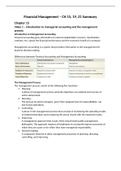
Differences between Financial Accounting and Management Accounting:


The Management Process
The management process consist of the following five functions:
1. Planning:
A phase of management process whereby objectives are outlined and courses of
action determined.
2. Directing:
The process by which managers, given their assigned level of responsibilities, run
day-to-day operations.
3. Controlling:
A phase in the management process that consists of monitoring the operating results
of implemented plans and comparing the actual results with the expected results.
4. Improving:
A management approach that is part of the overall total quality management
philosophy. The approach requires all employees to constantly improve processes of
which they are a part or for which they have managerial responsibility.
5. Decision making:
A component inherent in other management processes of planning, directing,
controlling, and improving.

,Planning
Management uses planning in developing the company’s objectives (goals) and translating
these objectives into courses of action.

Planning may be classified as follows:
 Strategic planning, which is developing long-term actions to achieve the company’s
objectives. These long-term courses of action are called strategies, which often
involve periods of 5 to 10 years.
 Operational planning, which develops short-term actions for managing the day-to-
day operations of the company.

Directing
The process of running the day-today-operations. Like:
 Acquiring the necessary resources
 Hiring people
 Assigning tasks to people
 Among others

Controlling
Monitoring operating results and comparing actual results with expected results is
controlling.

This feedback allows management to isolate areas for further investigation and possible
remedial action.

Management by exception: The philosophy of controlling by comparing actual and expected
results and highlighting only important deviations.


Video 2 – The manufacturing process and cost classifications

, Cost related to Manufacturing operations
In manufacturing operations we have to look at several aspects of costs:
 Classification of costs – which costs are there?
 Cost behaviour – How do costs change with volume
 Expense recognition

Most insights from manufacturing operations are also applicable in merchandising
businesses or service businesses.

Cost: A cost is a payment of cash or the commitment to pay cash in the future for the
purpose of generating revenues.
 A ‘cost’ tells us ‘what something costs’.
 A cost not necessarily an expense (yet).
 An expense is the cost of a resource that is sacrificed (used up) in order to generate
revenue.

When we pay for a resource that will be used in production, that cost is not an because the
value is still in the company until the product is sold.

Cost classification and cost object
In managerial accounting, costs are often classified according to the decision-making needs
of management.

For example, costs are often classified by their relationship to a segment of operations,
called a cost object.

A cost object may be a product, a sales territory, a department, or an activity, such as
research and development.

Cost classifications
We can look at cost in different ways:
 Which types of costs there are
 Direct cost and Indirect cost; has to do with if we can trace cost in a convenient way
to a cost object.
 The difference between Product cost and Period cost
 What we mean with prime cost and conversion cost


Types of costs

Document information

Study
Uploaded on
February 13, 2022
Number of pages
21
Written in
2021/2022
Type
Summary
$10.15

Wrong document? Swap it for free Within 14 days of purchase and before downloading, you can choose a different document. You can simply spend the amount again.
Written by students who passed
Immediately available after payment
Read online or as PDF

Seller avatar
Reputation scores are based on the amount of documents a seller has sold for a fee and the reviews they have received for those documents. There are three levels: Bronze, Silver and Gold. The better the reputation, the more your can rely on the quality of the sellers work.
DylanHoevenaars
3.8
(8)
Sold
34
Followers
24
Items
8
Last sold
7 months ago

Reviews from verified buyers


Why students choose Stuvia

Created by fellow students, verified by reviews

Quality you can trust: written by students who passed their tests and reviewed by others who've used these notes.

Didn't get what you expected? Choose another document

No worries! You can instantly pick a different document that better fits what you're looking for.

Pay as you like, start learning right away

No subscription, no commitments. Pay the way you're used to via credit card and download your PDF document instantly.

Student with book image

“Bought, downloaded, and aced it. It really can be that simple.”

Alisha Student

Working on your references?

Create accurate citations in APA, MLA and Harvard with our free citation generator.

Working on your references?

Frequently asked questions