HANDOUTS CHEMISTRY
IGCSE/GCE O Levels
Element, Compounds and Mixtures:
Speaking about the chemistry of matter, we have only 3 types of matter. These are
elements, mixtures and compounds. Long ago, scientists found out that the smallest unit of
a matter is called an atom. An elements is extremely pure because it is made up of only
one type of atoms. For example a pure gold ring has only the element Gold (Au) in it.
Compounds are very pure too, a compound is made up of one type of a particle called
molecule. A molecule consists of two or more atoms chemically bonded together. Carbon
Dioxide (CO2) gas is a compound. A mixture however is not pure at all. A mixture is just two
or more elements or compounds mixed together, but not chemically bonded. Forexample if
you dissolve some table salt, which is a compound called sodium chloride (NaCl) in some
water, which is also another compound (H2O), you will get a mixture of Sodium Chloride in
water, but there are absolutely no bonds between the Sodium Chloride molecules and
water molecules. Air is another good example of mixtures. Air is just a mixture of gases
floating around each other like Nitrogen and Oxygen, which are pure elements. Air also
contains compounds such is Carbon Dioxide.
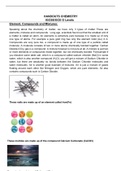
These nails are made up of an element called Iron(Fe)
These marbles are made up of the compound Calcium Carbonate (CaCO3)
, Elements, compounds and mixtures can be represented by diagrams likethis, where circles
of different sizes and colours represent different atoms. Circles attached to each other
mean that they are chemically bonded forming a molecule.
Monoatomic element Diatomic molecule Molecules of a compound
Diatomic Molecules are molecules made of two atoms of the same element, such as
Chlorine molecules (Cl2) and Oxygen molecules (O2). Since particles in mixtures have no
chemical bonding between them, they could be easily separated by physical means. The
method of separation however depends on the type of the mixture, and some ofthe physical
properties of its components.
We have 4 types of mixtures:
Solid/Solid mixtures
Solid/liquid mixtures
Liquid/liquid mixtures
Gas/gas mixtures
Separating Solid/Solid Mixtures:
By Magnet:
This method is used to separate a mixture of two solids. One condition must be present
though. This is that one of the solids is magnetic. For example if we have a mixture of
sand and iron chips. We can separate them by following these instructions:
Pour the mixture in a dish
Approach a magnet just above the mixture
The iron chips will immediately get attracted to the magnet leaving sandbehind.
IGCSE/GCE O Levels
Element, Compounds and Mixtures:
Speaking about the chemistry of matter, we have only 3 types of matter. These are
elements, mixtures and compounds. Long ago, scientists found out that the smallest unit of
a matter is called an atom. An elements is extremely pure because it is made up of only
one type of atoms. For example a pure gold ring has only the element Gold (Au) in it.
Compounds are very pure too, a compound is made up of one type of a particle called
molecule. A molecule consists of two or more atoms chemically bonded together. Carbon
Dioxide (CO2) gas is a compound. A mixture however is not pure at all. A mixture is just two
or more elements or compounds mixed together, but not chemically bonded. Forexample if
you dissolve some table salt, which is a compound called sodium chloride (NaCl) in some
water, which is also another compound (H2O), you will get a mixture of Sodium Chloride in
water, but there are absolutely no bonds between the Sodium Chloride molecules and
water molecules. Air is another good example of mixtures. Air is just a mixture of gases
floating around each other like Nitrogen and Oxygen, which are pure elements. Air also
contains compounds such is Carbon Dioxide.
These nails are made up of an element called Iron(Fe)
These marbles are made up of the compound Calcium Carbonate (CaCO3)
, Elements, compounds and mixtures can be represented by diagrams likethis, where circles
of different sizes and colours represent different atoms. Circles attached to each other
mean that they are chemically bonded forming a molecule.
Monoatomic element Diatomic molecule Molecules of a compound
Diatomic Molecules are molecules made of two atoms of the same element, such as
Chlorine molecules (Cl2) and Oxygen molecules (O2). Since particles in mixtures have no
chemical bonding between them, they could be easily separated by physical means. The
method of separation however depends on the type of the mixture, and some ofthe physical
properties of its components.
We have 4 types of mixtures:
Solid/Solid mixtures
Solid/liquid mixtures
Liquid/liquid mixtures
Gas/gas mixtures
Separating Solid/Solid Mixtures:
By Magnet:
This method is used to separate a mixture of two solids. One condition must be present
though. This is that one of the solids is magnetic. For example if we have a mixture of
sand and iron chips. We can separate them by following these instructions:
Pour the mixture in a dish
Approach a magnet just above the mixture
The iron chips will immediately get attracted to the magnet leaving sandbehind.