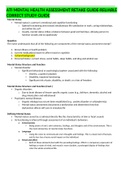
ATI MENTAL HEALTH ASSESSMENT RETAKE GUIDE-RELIABLE
CORRECT STUDY GUIDE
Mental Status
•Mental status is a person’s emotional and cognitive functioning
oOptimal functioning aims toward simultaneous life satisfaction in work, caring relationships, and within the self
oUsually, mental status strikes a balance between good and bad days, allowing person to function socially and occupationally
Question
The nurse understands that all of the following are components of the mental status assessment except?
1.Known illness or health problem
2.Current medications known to affect mood or cognition
3.Cultural background
4.Personal history; current stress, social habits, sleep habits, and drug and alcohol use
Mental Status Structure and Function
•Mental disorder
oSignificant behavioral or psychological pattern associated with the following:
▪Distress, a painful symptom
▪Disability, impaired functioning
▪Significant risk of pain, disability, or death, or a loss of freedom
Mental Status Structure and Function (Cont.)
•Organic disorders
oDue to brain disease of known specific organic cause (e.g., delirium, dementia, alcohol and drug intoxication and withdrawal)
•Psychiatric mental illnesses
oOrganic etiology has not yet been established (e.g., anxiety disorder or schizophrenia)
oMental status assessment documents a dysfunction and determines how that dysfunction affects self-care in everyday life
Defining Mental Status
•Mental status cannot be scrutinized directly like the characteristics of skin or heart sounds
•Its functioning is inferred through assessment of an individual’s behaviors:
oConsciousness
▪Being aware of one's own existence, feelings, and thoughts and of the environment. This is the most elementary of mental status functions.
oLanguage
▪Using the voice to communicate one's thoughts and feelings. This is a basic tool of humans, and its loss has a heavy social impact on the individual.
oMood and affect
▪Both of these elements deal with the prevailing feelings. Affect is a temporary expression of feelings or state of mind, and mood is more durable, a prolonged display of feelings that color the whole emotional life. QuestionoOrientation
▪The awareness of the objective world in relation to the self. Able to name own person, place, and time.
oAttention
▪The power of concentration, the ability to focus on one specific thing without being distracted by many environmental stimuli.
oMemory
▪The ability to lay down and store experiences and perceptions for later recall. Recent memory evokes day-to-day events; remote memory brings up years' worth of experiences.
oAbstract reasoning
▪Pondering a deeper meaning beyond the concrete and literal.
oThought process
▪The way a person thinks; the logical train of thought.
oThought content
▪What the person thinks—specific ideas, beliefs, the use of words.
oPerceptions
▪An awareness of objects through the five senses.
Which of the following basic functions should the nurse test first in an assessment of mental status?
1.Behavior
2.Consciousness (is the patient breathing? ABCs)
3.Judgment
4.Language
Developmental Competence
•Infants and children
oDifficult to separate and trace development of just one aspect of mental status in children, because all aspects are interdependent
•Aging adults
oOlder adulthood contains more potential for losses
oGrief and despair surrounding these losses can affect mental status and can result in disability, disorientation, or depression
oChronic diseases such as heart failure, cancer, diabetes, and osteoporosis include fear of loss of life
Components of the Mental Status Examination
•Full mental status examination is a systematic check of emotional and cognitive functioning
•Usually, mental status can be assessed in the context of the health history interview
•Keep in mind the four main headings of mental status assessment: A-B-C-T
oAppearance
oBehavior
oCognition
oThought processes
CORRECT STUDY GUIDE
Mental Status
•Mental status is a person’s emotional and cognitive functioning
oOptimal functioning aims toward simultaneous life satisfaction in work, caring relationships, and within the self
oUsually, mental status strikes a balance between good and bad days, allowing person to function socially and occupationally
Question
The nurse understands that all of the following are components of the mental status assessment except?
1.Known illness or health problem
2.Current medications known to affect mood or cognition
3.Cultural background
4.Personal history; current stress, social habits, sleep habits, and drug and alcohol use
Mental Status Structure and Function
•Mental disorder
oSignificant behavioral or psychological pattern associated with the following:
▪Distress, a painful symptom
▪Disability, impaired functioning
▪Significant risk of pain, disability, or death, or a loss of freedom
Mental Status Structure and Function (Cont.)
•Organic disorders
oDue to brain disease of known specific organic cause (e.g., delirium, dementia, alcohol and drug intoxication and withdrawal)
•Psychiatric mental illnesses
oOrganic etiology has not yet been established (e.g., anxiety disorder or schizophrenia)
oMental status assessment documents a dysfunction and determines how that dysfunction affects self-care in everyday life
Defining Mental Status
•Mental status cannot be scrutinized directly like the characteristics of skin or heart sounds
•Its functioning is inferred through assessment of an individual’s behaviors:
oConsciousness
▪Being aware of one's own existence, feelings, and thoughts and of the environment. This is the most elementary of mental status functions.
oLanguage
▪Using the voice to communicate one's thoughts and feelings. This is a basic tool of humans, and its loss has a heavy social impact on the individual.
oMood and affect
▪Both of these elements deal with the prevailing feelings. Affect is a temporary expression of feelings or state of mind, and mood is more durable, a prolonged display of feelings that color the whole emotional life. QuestionoOrientation
▪The awareness of the objective world in relation to the self. Able to name own person, place, and time.
oAttention
▪The power of concentration, the ability to focus on one specific thing without being distracted by many environmental stimuli.
oMemory
▪The ability to lay down and store experiences and perceptions for later recall. Recent memory evokes day-to-day events; remote memory brings up years' worth of experiences.
oAbstract reasoning
▪Pondering a deeper meaning beyond the concrete and literal.
oThought process
▪The way a person thinks; the logical train of thought.
oThought content
▪What the person thinks—specific ideas, beliefs, the use of words.
oPerceptions
▪An awareness of objects through the five senses.
Which of the following basic functions should the nurse test first in an assessment of mental status?
1.Behavior
2.Consciousness (is the patient breathing? ABCs)
3.Judgment
4.Language
Developmental Competence
•Infants and children
oDifficult to separate and trace development of just one aspect of mental status in children, because all aspects are interdependent
•Aging adults
oOlder adulthood contains more potential for losses
oGrief and despair surrounding these losses can affect mental status and can result in disability, disorientation, or depression
oChronic diseases such as heart failure, cancer, diabetes, and osteoporosis include fear of loss of life
Components of the Mental Status Examination
•Full mental status examination is a systematic check of emotional and cognitive functioning
•Usually, mental status can be assessed in the context of the health history interview
•Keep in mind the four main headings of mental status assessment: A-B-C-T
oAppearance
oBehavior
oCognition
oThought processes