
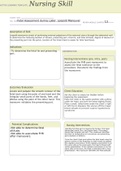
ACTIVE LEARNING TEMPLATE: Nursing Skill
STUDENT NAME SKILL NAMEFetal Assessment during Labor: Leopold Maneuver REVIEW MODULE CHAPTER 13 Potential Complications
-Not able to determine fetal attitude.
-Not able to auscultate FHR after manuevers.Nursing Interventions
-Identify the fetal part occupying the fundus. The head should feel round, firm, and move freely. The breech should feel irregular and soft. This maneuver identifies the fetal lie (longitudinal or transverse) and presenting part (cephalic or breech)..-Face the client's feet and outline the fetal head using the palmar surface of the fingertips on both hands to palpate the cephalic prominence. If the cephalic prominence is on the same side as the small parts, the head is flexed with vertex presentation. If the cephalic prominence is on the same side as the back, the head is extended with a face presentation. This maneuver identifies the fetal attitude.Description of Skill
Leopold maneuvers consist of performing external palpations of the maternal uterus through the abdominal wall to determine the following.Number of fetuses, presenting part, fetal lie, and fetal attitude, degree of descent of the presenting part into the pelvis, location of the fetus's back to assess for fetal hearttones.
Indications
- To determine the fetal lie and presenting part.
Outcomes/Evaluation
Locate and palpate the smooth contour of the fetal back using the palm of one hand and the irregular small parts of the hands, feet, and elbows using the palm of the other hand. This maneuver validates the presenting part.Client Education
Ask the client to empty her bladder before beginning the assessment.
Place the client in the supine position with a pillow under her head, and have her knees slightly flexed. Place a small, rolled towel under the client ’s right or left hip to displace the uterus off the major blood vessels to prevent supine hypotensive syndrome.Nursing Interventions (pre, intra, post)
Auscultate the FHR post-maneuvers to assess the fetal tolerance to the procedure. Document the findings from the maneuversCONSIDERATIONS
STUDENT NAME SKILL NAMEFetal Assessment during Labor: Leopold Maneuver REVIEW MODULE CHAPTER 13 Potential Complications
-Not able to determine fetal attitude.
-Not able to auscultate FHR after manuevers.Nursing Interventions
-Identify the fetal part occupying the fundus. The head should feel round, firm, and move freely. The breech should feel irregular and soft. This maneuver identifies the fetal lie (longitudinal or transverse) and presenting part (cephalic or breech)..-Face the client's feet and outline the fetal head using the palmar surface of the fingertips on both hands to palpate the cephalic prominence. If the cephalic prominence is on the same side as the small parts, the head is flexed with vertex presentation. If the cephalic prominence is on the same side as the back, the head is extended with a face presentation. This maneuver identifies the fetal attitude.Description of Skill
Leopold maneuvers consist of performing external palpations of the maternal uterus through the abdominal wall to determine the following.Number of fetuses, presenting part, fetal lie, and fetal attitude, degree of descent of the presenting part into the pelvis, location of the fetus's back to assess for fetal hearttones.
Indications
- To determine the fetal lie and presenting part.
Outcomes/Evaluation
Locate and palpate the smooth contour of the fetal back using the palm of one hand and the irregular small parts of the hands, feet, and elbows using the palm of the other hand. This maneuver validates the presenting part.Client Education
Ask the client to empty her bladder before beginning the assessment.
Place the client in the supine position with a pillow under her head, and have her knees slightly flexed. Place a small, rolled towel under the client ’s right or left hip to displace the uterus off the major blood vessels to prevent supine hypotensive syndrome.Nursing Interventions (pre, intra, post)
Auscultate the FHR post-maneuvers to assess the fetal tolerance to the procedure. Document the findings from the maneuversCONSIDERATIONS


