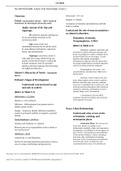
NUR 2488 Mental Health Exam 1 Study Guide | Download To Score A Mental Health Exam 1 Theorists: Freud ▪ Id: The primitive, pleasure-seeking part of our personalities that lurks in the unconscious mind. ▪ Ego: Our sense of self. Acts as an intermediary
Theorists: Freud : psychoanalytic therapy – relieve emotional disturbances by knowing the unconscious mind Apply concept of Id, Ego and Superego: Id: primitive, pleasure-seeking part of our personalities that lurks in the unconscious mind Ego: sense of self, acts intermediary between the id and the world by using defense mechanisms, repression, denial, and rationalization Superego: conscience, sense of what right and wrong, influenced by our parents, moral/ethical stances, realistically evaluate situations, limit id’s primitive impulses and keep superego form becoming too ridged and obsessive. Maslow’s Hierarchy of Needs – humanistic theory Erikson’s Stages of Development Understand concept based on age and task to achieve (Refer to Table 3-2) Adolescence = 12-20yrs Identity vs. role confusion Diffusion – Differentiation from patents leads to fidelity (sense of self) Danger – temporary identify diffusion (instability) results in permanent inability to integrate a personal identity Young Adulthood = 20-30 yrs Intimacy and Solidarity vs. isolation Maturity and social responsibility result in ability to love and be loved Adulthood = 30-65 Generativity vs. self-absorption Interest in nurturing subsequent generations creates a sens of caring, contributing, and generativity Senescense = 65+ yrs Integrity vs. despair Acceptance of mortality and satisfaction with life leads to wisdom Understand the role of neurotransmitters as related to disorders Dopamine, Serotonin, Norepinephrine, GABA (Refer to Table 4-2) Dopamine: cognition, motivation, and movement. Controls emotional responses and brains reward/pleasure centers, stimulates heart, increases blood flow to vital organs. Cocaine interfere with reuptake of dopamine. Schizophrenia originated from the observation that durgs (amphetamines) stimulated dopamine activity can induce psychotic symptoms Norepinephrine: low levels = low arousal/sedation, and depression. High levels = hyperarousal. Serotonin: found in spinal cord, and brain. Helps regulate mood, arousal, attention, behavior and body temp. serotonin syndrome may occur if combined with st. johns wort, cold medications/dextromethorphan. Mild syndrome (reslesness, shivering, and diarrhea) to severe (muscle ridgity, fever, and sezuires). y-Aminobutyric Acid (GABA): modulates neuronal excitability and associated with regulation of anxiety. Nurse-Client Relationship: Understand what occurs in the orientation, working, and termination phase Orientation Phase: First time pt and nurse meet. Interact according to own backgrounds, standards, values, and experiences. Atompsphere is established in which rapport can grow. Nurse’s role clarified and responsibilities of both pt/nurse defined. Contract containing time place, date, and duration of meetings discussed. Terms of termination are introduced, nurse becomes aware of transferene and countertransference issues. Pt’s problems are
Document information
- Uploaded on
- January 26, 2022
- Number of pages
- 7
- Written in
- 2021/2022
- Type
- Other
- Person
- Unknown