
Unit 1 assignment 4
Task 2
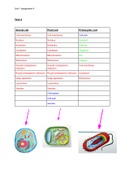
Animal cell Plant cell Prokaryotic cell
Cell membrane Cell membrane Cell wall
Nucleus Nucleus Nucleoid
Nucleolus Nucleolus Plasmid
Cytoplasm Cytoplasm Flagellum
Mitochondrion Mitochondrion Pili
Ribosomes Ribosomes Capsule
Smooth endoplasmic Smooth endoplasmic Cell membrane
reticulum reticulum
Rough endoplasmic reticulum Rough endoplasmic reticulum Cytoplasm
Golgi apparatus Golgi apparatus Ribosomes
Lysosomes Lysosomes
Vesicles Vesicles
Chloroplast
Cell wall
vacuole
, Unit 1 assignment 4
Structures
Cell membrane
The cell membrane is also known as
the plasma membrane or the
cytoplasmic membrane. It is a biological
membrane which divides the interior of
all cells from the outside, external
environment. The role of this is to protect the cell from its environment by controlling
which substances go into the cell and come out, causing the membrane to be
selectively permeable. This protects the cell as it prevents toxic substances from
entering the cell. It also receives chemical messengers from other cells and acts as a
receptor. The cell membrane is a double layer of lipids and proteins that surrounds a
cell, made of phospholipid bi-layers.
Nucleus
The nucleus is found in eukaryotic cells. It
is a membrane-bound structure. This
organelle has 2 major functions - Inside its
fully-enclosed membrane, it contains the
majority of the cell's genetic material and it
controls the cell's activities, which include
growth, metabolism, protein synthesis, and
cell division. The nucleus is the most
important organelle in the cell.
Task 2
Animal cell Plant cell Prokaryotic cell
Cell membrane Cell membrane Cell wall
Nucleus Nucleus Nucleoid
Nucleolus Nucleolus Plasmid
Cytoplasm Cytoplasm Flagellum
Mitochondrion Mitochondrion Pili
Ribosomes Ribosomes Capsule
Smooth endoplasmic Smooth endoplasmic Cell membrane
reticulum reticulum
Rough endoplasmic reticulum Rough endoplasmic reticulum Cytoplasm
Golgi apparatus Golgi apparatus Ribosomes
Lysosomes Lysosomes
Vesicles Vesicles
Chloroplast
Cell wall
vacuole
, Unit 1 assignment 4
Structures
Cell membrane
The cell membrane is also known as
the plasma membrane or the
cytoplasmic membrane. It is a biological
membrane which divides the interior of
all cells from the outside, external
environment. The role of this is to protect the cell from its environment by controlling
which substances go into the cell and come out, causing the membrane to be
selectively permeable. This protects the cell as it prevents toxic substances from
entering the cell. It also receives chemical messengers from other cells and acts as a
receptor. The cell membrane is a double layer of lipids and proteins that surrounds a
cell, made of phospholipid bi-layers.
Nucleus
The nucleus is found in eukaryotic cells. It
is a membrane-bound structure. This
organelle has 2 major functions - Inside its
fully-enclosed membrane, it contains the
majority of the cell's genetic material and it
controls the cell's activities, which include
growth, metabolism, protein synthesis, and
cell division. The nucleus is the most
important organelle in the cell.


