
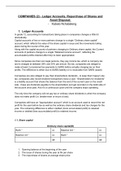
COMPANIES (2) - Ledger Accounts, Repurchase of Shares and
Asset Disposal.
- Kabelo Nchabeleng
1. Ledger Accounts
In grade 12, accounting for transactions taking place in companies changes a little bit
dramatically.
Capital accounts of two or more partners change to a single “Ordinary share capital”
account, which reflects the value of the share capital in issue and the movements taking
place during the course of the year.
Along with the capital accounts of partners changing to Ordinary share capital, the Current
accounts of partners change to a single “Retained income account”, reflecting the
accumulated profits retained after they’ve been appropriated.
Since companies are their own legal persons, they pay income tax, which is company tax
and is charged at between 28% and 30% per annum. By law, companies are obliged to
make at least 2 provisional tax payments to SARS before actually charging tax on their
profits. The difference is either due to SARS (liability) or is receivable from SARS (asset).
Companies are also obliged to pay their shareholders dividends - to keep them happy! Like
tax, companies also record dividend transactions twice a year. “Shareholders for dividends”
is a liability account that shows the balance from the end of the current year on the credit
side - these are dividends payable to the shareholders and get recorded on the debit side of
the account once paid. And it’s a continuous cycle until the company stops operating.
The only time the company will not pay tax or ordinary share dividends is when the company
does not make profit (i.e. breaks-even or incurs a loss).
Companies still have an “Appropriation account” which is an account used to record the net
profit for the year before tax as well as the ordinary share dividends and tax charges for the
year. The remaining difference is either credited (more accumulated profit) to retained
income or debited (less accumulated profit) to retained income.
1.1. Share capital
Ordinary share capital(B)
Bank 3 xx Balance b/d 1 xx
Balance c/d 4 xx Bank 2 xx
xx xx
1. Opening balance at the beginning of the year
2. The issue of shares during the year at Rx per share
3. The repurchase of shares at average share price
, 4. The balance of ordinary share capital at the end of the year.
Retained Income(B)
Bank 3 xx Balance 1 b/d xx
Appropriation account 4 OR xx Appropriation account 2 xx
Balance 5 c/d xx
xx xx
1. Retained income at the beginning of the year
2. Net positive profit retained
3. Repurchase of shares at excess over average share price*
4. Amount of accumulated profits lost in the year
5. Retained income at the end of the year.
*Excess over average share price = repurchase price per share - average share price. Bear
this in mind when the repurchase of shares is covered in great detail later in the notes!
1.2. Taxation
SARS(Income tax) (B)
Balance 1 b/d xx Balance 2 b/d xx
Bank 3 xx Income tax 6 xx
Bank 4 xx Balance 7 c/d xx
Bank 5 xx
Balance 8 c/d xx
xx xx
1. The balance due to us by SARS at the end of last year
2. The balance due to SARS by us at the end of last year
3. The credit opening balance settled/paid
4. First provisional tax payment
5. Second provisional tax payment
6. Actual income tax charged on net profit
7. Amount receivable from SARS at the end of this year (Income tax < Sum of
provisional tax payments)
8. Amount payable to SARS at the end of this year (Income tax > Sum of provisional tax
payments)
Income tax(N)
Asset Disposal.
- Kabelo Nchabeleng
1. Ledger Accounts
In grade 12, accounting for transactions taking place in companies changes a little bit
dramatically.
Capital accounts of two or more partners change to a single “Ordinary share capital”
account, which reflects the value of the share capital in issue and the movements taking
place during the course of the year.
Along with the capital accounts of partners changing to Ordinary share capital, the Current
accounts of partners change to a single “Retained income account”, reflecting the
accumulated profits retained after they’ve been appropriated.
Since companies are their own legal persons, they pay income tax, which is company tax
and is charged at between 28% and 30% per annum. By law, companies are obliged to
make at least 2 provisional tax payments to SARS before actually charging tax on their
profits. The difference is either due to SARS (liability) or is receivable from SARS (asset).
Companies are also obliged to pay their shareholders dividends - to keep them happy! Like
tax, companies also record dividend transactions twice a year. “Shareholders for dividends”
is a liability account that shows the balance from the end of the current year on the credit
side - these are dividends payable to the shareholders and get recorded on the debit side of
the account once paid. And it’s a continuous cycle until the company stops operating.
The only time the company will not pay tax or ordinary share dividends is when the company
does not make profit (i.e. breaks-even or incurs a loss).
Companies still have an “Appropriation account” which is an account used to record the net
profit for the year before tax as well as the ordinary share dividends and tax charges for the
year. The remaining difference is either credited (more accumulated profit) to retained
income or debited (less accumulated profit) to retained income.
1.1. Share capital
Ordinary share capital(B)
Bank 3 xx Balance b/d 1 xx
Balance c/d 4 xx Bank 2 xx
xx xx
1. Opening balance at the beginning of the year
2. The issue of shares during the year at Rx per share
3. The repurchase of shares at average share price
, 4. The balance of ordinary share capital at the end of the year.
Retained Income(B)
Bank 3 xx Balance 1 b/d xx
Appropriation account 4 OR xx Appropriation account 2 xx
Balance 5 c/d xx
xx xx
1. Retained income at the beginning of the year
2. Net positive profit retained
3. Repurchase of shares at excess over average share price*
4. Amount of accumulated profits lost in the year
5. Retained income at the end of the year.
*Excess over average share price = repurchase price per share - average share price. Bear
this in mind when the repurchase of shares is covered in great detail later in the notes!
1.2. Taxation
SARS(Income tax) (B)
Balance 1 b/d xx Balance 2 b/d xx
Bank 3 xx Income tax 6 xx
Bank 4 xx Balance 7 c/d xx
Bank 5 xx
Balance 8 c/d xx
xx xx
1. The balance due to us by SARS at the end of last year
2. The balance due to SARS by us at the end of last year
3. The credit opening balance settled/paid
4. First provisional tax payment
5. Second provisional tax payment
6. Actual income tax charged on net profit
7. Amount receivable from SARS at the end of this year (Income tax < Sum of
provisional tax payments)
8. Amount payable to SARS at the end of this year (Income tax > Sum of provisional tax
payments)
Income tax(N)


