

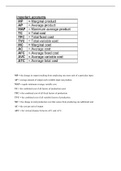
MP = the change in output resulting from employing one more unit of a particular input.
AP = average amount of output each variable input can produce.
MAP = equals minimum average variable cost.
TC = the combined cost of all factors of production used.
TFC = the combined cost of all fixed factors of production
TVC = the combined cost of all variable factors of production.
MC = the change in total production cost that comes from producing one additional unit
AC = the cost per unit of output
AFC = the vertical distance between ATC and AVC.
,CHAPTER 1
ECONOMICS = the social science that studies the choices that individuals, businesses, governments and
societies make as they cope with scarcity and the incentives that influence and reconcile those choices.
SCARSICITY = the universal inability of people to get everything they want. Is the foundation of economics.
INCENTIVE = a reward that encourages or a penalty that discourages an action.
MICROECONOMICS = the study of choices that individuals and businesses make, the way those choices
interact in markets and influence of governments. Ex/ how will a tax on sugar affect food manufacturers?
MACROECONOMICS = the study of performance of the national and global economies. Ex/ why does UK
employment rate fluctuate?
2 big econ. Questions: how do choices end up determining what, how and for whom goods and services get
produced?
GOOD and SERVICES = the physical objects or actions performed that people value and produce to satisfy
wants. What goods and services are produced changes over time and depends on the development of a country.
Developed countries mainly produce services. Goods and services are produces by factors of production, which
are productive resources used to produce good and s.
4 FACTORS OD PRODUCTION = LAND, natural res. LABOUR, the work, time and effort devoted to
production. CAPITAL, the tools, instruments, machines, buildings and other constructions that businesses use
for production. ENTREPRENEURSHIP, the human resource that organises labour, land, and capital to come up
with new ideas about what and how to produce.
HUMAN CAPITAL = the knowledge and skills that people obtain from education, trainings, and work
experience. It determines the quality of labour and expands over time.
FINANCIAL CAPITAL = the financial assets owned by a company, such as money, shares, and bonds, which
are not used in production.
Who gets the goods and services that are produced is determined by people income, which is earned through
factors of production. LAND earns rent, LABOUR earns wages, CAPITAL interest, ENTR profit.
EFFICIENT = a situation that cannot be improved further, when everyone is better off.
SELF INTEREST, choosing the best choice for yourself. SOCIAL INTEREST, choosing for the whole soc.
THE ECONOMIC WAY OF THINKING:
A choice is a trade off: exchange in which people give up one thing to get something else. Due to
scarsicity, every choice is a trade off.
People make rational choice by comparing benefits and costs. Benefit: the gain something brings and is
det by preferences. It’s measured by the amount people are willing to give up to get something.
Opportunity cost: the highest-valued alterative that must be given up to obtain benefit.
Most choices are how much choices made at the margin. Marginal benefit: the benefit that arises from
an increase in activity. Marginal cost: the opportunity cost of an increase in activity. Choices respond
to incentives.
POSIVITE STATEMENT = statement that can be correct or false and therefore, can be fact-checked. Ex/ our
planet is warming because of the amount of coal that we burn.
NORMATIVE ST = statement that people can agree or disagree with and which cannot be fact-checked. Ex/ we
ought to cut our use of coal by 50%.
ECONOMIC MODEL = a description of some aspects of economic world that includes only those features
needed for the purpose at hand. Tested by comparing predictions with facts, and used for unscrambling cause
effect.
, SCATTER DIAGRAM = a graph in which the values of 2 variables are plotted along 2 axis, the pattern of the
resulting points reveals any correlation present. Breaks in the axes: 2 parallel stripes that indicate there are
jumps from the origin, 0, to the first values recorded. Breaks can be misleading when they visualize different
distances from the origin to the first values recorded.
4 types of curves in economics
models
1. VARIABLES MOVE IN
THE SAME DIRECTION.
Also called positive or direct
relationship. 3 types
2. VAR MOVE IN OPP
DIRECTIONS. Also called
negative or inverse
relationship.
3. VAR THAT HAVE A
MAXIMUM OR MINIMUM.
AP = average amount of output each variable input can produce.
MAP = equals minimum average variable cost.
TC = the combined cost of all factors of production used.
TFC = the combined cost of all fixed factors of production
TVC = the combined cost of all variable factors of production.
MC = the change in total production cost that comes from producing one additional unit
AC = the cost per unit of output
AFC = the vertical distance between ATC and AVC.
,CHAPTER 1
ECONOMICS = the social science that studies the choices that individuals, businesses, governments and
societies make as they cope with scarcity and the incentives that influence and reconcile those choices.
SCARSICITY = the universal inability of people to get everything they want. Is the foundation of economics.
INCENTIVE = a reward that encourages or a penalty that discourages an action.
MICROECONOMICS = the study of choices that individuals and businesses make, the way those choices
interact in markets and influence of governments. Ex/ how will a tax on sugar affect food manufacturers?
MACROECONOMICS = the study of performance of the national and global economies. Ex/ why does UK
employment rate fluctuate?
2 big econ. Questions: how do choices end up determining what, how and for whom goods and services get
produced?
GOOD and SERVICES = the physical objects or actions performed that people value and produce to satisfy
wants. What goods and services are produced changes over time and depends on the development of a country.
Developed countries mainly produce services. Goods and services are produces by factors of production, which
are productive resources used to produce good and s.
4 FACTORS OD PRODUCTION = LAND, natural res. LABOUR, the work, time and effort devoted to
production. CAPITAL, the tools, instruments, machines, buildings and other constructions that businesses use
for production. ENTREPRENEURSHIP, the human resource that organises labour, land, and capital to come up
with new ideas about what and how to produce.
HUMAN CAPITAL = the knowledge and skills that people obtain from education, trainings, and work
experience. It determines the quality of labour and expands over time.
FINANCIAL CAPITAL = the financial assets owned by a company, such as money, shares, and bonds, which
are not used in production.
Who gets the goods and services that are produced is determined by people income, which is earned through
factors of production. LAND earns rent, LABOUR earns wages, CAPITAL interest, ENTR profit.
EFFICIENT = a situation that cannot be improved further, when everyone is better off.
SELF INTEREST, choosing the best choice for yourself. SOCIAL INTEREST, choosing for the whole soc.
THE ECONOMIC WAY OF THINKING:
A choice is a trade off: exchange in which people give up one thing to get something else. Due to
scarsicity, every choice is a trade off.
People make rational choice by comparing benefits and costs. Benefit: the gain something brings and is
det by preferences. It’s measured by the amount people are willing to give up to get something.
Opportunity cost: the highest-valued alterative that must be given up to obtain benefit.
Most choices are how much choices made at the margin. Marginal benefit: the benefit that arises from
an increase in activity. Marginal cost: the opportunity cost of an increase in activity. Choices respond
to incentives.
POSIVITE STATEMENT = statement that can be correct or false and therefore, can be fact-checked. Ex/ our
planet is warming because of the amount of coal that we burn.
NORMATIVE ST = statement that people can agree or disagree with and which cannot be fact-checked. Ex/ we
ought to cut our use of coal by 50%.
ECONOMIC MODEL = a description of some aspects of economic world that includes only those features
needed for the purpose at hand. Tested by comparing predictions with facts, and used for unscrambling cause
effect.
, SCATTER DIAGRAM = a graph in which the values of 2 variables are plotted along 2 axis, the pattern of the
resulting points reveals any correlation present. Breaks in the axes: 2 parallel stripes that indicate there are
jumps from the origin, 0, to the first values recorded. Breaks can be misleading when they visualize different
distances from the origin to the first values recorded.
4 types of curves in economics
models
1. VARIABLES MOVE IN
THE SAME DIRECTION.
Also called positive or direct
relationship. 3 types
2. VAR MOVE IN OPP
DIRECTIONS. Also called
negative or inverse
relationship.
3. VAR THAT HAVE A
MAXIMUM OR MINIMUM.




