

Business objectives are the aims that firms hope to achieve going forward. It forms part of
the planning process and influences pricing and output. A business could hope to achieve
profit maximising, revenue maximising, sales-volume maximising, or profit satisficing as any
of its objectives.
To begin with, neo-classical
economic theories presume that
firms are profit maximising in the
short run, as managers and
shareholder aim for the same
objectives. Therefore, firms
produce at the profit maximising
level of output where Marginal
Cost (MC) = Marginal Revenue
(MR). For example, since the retail
company Zara is a profit
maximising firm, it produces
where MC = MR. Businesses may
choose to be profit maximising as
higher profits could then be used to pay owners higher salaries or if the company is listed on
the stock market, shareholders would be able to earn higher dividends. As seen in the
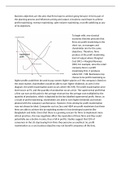
diagram, the profit maximisation point occurs where MC=MR. The profit maximisation price
level occurs at P1, and the quantity of production occurs at Q1. The supernormal profit that
a firm can earn at this point is the average revenue less the average cost multiplied by the
quantity of production, which is depicted by the box labelled supernormal profit. Hence, as
a result of profit maximising, shareholders are able to earn higher dividends and remain
pleased with the company’s performance. However, firms aiming for profit maximisation
may not always be ideal. Companies such as Zara and H&M are profit maximisers but these
firms are able to achieve this by exploiting workers in less developed countries like
Bangladesh and India. Given that there is a growing concern for firms to implement more
ethical practices, this may negatively affect the reputation of these firms and they could
potentially see a decline in sales, thus a fall in profits. Studies suggest that 35% of
consumers in the US stop buying from firms they perceive as unethical. So, profit
maximisation as a core business objective may not benefit companies all the time.
the planning process and influences pricing and output. A business could hope to achieve
profit maximising, revenue maximising, sales-volume maximising, or profit satisficing as any
of its objectives.
To begin with, neo-classical
economic theories presume that
firms are profit maximising in the
short run, as managers and
shareholder aim for the same
objectives. Therefore, firms
produce at the profit maximising
level of output where Marginal
Cost (MC) = Marginal Revenue
(MR). For example, since the retail
company Zara is a profit
maximising firm, it produces
where MC = MR. Businesses may
choose to be profit maximising as
higher profits could then be used to pay owners higher salaries or if the company is listed on
the stock market, shareholders would be able to earn higher dividends. As seen in the
diagram, the profit maximisation point occurs where MC=MR. The profit maximisation price
level occurs at P1, and the quantity of production occurs at Q1. The supernormal profit that
a firm can earn at this point is the average revenue less the average cost multiplied by the
quantity of production, which is depicted by the box labelled supernormal profit. Hence, as
a result of profit maximising, shareholders are able to earn higher dividends and remain
pleased with the company’s performance. However, firms aiming for profit maximisation
may not always be ideal. Companies such as Zara and H&M are profit maximisers but these
firms are able to achieve this by exploiting workers in less developed countries like
Bangladesh and India. Given that there is a growing concern for firms to implement more
ethical practices, this may negatively affect the reputation of these firms and they could
potentially see a decline in sales, thus a fall in profits. Studies suggest that 35% of
consumers in the US stop buying from firms they perceive as unethical. So, profit
maximisation as a core business objective may not benefit companies all the time.


