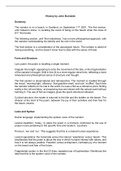
History by John Burnside
Summary
The narrator is on a beach, in Scotland, on September 11th 2001. The first section,
until ‘tideworn stone,’ is recalling the event of being on the beach when the news of
9/11 first broke.
The following section, until ‘first nakedness,’ has a more philosophical approach, with
the narrator contemplating his identity and his role in the world.
The final section is a consideration of the apocalyptic future. The narrator is afraid of
‘losing everything,’ and he doesn’t know how to deal with the sense of threat.
Form and Structure
Lyric poem: the poem is recalling a single moment.
Irregular line length: appearing to echo the movement of the tide, or the fragmentation
of the narrator’s thought. Shift in line 24 to a more regular verse form, reflecting a more
rehearsed and philosophical sense of structure and thought.
The first section is observational and retrospective. The moment is recalled through
the visual: ‘morning light,’ olfactory: ‘that gasoline smell,’ and oral: ‘muffled.’ Each time
the narrator reflects on his role in the world, he uses a fish as a reference point, finding
reality in the ‘silt and tides,’ and exploring how we interact with the natural world without
harming it. The use of fish as imagery gives the poem structural cohesion.
Cyclical structure: the reader is returned to the kite and the toddler on the beach. The
division at the start of the poem, between the joy of their activities and their fear for
the future, returns.
Lexis and Syntax
Deictic language: implementing the spoken voice of the narrator.
Lexical repetition: ‘today,’ to place the poem in a moment, reinforced by the use of
proper nouns pertaining to the specific time and location, ‘Leuchers.’
Pronoun: ‘we’ and ‘our.’ This suggests that this is a shared human experience.
Lexical oppositions: the manmade versus the natural: ‘warplanes’ versus ‘beach.’ This
emphasises that the poem is about the way in which humans interact with nature, and
how it is not always positive. Freedom versus entrapment, contrasts joy of a moment
on the beach and fear of the future.
Fragmented syntax: in the first 23 lines, repeated use of hyphenation. Reinforces the
idea that this is the spoken voice of the narrator.
Summary
The narrator is on a beach, in Scotland, on September 11th 2001. The first section,
until ‘tideworn stone,’ is recalling the event of being on the beach when the news of
9/11 first broke.
The following section, until ‘first nakedness,’ has a more philosophical approach, with
the narrator contemplating his identity and his role in the world.
The final section is a consideration of the apocalyptic future. The narrator is afraid of
‘losing everything,’ and he doesn’t know how to deal with the sense of threat.
Form and Structure
Lyric poem: the poem is recalling a single moment.
Irregular line length: appearing to echo the movement of the tide, or the fragmentation
of the narrator’s thought. Shift in line 24 to a more regular verse form, reflecting a more
rehearsed and philosophical sense of structure and thought.
The first section is observational and retrospective. The moment is recalled through
the visual: ‘morning light,’ olfactory: ‘that gasoline smell,’ and oral: ‘muffled.’ Each time
the narrator reflects on his role in the world, he uses a fish as a reference point, finding
reality in the ‘silt and tides,’ and exploring how we interact with the natural world without
harming it. The use of fish as imagery gives the poem structural cohesion.
Cyclical structure: the reader is returned to the kite and the toddler on the beach. The
division at the start of the poem, between the joy of their activities and their fear for
the future, returns.
Lexis and Syntax
Deictic language: implementing the spoken voice of the narrator.
Lexical repetition: ‘today,’ to place the poem in a moment, reinforced by the use of
proper nouns pertaining to the specific time and location, ‘Leuchers.’
Pronoun: ‘we’ and ‘our.’ This suggests that this is a shared human experience.
Lexical oppositions: the manmade versus the natural: ‘warplanes’ versus ‘beach.’ This
emphasises that the poem is about the way in which humans interact with nature, and
how it is not always positive. Freedom versus entrapment, contrasts joy of a moment
on the beach and fear of the future.
Fragmented syntax: in the first 23 lines, repeated use of hyphenation. Reinforces the
idea that this is the spoken voice of the narrator.