

Chapter 1: ETHICS
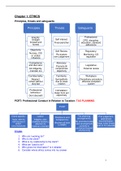
Principles, threats and safeguards
Principles Threats Safeguards
Integrity: Professional:
Straight Self interest: CPD, discipline,
forward and Financial/other education, standard
honest adherence
Objectivity:
Self Review: Regulatory:
No bias, COI
Re-evalute Monitoring, CG
or undue
own judgement regulation
influence
Competence Advocacy:
and due care: Promote till Legislative:
Act diligently, compromise External review
maintain k/s objectivity
Confidentiality: Familiarity: Workplace:
Respect, Sympathetic Disciplinary procedure,
refrain without due to close effective complaint
duty/law relation system
Professional Intimidation:
behaviour: Deter from act
Dont discredit objectively
PCRT: Professional Conduct in Relation to Taxation: TAX PLANNING
PCRT
Client specific: Lawful: Tax planning Prof judgement,
Disclosure and arrangements:
facts, alert to integrity, plan transparency: appropriate
risk/course of (credible/realistic), No promote/create documentation:
disclose all facts fake arrangement keep notes timely
action, attention to to HMRC
circumstances material uncertain contrary to and of PJ rationale
parliament/exploit
shortcoming
EXAM:
1. Who am I working for?
2. Who is the client?
3. What is my relationship to the client?
4. What am I paid to do?
5. Who gives me information? Is it reliable/
6. Consider where ethics comes into my answer
1
, Conflict of interest
The accountant should take reasonable steps to identify when COI arises (between 2 clients,
or firm and client).
Safeguards to be put in place: notify relevant parties, obtain consent to act. If yes, separate
team, info barrier, NDA, independent review of engagement.
If COI leads to a threat of fundamental principle that is not reduced to acceptable level,
resign.
Ethical Conflict Resolution Considerations
- Relevant parties
- Relevant facts
- Ethical issues
- Fundamental principles in question
- Internal procedures
- Alternative actions
Unresolved conflicts: seek internal firm advice, legal or professional advice or withdraw.
When to disclose information?
Authorised by client/employer and permitted by law OR required by law OR professional
duty/right to disclose, not prohibited by law (respond to/comply with inquiry, protect ICAEW).
Errors/Irregularities
If leads to overpayment, accountant should:
- Advise client of irregularity ASAP and possibility of overpayment
If leads to underpayment, accountant should:
- Check EL for authority to disclose (if not, include in next EL) to HMRC
- If no authority, advise client regarding the need to disclose with potential penalties
- Consider obligation under ML legislation
- Keep records of discussion and advice
- Cease to act and seek legal advice if no consent
New Client Procedures
Issues
Data Senior
Responsible PII:
Agent or protection: Accounting
for tax Y < £600k = Officer:
principal? GDPR - ICO
Client & returns: min of £100k
engagement A: low risk, monitor Large Co
accuracy = or 2.5 *
acceptance: client = comply, 72h (rev>£200m or
Engagement client gross fee
accuracy, breach BS>$2bn)
Firm letters income
confid Get Safe online: Penalty: £5k
competent? evidence of Y > £600k =
P: advice, pw/activity paid by SAO
Threats? client £1.5m
high risk, Criminal: See adequate
approval of Hold for 2-6y
liable EUR20m/4% system & find
return after cease
global rev inadequacies
2
, Money laundering
Train staff:
Register with
Appoint MLRO recognise, deal,
regulatory authority
report, verify
Establish internal Carry out customer Report suspicions
procedures: risk due diligence and to NCA via SAR.
assess, deter mgt, check ID Do not tip off
alert ee
Evasion v avoidance
Tax gap and data analytics:
Evasion Avoidance - Real Time Information: PAYE
- Making tax digital for business: VAT
Illegal Legal
Penalties for
Disclose scheme to
enables of
HRMC
offshore evasion
Avoid abusive/
Supress aggressive scheme
information (fake, tax benefit >
real benefit)
Organise tax to
Provide false
minimise bill: ISA,
information
use loss, spouse
Large businesses – requirement to publish tax strategies
- ‘Large’ companies (see above) must publish their UK tax strategies on the internet
- Failure to do so: initial penalty of £7,500 + more for continued non-compliance
Penalties for offshore tax evasion
Penalty for enablers is the higher of:
✓ 100% of the potential lost revenue; and
✓ £3,000.
HMRC publish information about the enabler if, potential revenue lost > £25k and there are 5
penalties in 5 years to the enabler
General anti-abuse rule (GAAR) (post 17 July 2013)
Applies if abusive arrangements to gain tax advantage (Y, CGT, CT, IHT, NIC, ATED)
Taxpayer must make a just and reasonable adjustment to counter advantage obtained
3
, HMRC will refer potential abusive arrangements to the GAAR advisory panel
If the panel feel the arrangements are not a reasonable course of action, they will meet a
threshold condition for the POTAS regime. POTAS: IW p.24.
HMRC can then choose to issue (if significant):
- A conduct notice setting out details of evidence of dishonest conduct. If upheld the
tax advisor can be charged a penalty; and/or
- A counteraction notice stating the adjustments needed under the GAAR +
accelerated payment notice
Possible penalty of 60% of counteracted tax levied if adjustments are needed under GAAR.
The Ramsay Doctrine
If considering tax avoidance schemes the courts will take a purposive view looking at the
overall purpose of the legislation.
Consideration if the provisions of the law were designed to apply to the transaction
(individual steps and whole transaction) in question, when considered objectively.
Base erosion and profit shifting (BEPS)
Covered in UK legislation in rules for:
- CFCs (chapter 6)
- Transfer pricing (chapter 6)
- DPT (chapter 6)
- Patent box (chapter 2)
- Hybrid mismatch arrangements (chapter 6)
- Corporate interest restriction (chapter 6)
Disclosure of tax avoidance schemes (DOTAS)/Disclosure of tax avoidance
schemes for VAT and other indirect taxes (DASVOIT)
1. Scheme promoters of tax avoidance must disclose full details of the scheme to
HMRC (generally within 5 days of making the scheme available).
2. HMRC provides the promoter with a scheme reference number (SRN). Promoter
sends HMRC list of clients quarterly.
3. The promoter passes the SRN to each client who uses the scheme.
4. Scheme user (client) must disclose SRN on tax return.
HMRC have power to find and interrogate the promoter IW p.30 and penalise them IW p.31.
Promoter: designs and approaches client to implement proposal, makes proposal available.
Hallmarks of notifiable arrangements (DOTAS)/(DASVOIT)
Must disclose if the scheme is for tax advantages or has a hallmark.
DOTAS: confidentiality (hide scheme from HMRC), premium fee (contingent success),
standardisation, losses (manufacture), lease agreement of => 2 years and costs => £10m.
Hallmarks of notifiable arrangements for DASVOIT: confidentiality, premium fee,
standardisation, retail supplies (value splitting/shifting for VAT), offshore supplies
(insurance/finance with offshore loop that would be exempt if from UK OR services goes
offshore so UK customer avoids VAT), and disapplication of OTT.
4
Principles, threats and safeguards
Principles Threats Safeguards
Integrity: Professional:
Straight Self interest: CPD, discipline,
forward and Financial/other education, standard
honest adherence
Objectivity:
Self Review: Regulatory:
No bias, COI
Re-evalute Monitoring, CG
or undue
own judgement regulation
influence
Competence Advocacy:
and due care: Promote till Legislative:
Act diligently, compromise External review
maintain k/s objectivity
Confidentiality: Familiarity: Workplace:
Respect, Sympathetic Disciplinary procedure,
refrain without due to close effective complaint
duty/law relation system
Professional Intimidation:
behaviour: Deter from act
Dont discredit objectively
PCRT: Professional Conduct in Relation to Taxation: TAX PLANNING
PCRT
Client specific: Lawful: Tax planning Prof judgement,
Disclosure and arrangements:
facts, alert to integrity, plan transparency: appropriate
risk/course of (credible/realistic), No promote/create documentation:
disclose all facts fake arrangement keep notes timely
action, attention to to HMRC
circumstances material uncertain contrary to and of PJ rationale
parliament/exploit
shortcoming
EXAM:
1. Who am I working for?
2. Who is the client?
3. What is my relationship to the client?
4. What am I paid to do?
5. Who gives me information? Is it reliable/
6. Consider where ethics comes into my answer
1
, Conflict of interest
The accountant should take reasonable steps to identify when COI arises (between 2 clients,
or firm and client).
Safeguards to be put in place: notify relevant parties, obtain consent to act. If yes, separate
team, info barrier, NDA, independent review of engagement.
If COI leads to a threat of fundamental principle that is not reduced to acceptable level,
resign.
Ethical Conflict Resolution Considerations
- Relevant parties
- Relevant facts
- Ethical issues
- Fundamental principles in question
- Internal procedures
- Alternative actions
Unresolved conflicts: seek internal firm advice, legal or professional advice or withdraw.
When to disclose information?
Authorised by client/employer and permitted by law OR required by law OR professional
duty/right to disclose, not prohibited by law (respond to/comply with inquiry, protect ICAEW).
Errors/Irregularities
If leads to overpayment, accountant should:
- Advise client of irregularity ASAP and possibility of overpayment
If leads to underpayment, accountant should:
- Check EL for authority to disclose (if not, include in next EL) to HMRC
- If no authority, advise client regarding the need to disclose with potential penalties
- Consider obligation under ML legislation
- Keep records of discussion and advice
- Cease to act and seek legal advice if no consent
New Client Procedures
Issues
Data Senior
Responsible PII:
Agent or protection: Accounting
for tax Y < £600k = Officer:
principal? GDPR - ICO
Client & returns: min of £100k
engagement A: low risk, monitor Large Co
accuracy = or 2.5 *
acceptance: client = comply, 72h (rev>£200m or
Engagement client gross fee
accuracy, breach BS>$2bn)
Firm letters income
confid Get Safe online: Penalty: £5k
competent? evidence of Y > £600k =
P: advice, pw/activity paid by SAO
Threats? client £1.5m
high risk, Criminal: See adequate
approval of Hold for 2-6y
liable EUR20m/4% system & find
return after cease
global rev inadequacies
2
, Money laundering
Train staff:
Register with
Appoint MLRO recognise, deal,
regulatory authority
report, verify
Establish internal Carry out customer Report suspicions
procedures: risk due diligence and to NCA via SAR.
assess, deter mgt, check ID Do not tip off
alert ee
Evasion v avoidance
Tax gap and data analytics:
Evasion Avoidance - Real Time Information: PAYE
- Making tax digital for business: VAT
Illegal Legal
Penalties for
Disclose scheme to
enables of
HRMC
offshore evasion
Avoid abusive/
Supress aggressive scheme
information (fake, tax benefit >
real benefit)
Organise tax to
Provide false
minimise bill: ISA,
information
use loss, spouse
Large businesses – requirement to publish tax strategies
- ‘Large’ companies (see above) must publish their UK tax strategies on the internet
- Failure to do so: initial penalty of £7,500 + more for continued non-compliance
Penalties for offshore tax evasion
Penalty for enablers is the higher of:
✓ 100% of the potential lost revenue; and
✓ £3,000.
HMRC publish information about the enabler if, potential revenue lost > £25k and there are 5
penalties in 5 years to the enabler
General anti-abuse rule (GAAR) (post 17 July 2013)
Applies if abusive arrangements to gain tax advantage (Y, CGT, CT, IHT, NIC, ATED)
Taxpayer must make a just and reasonable adjustment to counter advantage obtained
3
, HMRC will refer potential abusive arrangements to the GAAR advisory panel
If the panel feel the arrangements are not a reasonable course of action, they will meet a
threshold condition for the POTAS regime. POTAS: IW p.24.
HMRC can then choose to issue (if significant):
- A conduct notice setting out details of evidence of dishonest conduct. If upheld the
tax advisor can be charged a penalty; and/or
- A counteraction notice stating the adjustments needed under the GAAR +
accelerated payment notice
Possible penalty of 60% of counteracted tax levied if adjustments are needed under GAAR.
The Ramsay Doctrine
If considering tax avoidance schemes the courts will take a purposive view looking at the
overall purpose of the legislation.
Consideration if the provisions of the law were designed to apply to the transaction
(individual steps and whole transaction) in question, when considered objectively.
Base erosion and profit shifting (BEPS)
Covered in UK legislation in rules for:
- CFCs (chapter 6)
- Transfer pricing (chapter 6)
- DPT (chapter 6)
- Patent box (chapter 2)
- Hybrid mismatch arrangements (chapter 6)
- Corporate interest restriction (chapter 6)
Disclosure of tax avoidance schemes (DOTAS)/Disclosure of tax avoidance
schemes for VAT and other indirect taxes (DASVOIT)
1. Scheme promoters of tax avoidance must disclose full details of the scheme to
HMRC (generally within 5 days of making the scheme available).
2. HMRC provides the promoter with a scheme reference number (SRN). Promoter
sends HMRC list of clients quarterly.
3. The promoter passes the SRN to each client who uses the scheme.
4. Scheme user (client) must disclose SRN on tax return.
HMRC have power to find and interrogate the promoter IW p.30 and penalise them IW p.31.
Promoter: designs and approaches client to implement proposal, makes proposal available.
Hallmarks of notifiable arrangements (DOTAS)/(DASVOIT)
Must disclose if the scheme is for tax advantages or has a hallmark.
DOTAS: confidentiality (hide scheme from HMRC), premium fee (contingent success),
standardisation, losses (manufacture), lease agreement of => 2 years and costs => £10m.
Hallmarks of notifiable arrangements for DASVOIT: confidentiality, premium fee,
standardisation, retail supplies (value splitting/shifting for VAT), offshore supplies
(insurance/finance with offshore loop that would be exempt if from UK OR services goes
offshore so UK customer avoids VAT), and disapplication of OTT.
4



