BIOL 3270 - Zoology
PHYLUM CHORDATA
Subphylum VERTEBRATA (“Fish”)
FEATURES
All have a cranium with complex sensory organs
Paraphyletic lineage
Mineralized tissues (not necessarily bone)
Increased body size and activity (all are greater than 10cm in length)
Class Petromyzontida (lampreys)
They do not have vertebrae but instead possess cartilaginous skeletal elements called
arcualia which are homologous with neural arch of vertebrae.
the notochord is still the main means of support down the long axis of the body.
They lack jaws
Possess a piston-like tongue for rasping at their food.
Single nasal opening
Well-developed eyes
Pituitary gland
2 semicircular canals for water orientation.
Half are parasitic as adults.
The ammocoetes larva burrows into the silt on the bottom of the ocean and can live there
for 3-7 years.
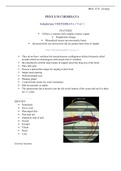
Ammocetes larva
IDENTIFY
Notochord
Nerve cord
Pharyngeal slits
Post-anal tail
Endostyle (end of tail)
Nostril
Eyespot
Velum
Heart
Liver
External anatomy
, BIOL 3270 - Zoology
IDENTIFY
Dorsal and caudal fins (tail fin for propulsion)
Gill opening
Nasohypophyseal opening
Eye
“teeth” (not true teeth)
Tongue (used to siphon food)
Oral hood (mouth)
Internal anatomy
IDENTIFY
Mouth
Tongue muscle
Nasohypophyseal duct (AKA pituitary gland – duct from nostril to brain)
Olfactory sac
Brain
Pineal eye (gland) (part of the brain – night/day)
Spinal cord
Notochord
Heart
Pharynx
Intestine
Gonads
Myomeres of muscle
Class Chondrichthyes (cartilaginous fish)
Subclass Elasmobranchii (sharks, skates, and rays)
PHYLUM CHORDATA
Subphylum VERTEBRATA (“Fish”)
FEATURES
All have a cranium with complex sensory organs
Paraphyletic lineage
Mineralized tissues (not necessarily bone)
Increased body size and activity (all are greater than 10cm in length)
Class Petromyzontida (lampreys)
They do not have vertebrae but instead possess cartilaginous skeletal elements called
arcualia which are homologous with neural arch of vertebrae.
the notochord is still the main means of support down the long axis of the body.
They lack jaws
Possess a piston-like tongue for rasping at their food.
Single nasal opening
Well-developed eyes
Pituitary gland
2 semicircular canals for water orientation.
Half are parasitic as adults.
The ammocoetes larva burrows into the silt on the bottom of the ocean and can live there
for 3-7 years.
Ammocetes larva
IDENTIFY
Notochord
Nerve cord
Pharyngeal slits
Post-anal tail
Endostyle (end of tail)
Nostril
Eyespot
Velum
Heart
Liver
External anatomy
, BIOL 3270 - Zoology
IDENTIFY
Dorsal and caudal fins (tail fin for propulsion)
Gill opening
Nasohypophyseal opening
Eye
“teeth” (not true teeth)
Tongue (used to siphon food)
Oral hood (mouth)
Internal anatomy
IDENTIFY
Mouth
Tongue muscle
Nasohypophyseal duct (AKA pituitary gland – duct from nostril to brain)
Olfactory sac
Brain
Pineal eye (gland) (part of the brain – night/day)
Spinal cord
Notochord
Heart
Pharynx
Intestine
Gonads
Myomeres of muscle
Class Chondrichthyes (cartilaginous fish)
Subclass Elasmobranchii (sharks, skates, and rays)