

Upper limb
Recovery
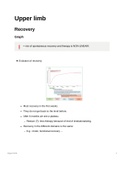
Graph
❗ = mix of spontaneous recovery and therapy is NON-LINEAIR.
Evolution of recovery:
Most recovery in the first weeks.
They do not get back to the level before.
After 6 months we see a plateau.
→ Reason (?): less therapy because of end of institutionalizing.
Recovery in the different domains is the same:
→ E.g.: motor, functional recovery ...
Upper limb 1
, Measurement tools
1. Trunk impairment scale (TIS).
2. Fugl-Meyer.
3. Barthel index.
Pain
Pain is the main complaint in de hemiplegic arm.
Test: NPRS = numeric pain rating scale.
Incident and prevalence:
1. Incidence = how many new cases = 22 - 47%.
2. Prevalence = how many cases over all = 10 - 22%.
Proportional recovery
Rule of proportional recovery:
Difference between 3 and 6 months is 70% of the FM score at 2 weeks.
→ = 70% of the 2 weeks score is what P. can evolve additionally.
This apply only to P. with ipsilesional corticomotor integrity.
→ Brain stimulation: you have motor activation in the distal limb, you belong to
this group.
→ Flacid upper limb = the group that does not belong to this group.
Upper limb 2
Recovery
Graph
❗ = mix of spontaneous recovery and therapy is NON-LINEAIR.
Evolution of recovery:
Most recovery in the first weeks.
They do not get back to the level before.
After 6 months we see a plateau.
→ Reason (?): less therapy because of end of institutionalizing.
Recovery in the different domains is the same:
→ E.g.: motor, functional recovery ...
Upper limb 1
, Measurement tools
1. Trunk impairment scale (TIS).
2. Fugl-Meyer.
3. Barthel index.
Pain
Pain is the main complaint in de hemiplegic arm.
Test: NPRS = numeric pain rating scale.
Incident and prevalence:
1. Incidence = how many new cases = 22 - 47%.
2. Prevalence = how many cases over all = 10 - 22%.
Proportional recovery
Rule of proportional recovery:
Difference between 3 and 6 months is 70% of the FM score at 2 weeks.
→ = 70% of the 2 weeks score is what P. can evolve additionally.
This apply only to P. with ipsilesional corticomotor integrity.
→ Brain stimulation: you have motor activation in the distal limb, you belong to
this group.
→ Flacid upper limb = the group that does not belong to this group.
Upper limb 2


