

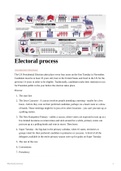
Electoral process
Presidential Elections
The US Presidential Election takes place every four years on the first Tuesday in November.
Candidate must be at least 35 years old, born in the United States and lived in the US for the
previous 14 years in order to be eligible. Traditionally, candidates make their intention to run
for President public in the year before the election takes place.
Process:
1. The start line
2. The Iowa Caucuses - A caucus involves people attending a meeting - maybe for a few
hours - before they vote on their preferred candidate, perhaps via a head count or a show
of hands. Those meetings might be in just a few select locations - you can't just turn up at
a polling station.
3. The New Hampshire Primary - unlike a caucus, where voters are expected to turn up at a
few limited locations at certain times and stick around for a while, primary voters can
just turn up at a polling booth and vote in secret. Then leave.
4. Super Tuesday - the big date in the primary calendar, when 16 states, territories or
groups voted for their preferred candidate in primaries or caucuses. A third of all the
delegates available in the entire primary season were up for grabs on Super Tuesday.
5. The rest of the race
6. Conventions
7. Presidency
Electoral process 1
, Primaries. Advantages and Disadvantages
increased level of interest; in the turnout is usually low
democratic race 2008 and 2016 election
voters are unrepresentative of typical
increased choice of candidates; 2016 17 general election voters; more elderly,
Reps and 6 Dems and in 2008 there more ideological, better educated, more
were 14 wealthy
opening up the process to outsider makes the process far too long which
candidates; Bill Clinton and Obama may discourage some better qualified
and Hilary candidates from running
removing power of the party bosses too expensive and media orientated
significantly diminishing opportunities bitter personal battles can develop;
for corruption by doing away with the Obama and Clinton - Trump and Hilary
old smoke filled rooms
fails to test a number of important
weeding out candidates not up to the presidential qualities
gruelling process
lack significant input from professional
increased level of participation by politicians, with too much power being
ordinary voters; 2004 - 14%/2008 - given to ordinary voters
30%/2016 - 28%
Congressional Elections
Congressional Elections are elections that are held across the United States in order to elect
both Representatives and Senators. Unlike Presidential elections, elections to Congress occur
every 2 years on the first Tuesday after the first Monday in November.
Elections to the House of Representatives
Members of the House of Representatives are up for election every two years, down to their
two year term length. This therefore means that all 435 members are up for election across all
states in the US. This means that every voter in the US has to opportunity to vote at least
every two years.
Elections to the US Senate
In a similar fashion to the House, elections to the Senate occur every two years also.
However, where it differs is that only one third of Senators are up for election at any one
time, down to their six year term length. Senators are divided into classes (I, II, III) and face
elections every two years. It is designed so that no state will ever elect two Senators at the
same time.
Electoral process 2
Presidential Elections
The US Presidential Election takes place every four years on the first Tuesday in November.
Candidate must be at least 35 years old, born in the United States and lived in the US for the
previous 14 years in order to be eligible. Traditionally, candidates make their intention to run
for President public in the year before the election takes place.
Process:
1. The start line
2. The Iowa Caucuses - A caucus involves people attending a meeting - maybe for a few
hours - before they vote on their preferred candidate, perhaps via a head count or a show
of hands. Those meetings might be in just a few select locations - you can't just turn up at
a polling station.
3. The New Hampshire Primary - unlike a caucus, where voters are expected to turn up at a
few limited locations at certain times and stick around for a while, primary voters can
just turn up at a polling booth and vote in secret. Then leave.
4. Super Tuesday - the big date in the primary calendar, when 16 states, territories or
groups voted for their preferred candidate in primaries or caucuses. A third of all the
delegates available in the entire primary season were up for grabs on Super Tuesday.
5. The rest of the race
6. Conventions
7. Presidency
Electoral process 1
, Primaries. Advantages and Disadvantages
increased level of interest; in the turnout is usually low
democratic race 2008 and 2016 election
voters are unrepresentative of typical
increased choice of candidates; 2016 17 general election voters; more elderly,
Reps and 6 Dems and in 2008 there more ideological, better educated, more
were 14 wealthy
opening up the process to outsider makes the process far too long which
candidates; Bill Clinton and Obama may discourage some better qualified
and Hilary candidates from running
removing power of the party bosses too expensive and media orientated
significantly diminishing opportunities bitter personal battles can develop;
for corruption by doing away with the Obama and Clinton - Trump and Hilary
old smoke filled rooms
fails to test a number of important
weeding out candidates not up to the presidential qualities
gruelling process
lack significant input from professional
increased level of participation by politicians, with too much power being
ordinary voters; 2004 - 14%/2008 - given to ordinary voters
30%/2016 - 28%
Congressional Elections
Congressional Elections are elections that are held across the United States in order to elect
both Representatives and Senators. Unlike Presidential elections, elections to Congress occur
every 2 years on the first Tuesday after the first Monday in November.
Elections to the House of Representatives
Members of the House of Representatives are up for election every two years, down to their
two year term length. This therefore means that all 435 members are up for election across all
states in the US. This means that every voter in the US has to opportunity to vote at least
every two years.
Elections to the US Senate
In a similar fashion to the House, elections to the Senate occur every two years also.
However, where it differs is that only one third of Senators are up for election at any one
time, down to their six year term length. Senators are divided into classes (I, II, III) and face
elections every two years. It is designed so that no state will ever elect two Senators at the
same time.
Electoral process 2


