

1
DIGESTIVE SYSTEM ANATOMY
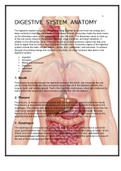
The digestive system is a group of organs working together to convert food into energy and
basic nutrients to feed the entire body. Food passes through a long tube inside the body known
as the alimentary canal or the gastrointestinal tract (GI tract). The alimentary canal is made up
of the oral cavity, pharynx, esophagus, stomach, small intestines, and large intestines. In
addition to the alimentary canal, there are several important accessory organs that help your
body to digest food but do not have food pass through them. Accessory organs of the digestive
system include the teeth, tongue, salivary glands, liver, gallbladder, and pancreas. To achieve
the goal of providing energy and nutrients to the body, six major functions take place in the
digestive system:
Ingestion
Secretion
Mixing and movement
Digestion
Absorption
Excretion
1. Mouth
Food begins its journey through the digestive system in the mouth, also known as the oral
cavity. Inside the mouth are many accessory organs that aid in the digestion of food—the
tongue, teeth, and salivary glands. Teeth chop food into small pieces, which are moistened by
saliva before the tongue and other muscles push the food into the pharynx.
2. Pharynx
The pharynx, or throat, is a funnel-shaped tube connected to the posterior end of the mouth.
The pharynx is responsible for the passing of masses of chewed food from the mouth to the
esophagus. The pharynx also plays an important role in the respiratory system, as air from the
nasal cavity passes through the pharynx on its way to the larynx and eventually the lungs.
Because the pharynx serves two different functions, it contains a flap of tissue known as the
epiglottis that acts as a switch to route food to the esophagus and air to the larynx.
3. Esophagus
The esophagus is a muscular tube connecting the pharynx to the stomach that is part of the
upper gastrointestinal tract. It carries swallowed masses of chewed food along its length. At the
inferior end of the esophagus is a muscular ring called the lower Stomach, gallbladder and
pancreasesophageal sphincter or cardiac sphincter. The function of this sphincter is to close of
the end of the esophagus and trap food in the stomach.
DIGESTIVE SYSTEM ANATOMY
The digestive system is a group of organs working together to convert food into energy and
basic nutrients to feed the entire body. Food passes through a long tube inside the body known
as the alimentary canal or the gastrointestinal tract (GI tract). The alimentary canal is made up
of the oral cavity, pharynx, esophagus, stomach, small intestines, and large intestines. In
addition to the alimentary canal, there are several important accessory organs that help your
body to digest food but do not have food pass through them. Accessory organs of the digestive
system include the teeth, tongue, salivary glands, liver, gallbladder, and pancreas. To achieve
the goal of providing energy and nutrients to the body, six major functions take place in the
digestive system:
Ingestion
Secretion
Mixing and movement
Digestion
Absorption
Excretion
1. Mouth
Food begins its journey through the digestive system in the mouth, also known as the oral
cavity. Inside the mouth are many accessory organs that aid in the digestion of food—the
tongue, teeth, and salivary glands. Teeth chop food into small pieces, which are moistened by
saliva before the tongue and other muscles push the food into the pharynx.
2. Pharynx
The pharynx, or throat, is a funnel-shaped tube connected to the posterior end of the mouth.
The pharynx is responsible for the passing of masses of chewed food from the mouth to the
esophagus. The pharynx also plays an important role in the respiratory system, as air from the
nasal cavity passes through the pharynx on its way to the larynx and eventually the lungs.
Because the pharynx serves two different functions, it contains a flap of tissue known as the
epiglottis that acts as a switch to route food to the esophagus and air to the larynx.
3. Esophagus
The esophagus is a muscular tube connecting the pharynx to the stomach that is part of the
upper gastrointestinal tract. It carries swallowed masses of chewed food along its length. At the
inferior end of the esophagus is a muscular ring called the lower Stomach, gallbladder and
pancreasesophageal sphincter or cardiac sphincter. The function of this sphincter is to close of
the end of the esophagus and trap food in the stomach.


