

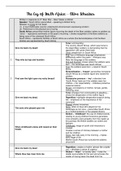
The Cry of South Africa – Olive Schreiner
· Written in response to 2nd Boer War – Boer States vs British
· Speaker: ‘South Africa’ personified – speaking to British Army
· Speaker is crying for her dead:
(1) A loud inarticulate (cannot understand) shout/scream expressing emotion
(2) Reference to the physical act of crying
· South Africa: personified mother figure mourning the death of the Boer soldiers (refers to soldiers as
‘sons’) – represents sentiments of the poet’s mourning + shows recognition of the Boer soldiers as
being sons of the colonised South Africa
South Africa – represents families of South Africa as a whole (the demands/pleas of all the Boer
families are represented by South Africa)
· Tone: commanding
· The country (South Africa), which was home to
Give me back my dead! the dead (Boer soldiers) is demanding that the
opposition (UK) gives them back
· Dead: people born in South Africa
· Kop: use of Afrikaans language emphasises
authenticity within the poem – Afrikaans was
2 They who by kop and fountain likely the language of the soldiers
· Kop and fountain: shows where the soldiers were
born – the landscape was South African
· First: the soldiers were born + raised in South
Africa
· Personification – ‘breast’: personifies homeland
(South Africa) as a mother figure who raised the
soldiers
3 First saw the light upon my rocky breast! · Possessive pronoun – ‘my’: reiterates how
‘South Africa’ feels as if the soldiers were her
children + her responsibility – indicates protective
maternal instinct
· Breast: connotations of mother, female, gentle,
nurturing, kind
· Tone: changes from commanding to pleading –
shows the desperation of the mother figure
Give me back my dead, · Repetition: highlights desperation/anguish being
felt – emphasis on the importance of her
command
· Played: shows innocence
· Sons: refers to boys who played on her
The sons who played upon me
landscape as her sons – personifies South Africa
as a mother/protector of her people/citizens
· Diction – ‘childhood’: the use of children/words
relating to young children/innocence generates
more empathy and sympathy from the reader as
this portrays the British soldiers as violent and
barbaric
· Childhood: image of youth and innocence is
When childhood’s dews still rested on their
created
heads.
· Creates a sense of intimacy between a mother
and her children
· Dews: dew falls early in the morning – implies
early stage of life
· Mother South Africa has nurtured the soldiers
since birth
·
· Repetition: creates a rhythm (almost like a battle
Give me back my dead
cry) + develops a sense of urgency
· Diction – ‘riven’: to forcibly take – holds the
Whom thou has riven from me reader accountable for the war and accuses the
reader of having taken the dead from her
· Written in response to 2nd Boer War – Boer States vs British
· Speaker: ‘South Africa’ personified – speaking to British Army
· Speaker is crying for her dead:
(1) A loud inarticulate (cannot understand) shout/scream expressing emotion
(2) Reference to the physical act of crying
· South Africa: personified mother figure mourning the death of the Boer soldiers (refers to soldiers as
‘sons’) – represents sentiments of the poet’s mourning + shows recognition of the Boer soldiers as
being sons of the colonised South Africa
South Africa – represents families of South Africa as a whole (the demands/pleas of all the Boer
families are represented by South Africa)
· Tone: commanding
· The country (South Africa), which was home to
Give me back my dead! the dead (Boer soldiers) is demanding that the
opposition (UK) gives them back
· Dead: people born in South Africa
· Kop: use of Afrikaans language emphasises
authenticity within the poem – Afrikaans was
2 They who by kop and fountain likely the language of the soldiers
· Kop and fountain: shows where the soldiers were
born – the landscape was South African
· First: the soldiers were born + raised in South
Africa
· Personification – ‘breast’: personifies homeland
(South Africa) as a mother figure who raised the
soldiers
3 First saw the light upon my rocky breast! · Possessive pronoun – ‘my’: reiterates how
‘South Africa’ feels as if the soldiers were her
children + her responsibility – indicates protective
maternal instinct
· Breast: connotations of mother, female, gentle,
nurturing, kind
· Tone: changes from commanding to pleading –
shows the desperation of the mother figure
Give me back my dead, · Repetition: highlights desperation/anguish being
felt – emphasis on the importance of her
command
· Played: shows innocence
· Sons: refers to boys who played on her
The sons who played upon me
landscape as her sons – personifies South Africa
as a mother/protector of her people/citizens
· Diction – ‘childhood’: the use of children/words
relating to young children/innocence generates
more empathy and sympathy from the reader as
this portrays the British soldiers as violent and
barbaric
· Childhood: image of youth and innocence is
When childhood’s dews still rested on their
created
heads.
· Creates a sense of intimacy between a mother
and her children
· Dews: dew falls early in the morning – implies
early stage of life
· Mother South Africa has nurtured the soldiers
since birth
·
· Repetition: creates a rhythm (almost like a battle
Give me back my dead
cry) + develops a sense of urgency
· Diction – ‘riven’: to forcibly take – holds the
Whom thou has riven from me reader accountable for the war and accuses the
reader of having taken the dead from her


