

THE PHOTOELECTRIC EFFECT
is used in solar panels to generate electricity. The photoelectric effect refers to the ability of light to cause metals to
release electrons. Light energy is converted to electrical energy
Electromagnetic waves consist of electric and magnetic fields, these fields are perpendicular to each other and to the
direction in which the wave is propagated (the direction in which it travels)
R ● Light energy is transmitted in ‘packages’ which are called photons.
E
M ● Each photon consists of a certain amount of energy which is called a quantum.
E
M ● The amount of energy (E) in a quantum is directly proportional to the frequency (f) of the light.
B
E ● An electron needs a minimum amount of energy to be released from an atom. So the photon providing
R this energy must have a minimum frequency before it will allow an electron to be released from the metal
surface.
● When light shines on a surface (like a metal), the photons collide with the atoms in the surface.
● All the energy of the photon (E = hf) is transferred to the atom with which the photon collides.
● If an electron in an atom on the surface of the metal gains sufficient energy during the collision, it is
ejected from the metal surface and is called a photoelectron.
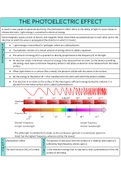
Shorter frequency longer frquency
Longer wavelength shorter wavelength
The white light is emitted from a bulb, so the continuous spectrum is an emission spectrum.
Violet has the highest frequency, whereas red has the lowest.
T photoelectric effect D The ejection of electrons from the surface of a material when light of a
E E sufficiently high frequency shines upon it.
R F
M I
S The work function (W0) of a metal N is the minimum energy that is required to emit a photoelectron from the
I surface of the metal.
is used in solar panels to generate electricity. The photoelectric effect refers to the ability of light to cause metals to
release electrons. Light energy is converted to electrical energy
Electromagnetic waves consist of electric and magnetic fields, these fields are perpendicular to each other and to the
direction in which the wave is propagated (the direction in which it travels)
R ● Light energy is transmitted in ‘packages’ which are called photons.
E
M ● Each photon consists of a certain amount of energy which is called a quantum.
E
M ● The amount of energy (E) in a quantum is directly proportional to the frequency (f) of the light.
B
E ● An electron needs a minimum amount of energy to be released from an atom. So the photon providing
R this energy must have a minimum frequency before it will allow an electron to be released from the metal
surface.
● When light shines on a surface (like a metal), the photons collide with the atoms in the surface.
● All the energy of the photon (E = hf) is transferred to the atom with which the photon collides.
● If an electron in an atom on the surface of the metal gains sufficient energy during the collision, it is
ejected from the metal surface and is called a photoelectron.
Shorter frequency longer frquency
Longer wavelength shorter wavelength
The white light is emitted from a bulb, so the continuous spectrum is an emission spectrum.
Violet has the highest frequency, whereas red has the lowest.
T photoelectric effect D The ejection of electrons from the surface of a material when light of a
E E sufficiently high frequency shines upon it.
R F
M I
S The work function (W0) of a metal N is the minimum energy that is required to emit a photoelectron from the
I surface of the metal.


