

Patterns and Regularities in
Mathematics
Mathematics is all around us. As we discover more about our environment, we can
mathematically describe nature. The beauty of a flower, the majestic tree, and even the
rock formation exhibits nature’s sense of symmetry. Nothing in nature happens without
a reason, all of these patterns have an important reason to exist.
TYPES OF PATTERNS
1. SYMMETRY – a pattern with a sense of harmonious and beautiful proportion of
balance or an object is invariant to any various transformations examples are reflection,
rotation or scaling. Bilateral Symmetry - is symmetry in which the left and right sides of
the organism can be divided into approximately mirror images of each other along the
midline. This exists in living things like insects, animals, plants, flowers, and others.
Animals can further be classified as either cyclic or dihedral. Plants on the other hand
often have radial or rotational symmetry, as to flowers and some group of animals.
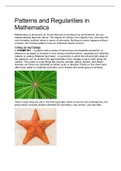
There is also what we call a five-fold symmetry which is found in the echinoderms, the
group which includes starfish (dihedral-D5 symmetry), sea urchins, and sea lilies.
Mathematics
Mathematics is all around us. As we discover more about our environment, we can
mathematically describe nature. The beauty of a flower, the majestic tree, and even the
rock formation exhibits nature’s sense of symmetry. Nothing in nature happens without
a reason, all of these patterns have an important reason to exist.
TYPES OF PATTERNS
1. SYMMETRY – a pattern with a sense of harmonious and beautiful proportion of
balance or an object is invariant to any various transformations examples are reflection,
rotation or scaling. Bilateral Symmetry - is symmetry in which the left and right sides of
the organism can be divided into approximately mirror images of each other along the
midline. This exists in living things like insects, animals, plants, flowers, and others.
Animals can further be classified as either cyclic or dihedral. Plants on the other hand
often have radial or rotational symmetry, as to flowers and some group of animals.
There is also what we call a five-fold symmetry which is found in the echinoderms, the
group which includes starfish (dihedral-D5 symmetry), sea urchins, and sea lilies.


